Avoid debonding with the right adhesive selection and application method. FairFix Tile Adhesive Solutions Fairmate Prashita | 1800 571 8862

Common Tile Fixing Mistakes That Cause Debonding and How to Avoid Them

Common tile Fixing Mistakes That Cause Debonding and How to Avoid Them

Tile debonding is one of the most common complaints in tile installation work. A tile may look properly fixed on the first day, but after some time, problems such as hollow sound, loose tiles, cracked joints, water seepage, uneven levels or complete tile failure may appear.

In many cases, the problem is not only with the tile. The real reason is often poor surface preparation, wrong adhesive selection, incorrect mixing, improper bedding or careless application technique.

For contractors, applicators, builders and dealers, understanding these mistakes is important because tile fixing quality directly affects project finish, customer satisfaction and long-term site performance.

Fairmate Prashita’s FairFix tile adhesive and mortar solutions are designed to support better bonding, cleaner application and more controlled site work when used with the right application method.

Why Tile Debonding Happens

Tile debonding means the tile loses proper bond with the surface below it. This can happen on floors, walls, bathrooms, kitchens, balconies, commercial spaces and renovation projects.

Common signs of tile debonding include:

  • Hollow sound when tapping tiles
  • Loose or lifted tiles
  • Cracked grout joints
  • Tile edges opening
  • Water entering below the tile
  • Uneven tile level
  • Repeated repair complaints

Debonding usually happens when the adhesive layer does not create strong contact between the tile and the substrate. This can happen due to product selection mistakes or application mistakes.

Mistake 1: Poor Surface Preparation

Surface preparation is one of the most important steps in tile fixing. If the surface is dusty, oily, weak, uneven or loose, the adhesive will not bond properly.

Many applicators start tile fixing without checking whether the surface is clean and sound. This can reduce bonding strength and create future tile failure.

How to Avoid It

Before applying tile adhesive:

  • Remove dust and loose particles
  • Clean oil, grease or paint contamination
  • Repair weak or damaged areas
  • Check surface level
  • Ensure the substrate is strong and stable
  • Avoid applying adhesive on loose plaster or weak screed

A clean and strong surface gives the tile adhesive better contact and improves bonding performance.

Mistake 2: Using Cement Mortar for Every Tile Application

Traditional cement-sand mortar is still used on many sites, but modern tiles and modern construction requirements need better bonding control. Cement mortar quality depends on site mixing, sand quality, water addition and workmanship. These factors can vary from site to site.

For vitrified tiles, large tiles, wet areas, renovation work or commercial projects, relying only on conventional mortar may not give the desired performance.

How to Avoid It

Use the right tile adhesive system based on tile type, tile size and application area. FairFix tile adhesive solutions from Fairmate Prashita support better bonding control, cleaner application and more consistent site performance compared to uncontrolled site mixing.

For routine tile fixing, FairFix TA STD can be considered as a practical tile adhesive solution. For higher-performance requirements, upgraded FairFix adhesive options may be recommended after technical guidance.

Mistake 3: Adding Too Much Water During Mixing

Excess water is a common mistake during tile adhesive preparation. Applicators sometimes add extra water to make the paste more workable. However, too much water can weaken the adhesive mix and affect bonding performance.

A watery mix may look easy to apply, but it can reduce strength, increase shrinkage and create poor tile contact.

How to Avoid It

Always follow the recommended water ratio given in the product technical data sheet. Add powder slowly into clean water and mix until a smooth, lump-free paste is formed.

Avoid:

  • Adding water again and again
  • Making the mix too thin
  • Using dirty water
  • Mixing without proper consistency
  • Using material after its workable time

Correct mixing supports better adhesive performance and easier application.

Mistake 4: Not Using a Notched Trowel

Using a flat trowel only or applying adhesive unevenly can create poor bedding below the tile. Without proper ridges, the tile may not get full contact with the adhesive bed.

This can lead to hollow sound, weak bonding and future debonding.

How to Avoid It

Use a suitable notched trowel based on tile size and surface condition. First spread the adhesive with the flat side of the trowel, then comb it using the notched side.

This helps create uniform adhesive ridges and improves tile contact when the tile is pressed properly.

Mistake 5: Spreading Too Much Adhesive at Once

Tile adhesive has an open time. If adhesive is spread over a large area and tiles are not placed quickly, the surface of the adhesive may start drying. Once this happens, bonding performance can reduce.

This mistake is common on large floor areas where applicators try to cover more area quickly.

How to Avoid It

Apply adhesive only on the area that can be tiled within the recommended open time. Avoid spreading adhesive too far ahead of tile placement.

Work in smaller sections and keep checking adhesive freshness before placing tiles.

Mistake 6: Poor Tile Contact

After placing the tile, it must be pressed properly into the adhesive bed. If the tile is only placed lightly without proper pressure and movement, full contact may not happen.

Poor contact creates empty areas below the tile. These areas can later cause hollow sound or tile breakage under load.

How to Avoid It

After placing the tile:

  • Press it firmly
  • Move slightly to ensure contact
  • Use spacers for uniform joints
  • Check tile level
  • Lift one tile occasionally to confirm adhesive coverage
  • Avoid leaving voids below the tile

Proper tile contact is critical for strong bonding and long-term performance.

Mistake 7: Ignoring Tile Type and Tile Size

Every tile is not the same. Ceramic tiles, vitrified tiles, large-format tiles, glass mosaics and stone tiles can have different bonding requirements.

Using the same adhesive or same method for every tile type can create performance issues.

How to Avoid It

Before starting tile work, check:

  • Tile size
  • Tile weight
  • Tile back surface
  • Water absorption
  • Application area
  • Interior or exterior exposure
  • Floor or wall use
  • Wet or dry area

Select the FairFix tile adhesive grade based on the actual site requirement. For routine work, FairFix TA STD may be suitable. For more demanding applications, ask for technical guidance before product selection.

Mistake 8: Applying on Uneven Surface

If the substrate is uneven, applicators may try to correct the level using extra adhesive thickness. This can create uneven drying, poor bedding and weak performance.

Tile adhesive should not be used as a replacement for proper surface levelling unless the product recommendation allows it.

How to Avoid It

Correct major surface unevenness before tile fixing. Ensure the substrate is properly levelled, cured and prepared before applying adhesive.

A level surface improves adhesive coverage, tile alignment and finish quality.

Mistake 9: Early Grouting or Early Loading

Grouting too early or allowing foot traffic before the adhesive has set properly can disturb the tile bond. This can cause movement, joint cracks or weak bonding.

How to Avoid It

Allow proper setting time before grouting or loading the tiled area. Follow the product recommendation for setting time and grouting time.

Avoid rushing the process, especially in areas where performance and finish are important.

Mistake 10: Not Taking Product Guidance

Many site problems happen because the same product is used for all applications without technical checking. For example, bathroom tiles, swimming pool tiles, external cladding, tile-on-tile work and heavy traffic areas may need different adhesive performance.

How to Avoid It

Before selecting tile adhesive, contractors and dealers should take product guidance based on tile type, surface and application area.

Fairmate Prashita provides technical support to help select the right FairFix solution for site requirements.

How FairFix Tile Adhesive Solutions Help

FairFix tile adhesive and mortar products are designed to support practical site performance for contractors, applicators and builders.

FairFix solutions can help with:

  • Better tile bonding support
  • Cleaner site application
  • Prepacked product consistency
  • Easy mixing and application
  • Reduced dependence on uncontrolled site mixing
  • Contractor-friendly use
  • Product selection support for different applications

For everyday tile fixing, FairFix TA STD can be positioned as a practical adhesive option. FairFix Mortar can support routine tile fixing and mortar work. For demanding applications, higher-grade FairFix solutions can be recommended after technical evaluation.

Basic Correct Tile Adhesive Application Method

For better bonding, follow these basic steps:

  1. Clean the surface properly.
  2. Remove dust, oil, grease and loose material.
  3. Check whether the surface is level and strong.
  4. Mix FairFix tile adhesive with clean water as recommended.
  5. Avoid adding excess water.
  6. Use a notched trowel for adhesive application.
  7. Apply adhesive only within workable area.
  8. Press tiles properly into the adhesive bed.
  9. Use spacers and check level.
  10. Clean excess adhesive before hardening.
  11. Allow proper setting before grouting or loading.

Correct product selection and correct application both are necessary for durable tile fixing.

Conclusion

Tile debonding is not a small issue. It can lead to repair cost, customer complaints, site delays and loss of trust. Most debonding problems can be reduced by avoiding common tile fixing mistakes and using the right adhesive system.

Contractors should not depend only on traditional methods for every tile application. Modern tile fixing needs better surface preparation, correct mixing, proper bedding and suitable tile adhesive selection.

FairFix tile adhesive and mortar products from Fairmate Prashita help contractors, applicators, builders and dealers choose a more controlled and reliable solution for tile bonding work.

Need help selecting the right FairFix product for your site?

Call Fairmate Prashita for product guidance: 1800 571 8862
Visit: www.fairmateprashita.com

FairFix tile adhesive, FairFix TA STD

FairFix Tile Adhesive Guide: Uses, Benefits and Application Selection

FairFix Tile Adhesive Guide: Uses, Benefits and Application Selection

Tile installation quality depends on more than tile selection. The bonding material behind the tile plays a major role in long-term performance, finish quality, site speed and customer satisfaction. For many years, contractors have used traditional cement-sand mortar for tile fixing. However, modern construction sites now demand better bonding control, cleaner application and more consistent results.

This is where FairFix tile adhesive and mortar products from Fairmate Prashita help contractors, builders, applicators and dealers choose a more reliable tile fixing system.

FairFix tile adhesive solutions are designed to support practical site requirements such as better adhesion, ease of use, controlled application and dependable bonding performance for different tile fixing needs.

Why Tile Adhesive Selection Matters

Tile debonding, hollow sound, uneven tile levels, cracked joints and repair complaints are often linked to incorrect bonding material or poor application practices. In many cases, the tile itself is not the problem. The issue starts with the adhesive selection, substrate condition, mixing method or application technique.

Traditional cement-sand mortar is commonly mixed at site. Its final quality depends on cement quality, sand grading, water addition, batching ratio and workmanship. These factors are not always controlled properly on active construction sites.

Prepacked tile adhesive systems help reduce this uncertainty. Since the product is factory-controlled, contractors get better consistency compared to site-mixed mortar. Fairmate Prashita’s FairFix range is developed to support contractors with practical tile bonding solutions for different site requirements.

What Is FairFix Tile Adhesive?

FairFix tile adhesive is a cementitious tile fixing solution used for bonding tiles to prepared substrates. Depending on the product grade, it can be used for ceramic tiles, vitrified tiles, internal areas, external areas, wet areas, tile-on-tile applications and other site conditions after proper product selection.

Fairmate Prashita’s FairFix range includes options such as FairFix Mortar, FairFix TA STD and FairFix TA Ultra. These products help contractors select the right tile adhesive based on tile type, surface condition and application requirement.

FairFix Mortar: General Tile Fixing Support

FairFix Mortar is suitable for contractors and masons who need a practical tile fixing mortar for routine site applications. It offers a more controlled alternative to conventional cement-sand fixing.

Key advantages include:

  • Fast and efficient use
  • Easy mixing with water
  • Better bonding strength
  • Thinner application layer
  • Cleaner site application
  • Prepacked product consistency
  • Useful for ceramic and vitrified tile fixing

FairFix Mortar can help reduce the uncertainty of site mixing and support more dependable tile bonding when applied correctly on prepared surfaces.

FairFix TA STD: Practical Tile Adhesive for Everyday Site Work

FairFix TA STD is a strong product choice for everyday tile fixing requirements. It is suitable for contractors, builders, applicators and dealers who need a practical adhesive system for regular tile installation work.

FairFix TA STD supports:

  • Better tile bonding
  • Improved workability
  • Consistent application quality
  • Contractor-friendly use
  • Controlled tile fixing compared to conventional mortar
  • Cleaner and faster site work

For routine residential, commercial and contractor-led tile fixing projects, FairFix TA STD can be positioned as a dependable tile adhesive solution.

FairFix TA Ultra: For Higher-Performance Tile Fixing Needs

For demanding tile fixing applications, contractors may require a higher-performance tile adhesive. FairFix TA Ultra is described by Fairmate Prashita as a polymer-rich cementitious tile adhesive for thin or thick bed fixing of ceramic tiles in interior or exterior situations. It provides strong adhesion to cement-sand screeds, concrete and brickwork, and can also be suitable for substrates such as glazed tiles, terrazzo and suitably prepared timber.

FairFix TA Ultra benefits include:

  • High adhesive bond strength
  • Excellent waterproofing characteristics
  • Non-slip and excellent grab properties
  • Excellent tensile strength
  • Prepacked factory-controlled quality
  • Easy-to-use application
  • Waterproof immersion does not affect adhesion

FairFix TA Ultra may be considered for applications like tile-on-tile fixing, bathrooms, kitchens, swimming pools, glass mosaics, laboratories, canteens and other demanding areas where suitable after technical evaluation.

Benefits of Using FairFix Tile Adhesive

1. Better Bonding Strength

Tile adhesive is designed to improve the bond between tile and substrate. This helps reduce risks such as loose tiles, hollow sound and early debonding when surface preparation and application are done correctly.

2. Controlled Product Quality

FairFix tile adhesives are prepacked systems. This reduces dependence on uncontrolled site batching and helps provide more consistent material quality.

3. Cleaner Application

Tile adhesive is generally easier to apply using proper tools such as a notched trowel. This supports cleaner work, better spreading and improved tile contact.

4. Faster Site Execution

Because the product is ready to mix with water, it saves time compared to collecting, measuring and mixing cement and sand at site.

5. Thinner Application Layer

Compared to conventional thick-bed mortar, tile adhesive can often be applied in a thinner layer, depending on tile type, substrate level and product recommendation.

6. Suitable for Modern Tile Requirements

Modern tiles may have low water absorption, larger formats or smoother backs. These conditions require better adhesive support than traditional mortar in many applications.

Where FairFix Tile Adhesive Can Be Used

FairFix tile adhesive solutions can be considered for:

  • Residential flooring
  • Commercial flooring
  • Internal wall tiles
  • Bathroom tiles
  • Kitchen tiles
  • Ceramic tile fixing
  • Vitrified tile fixing
  • Renovation tile work
  • Contractor-led site applications
  • Dealer and applicator projects

For special applications such as external cladding, swimming pools, tile-on-tile or large-format tiles, contractors should take proper product guidance before selection.

How to Select the Right FairFix Product

Choosing the right tile adhesive depends on the site requirement. Contractors should check these points before selection:

1. Tile Type

Ceramic, vitrified, mosaic, stone, glass mosaic or large-format tiles may require different adhesive grades.

2. Tile Size

Larger tiles need better contact and bonding support. Product selection should match tile size and application area.

3. Surface Condition

The substrate should be sound, clean, level and free from dust, oil, grease or loose particles.

4. Application Area

Bathrooms, kitchens, balconies, swimming pools, external areas and commercial spaces may need higher adhesive performance.

5. Site Requirement

Routine tile fixing may be suitable with FairFix Mortar or FairFix TA STD, while demanding conditions may require upgraded FairFix adhesive options.

Basic Application Guidelines

Correct application is as important as product selection. Contractors should follow these basic steps:

  1. Clean the substrate properly.
  2. Remove dust, oil, grease and loose material.
  3. Mix the adhesive with clean water as recommended.
  4. Use a slow-speed mixer if available to avoid lumps.
  5. Allow proper mixing and resting time where recommended.
  6. Apply adhesive with a suitable notched trowel.
  7. Press and align tiles properly.
  8. Ensure full tile contact with the adhesive bed.
  9. Avoid applying more adhesive than can be tiled within open time.
  10. Follow recommended curing and grouting timelines.

For best results, always refer to the product technical data sheet and take technical guidance where required.

Common Tile Fixing Mistakes to Avoid

  • Using one product for every tile type
  • Applying tiles on dusty or weak surfaces
  • Adding excess water during mixing
  • Using improper trowel size
  • Not achieving full tile contact
  • Ignoring open time
  • Fixing tiles on uneven surfaces without correction
  • Using cement mortar where tile adhesive is required
  • Skipping product guidance for wet or external areas

Avoiding these mistakes can improve tile bonding performance and reduce site complaints.

Why Contractors and Dealers Should Promote FairFix

FairFix tile adhesive and mortar products are practical for contractor sales because they solve real site problems. Dealers can position FairFix products as a better tile fixing solution for customers who want reliable bonding, cleaner application and improved workability.

For contractors, FairFix supports better site confidence. For builders, it supports quality control. For dealers, it creates a clear product category with repeat demand.

Conclusion

Conclusion: Adhesive Selection as a Performance‑Critical Decision Tile adhesive choice directly determines tile service life, finish quality, installation speed, and customer satisfaction. Conventional cement–sand mortar often lacks the bonding control, dimensional stability, and workability required for modern tile formats and substrates.

Need help selecting the right FairFix product for your site?

Call Fairmate Prashita for product guidance: 1800 571 8862
Visit: www.fairmateprashita.com

concrete-repair-chemicals

Concrete Repair Chemicals: How to Repair Cracks and Spalling

Concrete is one of the most durable construction materials, but it can still get damaged due to structural movement, water ingress, corrosion, poor workmanship, chemical exposure, carbonation, impact damage or long-term weathering. Two of the most common concrete repair problems seen on sites are cracks and spalling, raises need of Concrete Repair Chemicals.

Small cracks may look minor in the beginning, but if they are ignored, they can allow moisture, chlorides and carbon dioxide to enter the concrete. Over time, this can affect reinforcement, reduce durability and increase repair costs. Spalling is another serious issue where the concrete surface breaks, flakes or comes off, often exposing steel reinforcement.

The right concrete repair chemicals help restore surface integrity, improve bonding, protect reinforcement and extend the service life of the structure. However, repair success depends on proper inspection, surface preparation, product selection and application method.

What Causes Cracks in Concrete?

Concrete cracks can happen due to many reasons. Some cracks are non-structural, while others may indicate deeper structural or durability issues. Before selecting a repair material, the cause of cracking should be understood.

Common causes of concrete cracks include:

  • Drying shrinkage
  • Thermal movement
  • Structural loading
  • Settlement
  • Poor curing
  • Water leakage
  • Corrosion of reinforcement
  • Poor concrete mix or compaction
  • Construction joint movement
  • Chemical or weather exposure

Not every crack needs the same repair method. A hairline crack on a plastered surface, a leakage crack on a terrace, and a structural crack in a beam or column may require different repair systems.

What Is Concrete Spalling?

Concrete spalling happens when the surface layer of concrete breaks, chips, flakes or separates from the main body of concrete. It is commonly seen on slabs, columns, beams, balconies, basements, parking areas, industrial floors and exposed concrete structures.

Spalling may occur due to:

  • Corrosion of reinforcement
  • Water ingress
  • Carbonation
  • Chloride attack
  • Freeze-thaw damage in cold regions
  • Impact or abrasion
  • Low cover to reinforcement
  • Poor quality concrete
  • Poor compaction or honeycombing
  • Chemical exposure

When reinforcement starts corroding, rust expands and creates internal pressure. This pressure can push the surrounding concrete outward, causing cracks and spalling. If this is not repaired correctly, the damage can spread further.

Why Concrete Repair Chemicals Are Important

Concrete repair is not only about filling a visible gap or covering damaged concrete. A good repair system should support bonding, strength, durability, protection and compatibility with the existing structure.

Concrete repair chemicals are used to:

  • Fill cracks and voids
  • Repair spalled concrete
  • Restore damaged surfaces
  • Improve bonding between old and new concrete
  • Protect reinforcement from corrosion
  • Reduce water ingress
  • Improve surface durability
  • Support long-term concrete rehabilitation

Using ordinary cement mortar for all repair work may not provide the required bonding, shrinkage control or durability. Purpose-designed concrete repair products are often needed for long-term performance.

Step-by-Step Approach to Repair Cracks and Spalling

1. Inspect the Damage

The first step is inspection. Check whether the damage is limited to the surface or connected to a deeper structural issue. Identify the type of crack, crack width, location, leakage condition, reinforcement exposure and surrounding concrete quality.

For spalling, check whether reinforcement is exposed, corroded or loose. Also inspect whether the concrete around the damaged area is sound or weak.

Important inspection points include:

  • Crack width and depth
  • Active or inactive crack movement
  • Water seepage or leakage
  • Hollow or loose concrete
  • Reinforcement corrosion
  • Surface contamination
  • Chemical exposure
  • Load-bearing condition

If the damage is structural, a qualified engineer should evaluate it before repair.

2. Remove Loose and Damaged Concrete

For spalling repair, all loose, weak and delaminated concrete must be removed. Repair should not be done over unsound concrete because it can affect bonding and durability.

The repair area should be cut or prepared properly so the repair mortar can bond with a stable substrate. Exposed reinforcement should be cleaned and treated before applying repair material.

Surface preparation may include:

  • Chipping loose concrete
  • Removing dust and laitance
  • Cleaning rust from reinforcement
  • Removing oil, grease and contaminants
  • Creating a firm and clean repair edge
  • Washing and drying the surface as required

Good surface preparation is one of the most important factors in repair success.

3. Treat Reinforcement if Required

If steel reinforcement is exposed or corroded, it should be cleaned properly. Rust, loose scale and contaminants must be removed. Depending on project requirement, an anti-corrosion coating or reinforcement protection system may be applied.

This step is important because untreated reinforcement corrosion can continue even after surface repair. If corrosion is active, the repair may fail early.

4. Select the Right Repair Material

Different repair conditions require different repair products. The repair material should be selected based on repair thickness, structural requirement, exposure condition, application method and required strength.

Common types of concrete repair chemicals include:

  • Polymer modified repair mortar
  • High strength repair mortar
  • Micro concrete
  • Epoxy repair mortar
  • Crack filling compounds
  • Injection grouts
  • Bonding agents
  • Anti-corrosion coatings
  • Protective coatings

For small non-structural surface cracks, crack filling material may be suitable. For spalling, polymer modified repair mortar or structural repair mortar may be required. For deeper repairs or congested reinforcement areas, micro concrete may be considered.

5. Apply Bonding Agent or Primer

In many repair applications, bonding between old concrete and new repair material is critical. A suitable bonding agent or primer may be used to improve adhesion.

The bonding system should be compatible with the repair mortar and substrate condition. Application should follow the recommended method, because improper timing or poor surface condition can affect bonding.

6. Apply Repair Mortar or Repair System

After surface preparation and bonding treatment, the selected repair mortar can be applied. The material should be placed properly into the repair area without leaving voids.

For vertical and overhead repairs, the repair mortar should have suitable build-up properties. For larger repairs, layer-by-layer application may be required.

Key points during application:

  • Mix the product in the correct ratio
  • Avoid excess water addition
  • Apply within working time
  • Compact the material properly
  • Maintain required repair thickness
  • Finish the surface as per requirement
  • Cure the repair area properly

Incorrect mixing or poor application can reduce performance.

7. Cure and Protect the Repaired Area

Curing is important for cementitious repair mortars. Proper curing helps strength development and reduces shrinkage-related problems.

After repair, the surface may also require protective coating depending on exposure condition. For example, exposed concrete surfaces, industrial structures, basements, parking areas or coastal structures may need additional protection from moisture, carbonation, chemicals or weathering.

Common Mistakes in Concrete Repair

Concrete repair failure often happens because of poor preparation or wrong product selection. Some common mistakes include:

  • Filling cracks without identifying the cause
  • Applying repair mortar over loose concrete
  • Ignoring reinforcement corrosion
  • Using ordinary cement mortar for all repairs
  • Poor surface cleaning
  • Adding excess water to repair mortar
  • Not using bonding agent where required
  • Ignoring curing
  • Not protecting the repaired surface from future exposure

A repair should be planned as a system, not as a temporary patch.

How to Select Concrete Repair Chemicals

When selecting concrete repair chemicals, consider these factors:

  • Type of damage: crack, spalling, honeycombing or surface erosion
  • Structural or non-structural repair requirement
  • Repair depth and thickness
  • Exposure to water, chemicals or weather
  • Reinforcement condition
  • Required strength and durability
  • Application area: horizontal, vertical or overhead
  • Compatibility with existing concrete
  • Need for protective coating after repair

Correct product selection helps improve repair life and reduces repeat maintenance.

Fairmate Prashita Concrete Repair Support

Fairmate Prashita offers concrete repair solutions for cracks, spalling, damaged concrete surfaces, repair mortars, bonding support and concrete rehabilitation applications.

Our concrete repair approach focuses on:

  • Proper surface preparation
  • Strong bonding
  • Low shrinkage repair
  • Durable repair performance
  • Reinforcement protection support
  • Long-term concrete rehabilitation

Fairmate Prashita supports engineers, contractors, consultants and maintenance teams with product guidance for concrete repair and protection requirements.

Conclusion

Concrete cracks and spalling should not be ignored. Even small visible damage can become a larger durability issue if moisture and aggressive agents enter the concrete. Successful repair requires proper inspection, removal of damaged concrete, reinforcement treatment, correct repair material selection, bonding support, careful application and curing.

The right concrete repair chemicals help restore damaged surfaces, improve durability and protect the structure for long-term performance.

For concrete repair system guidance, connect with Fairmate Prashita.

Explore repair systems:
Call: 1800 571 8862
Website: www.fairmateprashita.com

Epoxy flooring for warehouses & Factories

Epoxy Flooring for Warehouses and Factories: Complete Selection Guide

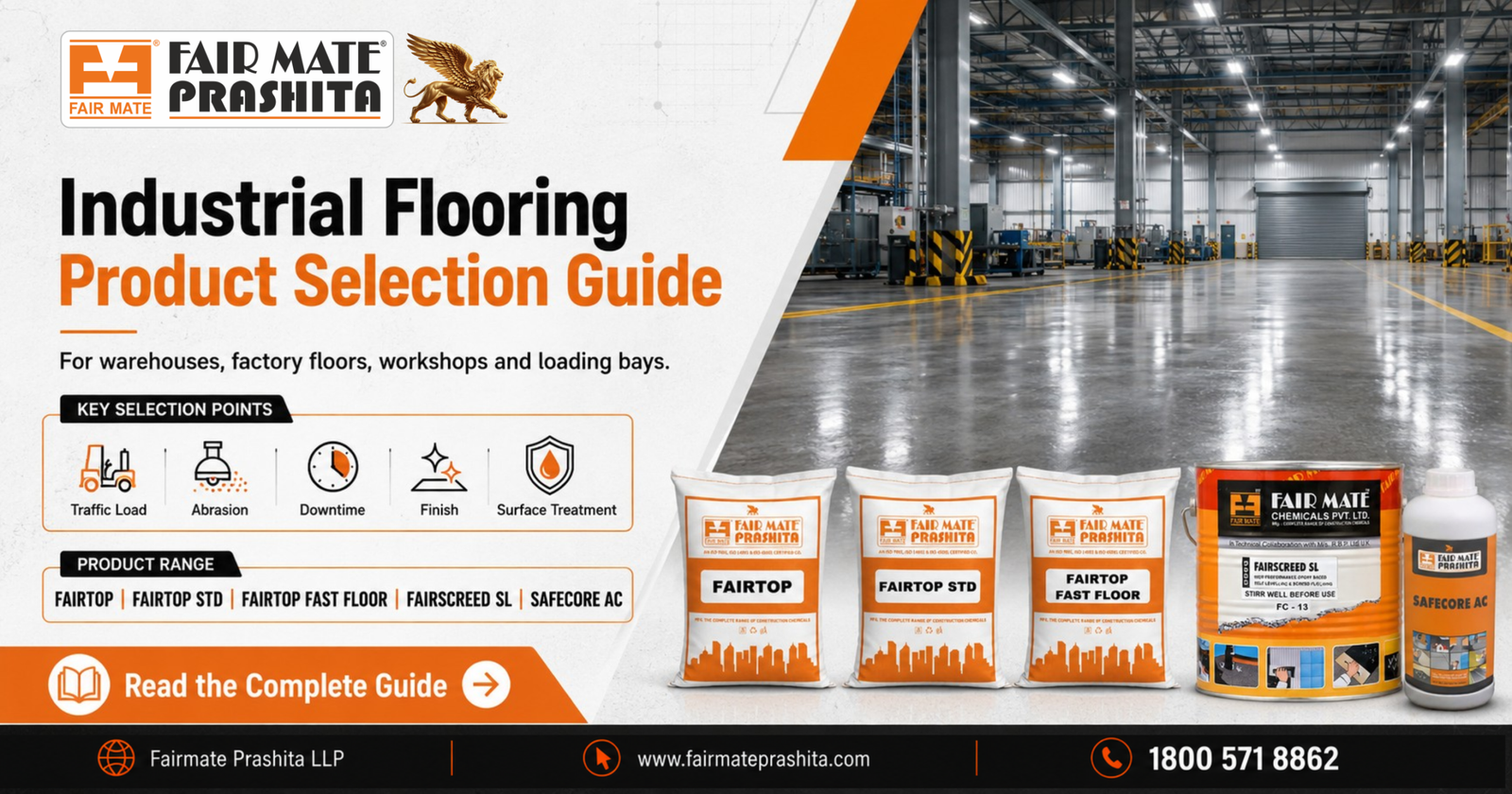
Warehouse and factory floors are exposed to continuous movement, heavy loads, machinery, forklifts, pallet trucks, chemicals, oil stains, dust, abrasion, and regular cleaning. A weak or untreated concrete floor can quickly become dusty, uneven, stained, and difficult to maintain.

This is why epoxy flooring for Warehouses has become one of the most preferred industrial flooring solutions for warehouses, factories, production units, logistics centers, workshops, and commercial industrial spaces. A properly selected epoxy flooring system can improve surface durability, hygiene, maintenance, appearance, and long-term floor performance.

Fairmate Prashita provides industrial flooring solutions designed to support factory owners, architects, engineers, contractors, and project teams in selecting the right flooring system based on actual site conditions.


Why Flooring Selection Matters in Warehouses and Factories

Industrial floors are not just walking surfaces. They directly affect productivity, safety, movement, cleaning, and maintenance cost.

In warehouses and factories, poor flooring may lead to:

  • Concrete dusting
  • Surface wear and abrasion
  • Cracks and uneven patches
  • Difficult cleaning
  • Staining from oil or chemicals
  • Reduced floor life
  • Maintenance shutdowns
  • Poor appearance of the facility

A suitable epoxy flooring system helps protect the concrete substrate and creates a stronger, cleaner, and more professional floor surface.


What Is Epoxy Flooring?

Epoxy flooring is a resin-based flooring system applied over prepared concrete surfaces. It forms a seamless, hard-wearing, and durable protective layer that improves the performance of the floor.

Epoxy flooring is commonly used in:

  • Warehouses
  • Factories
  • Manufacturing units
  • Food processing areas
  • Pharmaceutical facilities
  • Automobile workshops
  • Logistics centers
  • Industrial plants
  • Parking and service areas
  • Heavy-duty movement zones

Depending on the site requirement, the epoxy system may vary in thickness, finish, chemical resistance, anti-skid properties, and load-bearing performance.


Key Benefits of Epoxy Flooring for Warehouses and Factories

1. High Traffic Resistance

Warehouses and factories face regular movement of workers, trolleys, forklifts, and material handling equipment. Epoxy flooring helps create a durable surface that can withstand industrial traffic better than untreated concrete.

2. Dust-Free Surface

Concrete dusting is a common issue in industrial floors. Epoxy flooring helps seal the surface and reduce dust generation, making the area cleaner and easier to maintain.

3. Easy Cleaning and Maintenance

A seamless epoxy floor reduces dirt accumulation and allows easier cleaning. This is especially useful for factories, production units, warehouses, and facilities where hygiene and appearance matter.

4. Improved Durability

Epoxy flooring improves surface resistance against abrasion, impact, and general wear. This helps reduce frequent repair and maintenance requirements.

5. Better Floor Appearance

A finished epoxy floor gives a clean, smooth, and premium industrial appearance. It improves the overall look of warehouses, factories, and commercial workspaces.

6. Chemical and Stain Resistance

Many industrial areas are exposed to oils, chemicals, lubricants, and cleaning agents. Depending on the epoxy system selected, the floor can provide better resistance against stains and chemical exposure.


How to Select the Right Epoxy Flooring System

Choosing epoxy flooring should not be based only on appearance. The system must be selected according to the actual use of the area.

1. Understand the Traffic Load

First, identify the type of movement on the floor:

  • Foot traffic
  • Trolley movement
  • Forklift movement
  • Heavy machinery
  • Pallet truck movement
  • Static equipment load

High-load areas require stronger and more durable flooring systems.

2. Check the Condition of Existing Concrete

Before applying epoxy flooring, the concrete surface must be inspected properly. Important checks include:

  • Surface strength
  • Cracks
  • Dusting
  • Oil contamination
  • Moisture level
  • Uneven surface
  • Existing coating condition

A weak or contaminated surface may affect bonding and long-term performance.

3. Consider Surface Preparation

Surface preparation is one of the most important steps in epoxy flooring. Even the best product may fail if the surface is not prepared properly.

Common preparation steps include:

  • Cleaning the surface
  • Removing dust and loose particles
  • Grinding or mechanical preparation
  • Repairing cracks or damaged patches
  • Removing oil or contamination
  • Applying suitable primer where required

Good surface preparation helps improve bonding and floor life.

4. Choose the Required Thickness

Different industrial areas need different flooring thickness. A light-duty warehouse may need a different system compared to a heavy manufacturing unit.

Thickness selection depends on:

  • Traffic intensity
  • Load movement
  • Chemical exposure
  • Expected service life
  • Existing floor condition
  • Cleaning method

5. Decide the Finish

The floor finish should match site requirements. Common finish considerations include:

  • Smooth finish
  • Anti-skid finish
  • Glossy finish
  • Matte finish
  • Decorative finish
  • Line marking compatibility

For areas with water, oil, or chemical exposure, anti-skid properties may be important.

6. Consider Chemical Exposure

If the floor is exposed to chemicals, oils, solvents, or cleaning agents, the epoxy system must be selected accordingly. Chemical-resistant flooring helps protect the concrete surface and improves long-term durability.

7. Plan Maintenance Requirements

A good industrial flooring system should be easy to clean and maintain. Before final selection, the maintenance team should understand:

  • Cleaning frequency
  • Cleaning chemicals used
  • Machine cleaning requirement
  • Repair procedure
  • Expected traffic pattern

Common Areas Where Epoxy Flooring Is Used

Epoxy flooring can be used in multiple industrial and commercial applications, including:

  • Warehouse storage areas
  • Factory production floors
  • Assembly lines
  • Machine rooms
  • Loading and unloading areas
  • Automobile workshops
  • Packaging units
  • Pharmaceutical production areas
  • Food processing units
  • Industrial corridors
  • Maintenance areas

Each area may require a different flooring approach depending on the traffic, exposure, and performance requirement.


Mistakes to Avoid While Selecting Epoxy Flooring

Avoid these common mistakes:

  • Selecting flooring only based on price
  • Ignoring concrete surface condition
  • Applying epoxy on damp or contaminated concrete
  • Skipping surface preparation
  • Using the wrong thickness
  • Not considering traffic load
  • Ignoring chemical exposure
  • Not planning downtime for application
  • Choosing aesthetics over performance

The right epoxy flooring system should balance performance, durability, maintenance, and budget.


Why Choose Fairmate Prashita for Industrial Flooring Support?

Fairmate Prashita supports industrial flooring requirements with practical product guidance and site-focused solutions. Our approach helps contractors, engineers, architects, and factory teams choose flooring systems based on actual application conditions.

Fairmate Prashita industrial flooring solutions support:

  • Warehouses
  • Factories
  • Industrial plants
  • Production areas
  • Commercial floors
  • Heavy traffic zones
  • Maintenance-sensitive facilities

Whether the requirement is dust control, surface protection, chemical resistance, easy cleaning, or premium finish, selecting the right flooring system is important for long-term performance.


Conclusion

Epoxy flooring is a smart solution for warehouses and factories where durability, cleanliness, surface protection, and easy maintenance are required. However, the success of the flooring system depends on correct product selection, surface preparation, application method, and site condition assessment.

For industrial flooring guidance, system recommendation, or site consultation, connect with Fairmate Prashita.

Request Flooring Guide
Toll Free: 1800 571 8862
Website: www.fairmateprashita.com

Fairmate Prashita protective coatings for concrete and steel surfaces in industrial and infrastructure projects

Protective Coatings for Concrete and Steel: Complete Guide | Fairmate Prashita

Fairmate Prashita protective coatings for concrete and steel surfaces in industrial and infrastructure projects

Protective Coatings for Concrete and Steel: Complete Guide

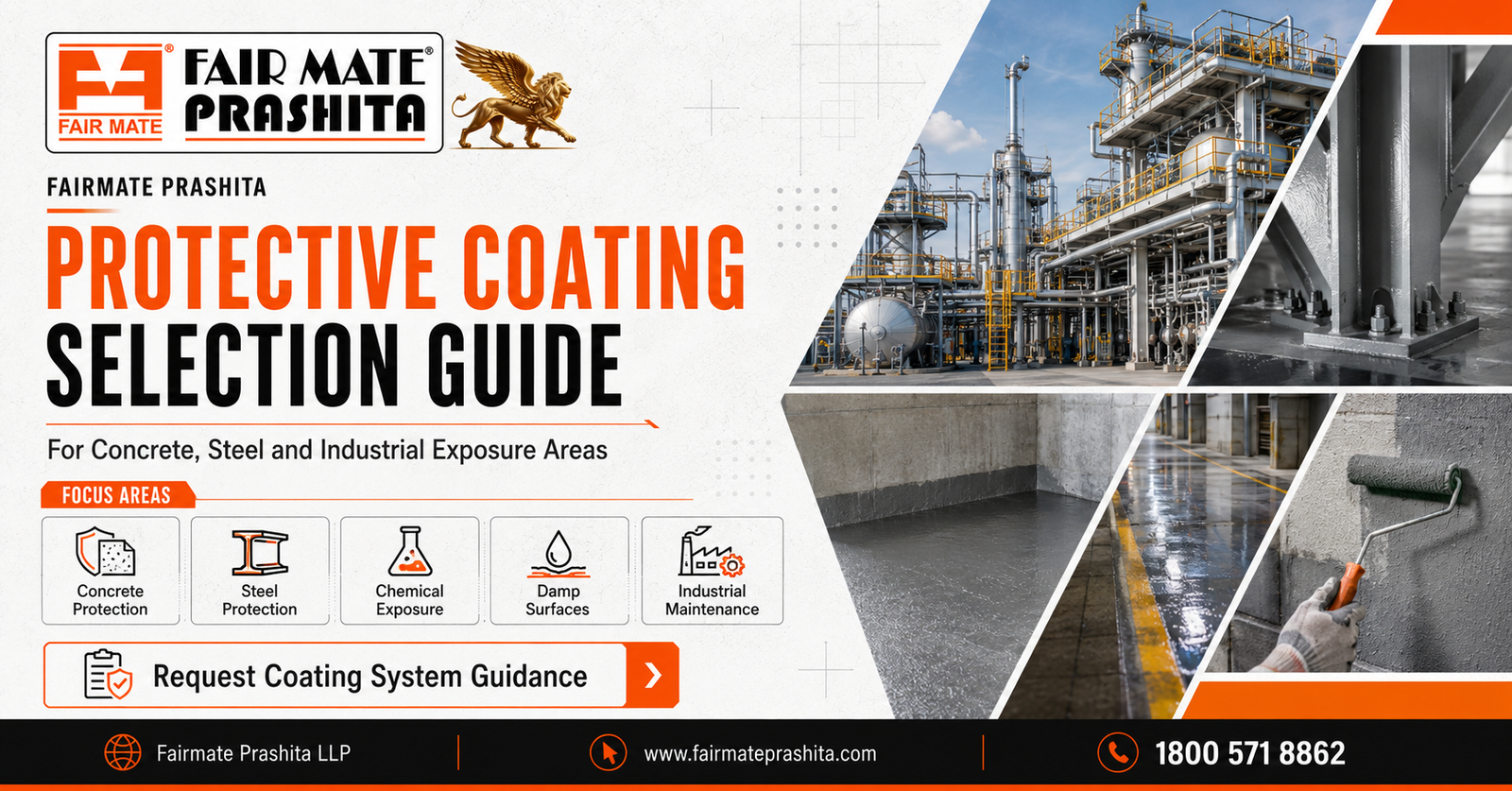
Concrete and steel are two of the most important materials used in modern construction and industrial infrastructure. From factories, warehouses, bridges, basements, water-retaining structures and parking areas to manufacturing plants and utility zones, these materials are exposed to moisture, chemicals, abrasion, carbonation, corrosion and weathering.

Protective coatings help create a durable barrier between the surface and the surrounding environment. For engineers, contractors and industrial buyers, the right coating system can improve service life, reduce maintenance cost and protect critical assets from early deterioration.

Fairmate Prashita offers construction chemical solutions including industrial flooring and protective coating systems for long-term site performance. (Fairmate Prashita)


What Are Protective Coatings?

Protective coatings are specially designed surface-applied systems used to protect concrete and steel from environmental, mechanical and chemical damage.

They are not only applied for appearance. Their main purpose is performance protection.

A good protective coating system can help improve:

✅ Surface durability
✅ Resistance to moisture ingress
✅ Resistance to chemicals and abrasion
✅ Protection against corrosion
✅ Cleanability and maintenance
✅ Long-term structural performance
✅ Aesthetic appearance of industrial and commercial spaces

For concrete and steel surfaces, coating selection should be based on exposure condition, surface condition, traffic load, chemical contact, temperature, moisture level and expected service life.


Why Protective Coatings Are Important for Concrete

Concrete is strong in compression, but it is naturally porous. Water, carbon dioxide, chlorides, sulphates and chemicals can enter through pores, cracks or weak surface zones. Over time, this may lead to reinforcement corrosion, surface scaling, cracking, dampness, dusting and durability loss.

Protective coatings for concrete help reduce direct exposure to aggressive elements.

They are commonly used for:

✅ Industrial floors
✅ Parking decks
✅ Basements
✅ Water tanks
✅ Factory walls and floors
✅ Chemical storage areas
✅ Utility rooms
✅ Commercial buildings
✅ Infrastructure structures
✅ Concrete repair protection

AMPP notes that concrete assets are coated to protect them against harsh service environments, and coating performance depends heavily on correct surface preparation. (ampp.org)


Why Protective Coatings Are Important for Steel

Steel is widely used in factories, structural frames, tanks, pipelines, platforms, equipment foundations and industrial infrastructure. However, when steel is exposed to moisture and oxygen, corrosion may begin.

Corrosion can reduce steel thickness, weaken structural performance, damage appearance and increase maintenance cost.

Protective coatings for steel help create a barrier against:

✅ Moisture
✅ Oxygen
✅ Industrial fumes
✅ Chemical splashes
✅ Weather exposure
✅ Salt-laden environments
✅ Abrasion and wear

For steel, coating selection must consider surface preparation grade, corrosion environment, dry film thickness, primer compatibility and topcoat performance.


Common Types of Protective Coatings

Different coating systems are used depending on project requirement. The most common types include:

1. Epoxy Coatings

Epoxy coatings are widely used for concrete and steel protection because of their strong adhesion, chemical resistance and durability.

They are suitable for:

✅ Industrial floors
✅ Warehouses
✅ Production areas
✅ Concrete protection
✅ Steel structures
✅ Chemical handling zones

Epoxy coatings are preferred where strength, bonding and chemical resistance are important.

2. Polyurethane Coatings

PU coatings are known for flexibility, UV resistance and abrasion resistance, depending on the system type.

They are suitable for:

✅ Exposed surfaces
✅ Parking areas
✅ Industrial floors
✅ Protective topcoats
✅ Areas requiring better weather resistance

3. Anti-Carbonation Coatings

Anti-carbonation coatings are mainly used on concrete surfaces to reduce carbon dioxide penetration and protect reinforcement from corrosion risk.

They are suitable for:

✅ RCC structures
✅ Bridges
✅ Exterior concrete walls
✅ Infrastructure projects
✅ Repair and rehabilitation work

4. Cementitious Protective Coatings

Cementitious coatings are used for concrete protection, waterproofing support and surface protection in specific applications.

They are suitable for:

✅ Water-retaining structures
✅ Basements
✅ Wet areas
✅ Concrete protection zones

5. Anti-Corrosive Coatings

Anti-corrosive coatings are used on steel surfaces to protect against rust and industrial exposure.

They are suitable for:

✅ Steel structures
✅ Tanks
✅ Pipelines
✅ Plant equipment
✅ Fabrication units
✅ Industrial sheds


Surface Preparation: The Most Important Step

Protective coating failure often starts before the coating is applied. Poor surface preparation is one of the biggest reasons for peeling, blistering, debonding, pinholes and premature failure.

For concrete, the surface must be checked for:

✅ Dust and laitance
✅ Oil, grease and contamination
✅ Weak or loose concrete
✅ Cracks and honeycombing
✅ Moisture condition
✅ Surface profile
✅ Previous coating compatibility

For steel, the surface must be checked for:

✅ Rust
✅ Mill scale
✅ Oil and grease
✅ Dust
✅ Existing coating failure
✅ Surface profile after blasting or cleaning

Concrete surface preparation standards highlight the need for a clean, sound, dry and properly profiled surface before applying coating or lining systems. (relisleeve.com)


How Protective Coatings Improve Durability

Protective coatings improve durability by limiting the contact between the structure and damaging external conditions.

They can help protect against:

✅ Water ingress
✅ Reinforcement corrosion
✅ Chemical attack
✅ Surface abrasion
✅ Carbonation
✅ Dusting
✅ Weathering
✅ Industrial contamination
✅ Cleaning chemical exposure

In industrial and infrastructure projects, durability is not optional. A failed coating can lead to downtime, repair cost, production disturbance and safety concerns.

This is why product selection and application quality must be treated as technical decisions, not only commercial decisions.


Key Areas Where Protective Coatings Are Used

Protective coatings are useful across many construction and industrial segments.

Industrial Projects

Factories, manufacturing units, warehouses, chemical plants, food processing units and utility buildings need coatings that support durability, cleanability and surface protection.

Commercial Buildings

Parking areas, service zones, basements, ramps, terrace equipment areas and exposed RCC surfaces require protective systems for long-term performance.

Infrastructure Projects

Bridges, flyovers, tunnels, water-retaining structures, treatment plants and marine-adjacent structures require protection from aggressive environments.

Steel Fabrication and Equipment

Steel tanks, platforms, pipelines, machinery bases and structural members need anti-corrosive protection to reduce rusting and maintenance frequency.


Common Protective Coating Failure Reasons

Protective coating problems can happen due to poor selection, poor preparation or poor application.

Common reasons include:

✅ Wrong coating system selection
✅ Poor surface cleaning
✅ Moisture trapped below coating
✅ Inadequate surface profile
✅ Application on weak substrate
✅ Incorrect mixing ratio
✅ Wrong application thickness
✅ Poor curing conditions
✅ Chemical exposure before full cure
✅ Incompatible primer or topcoat

To avoid failure, the project team should follow manufacturer guidance, conduct proper inspection and ensure applicators are trained for the selected system.


How to Select the Right Protective Coating

Before selecting a coating system, engineers and industrial buyers should evaluate:

✅ Surface type: concrete or steel
✅ Indoor or outdoor exposure
✅ Chemical exposure level
✅ Traffic and abrasion load
✅ Moisture condition
✅ Temperature during application
✅ Required finish
✅ Expected service life
✅ Maintenance schedule
✅ Application method
✅ Site shutdown time available

A coating used for a parking deck may not be suitable for a chemical storage area. Similarly, a steel structure exposed to industrial fumes may need a different system than an indoor equipment frame.

Correct coating selection should always be based on site condition and performance requirement.


Protective Coatings and Maintenance Planning

Protective coatings reduce maintenance, but they do not remove the need for inspection.

A proper maintenance plan should include:

✅ Regular surface inspection
✅ Checking cracks, peeling or blistering
✅ Cleaning chemical spills quickly
✅ Repairing damaged coating areas early
✅ Recoating before major failure
✅ Monitoring steel corrosion signs
✅ Checking water ponding areas

Early repair of coating damage can prevent larger surface failure and reduce long-term cost.


Fairmate Prashita Protective Coating Support

Fairmate Prashita supports engineers, contractors, applicators and industrial buyers with construction chemical solutions for concrete protection, industrial flooring, waterproofing, repair, grouting and protective coating requirements. (Fairmate Prashita)

Our technical team can help guide product selection based on surface type, project condition and performance requirement.

For coating support, connect with Fairmate Prashita.

📞 Call: 1800 571 8862
🌐 Website: www.fairmateprashita.com


Best Product Links:-

  1. SAFECORE PUD
    Best anchor text: polyurethane dispersion protective coating
    Use in section: Common types of protective coatings
  2. SAFECORE ANTICORROSIVE COAT
    Best anchor text: anti-corrosive coating for steel and rebars
    Use in section: Why protective coatings are important for steel
  3. SAFECORE EP PRIMER
    Best anchor text: epoxy primer for protective coating systems
    Use in section: Surface preparation and primer compatibility
  4. FAIRCOAT ELASTOMERIC
    Best anchor text: elastomeric protective coating
    Use in section: Protective coatings for exterior concrete surfaces

Conclusion

Protective coatings are essential for improving the durability, service life and performance of concrete and steel structures. They protect surfaces from moisture, corrosion, chemicals, abrasion, carbonation and industrial exposure.

For engineers and industrial buyers, the right coating system can reduce maintenance cost, improve safety and extend asset life. However, coating performance depends on correct product selection, proper surface preparation, skilled application and regular inspection.

Whether the project involves concrete floors, steel structures, basements, parking areas, factories, warehouses or infrastructure assets, protective coatings should be selected with a clear technical approach.

Request coating support from Fairmate Prashita for the right protective coating solution for your project.

How Construction Chemicals Improve Concrete Strength | Fairmate Prashita

How Construction Chemicals Improve Concrete Strength

How Construction Chemicals Improve Concrete Strength

Concrete strength is one of the most important factors in any construction project. Whether it is a residential building, commercial structure, bridge, factory floor, road, basement, or infrastructure project, concrete must perform under load, weather exposure, site conditions, and long-term usage.

But concrete strength does not depend only on cement. It depends on proper mix design, water-cement ratio, aggregate quality, compaction, curing, placement method, and the correct use of construction chemicals. This is where concrete admixtures play a major role.

Fairmate Prashita offers a wide range of concrete admixture solutions under product families such as FAIRCRETE, FAIRFLO and BROCRETE, including plasticizers, superplasticizers, retarders, slump retainers, accelerators, mineral admixtures, fibers and plastering admixtures for improving concrete workability and performance. (Fairmate Prashita)


What Are Construction Chemicals in Concrete?

Construction chemicals are specially designed materials added to concrete, mortar, or cement-based systems to improve performance. In concrete, the most commonly used construction chemicals are admixtures.

Concrete admixtures are added during batching or mixing to modify the fresh and hardened properties of concrete. They help improve workability, strength, setting time, durability, pumpability, water reduction, and placement quality.

Concrete itself is made from cement, water, fine aggregate and coarse aggregate. Cement reacts with water through hydration and binds the aggregates into a hardened mass. (American Cement Association) However, site conditions are rarely perfect. Temperature changes, long transportation time, congested reinforcement, pumping distance, low water-cement ratio, and durability requirements can make concrete difficult to place and finish.

Construction chemicals help engineers and contractors manage these challenges more effectively.


Why Concrete Strength Depends on More Than Cement

Many people assume that adding more cement automatically increases concrete strength. In reality, strong concrete depends on balance.

The key factors that influence concrete strength include:

✅ Correct water-cement ratio
✅ Proper aggregate grading
✅ Good compaction
✅ Controlled workability
✅ Proper curing
✅ Suitable admixture selection
✅ Correct placement and finishing
✅ Protection from early drying or poor site conditions

If excess water is added to concrete for easier placement, strength can reduce. If concrete is too stiff, it may not compact properly, leading to honeycombing and voids. If concrete loses slump before placement, the finish and compaction may suffer.

This is why admixtures are important. They help achieve better workability without unnecessary water addition.


1. Water-Reducing Admixtures Improve Strength

One of the most important ways construction chemicals improve concrete strength is by reducing water demand.

Concrete needs water for hydration, but extra water creates capillary pores inside the hardened concrete. These pores can reduce strength and increase permeability. A lower water-cement ratio usually helps produce stronger and denser concrete when the mix is properly designed and placed.

Water-reducing admixtures and superplasticizers allow concrete to remain workable even with reduced water content. This helps improve:

✅ Compressive strength
✅ Concrete density
✅ Surface finish
✅ Durability
✅ Pumpability
✅ Reduced shrinkage risk

For RMC plants and contractors, this is especially useful because concrete must remain workable during transportation, pumping, placement and finishing.

Best Product Link:- FAIRFLO RMC 100


2. Superplasticizers Support High-Performance Concrete

Superplasticizers are high-range water-reducing admixtures used to produce flowing concrete without increasing water content.

They are useful for:

✅ High-strength concrete
✅ RMC concrete
✅ Pumped concrete
✅ Congested reinforcement areas
✅ High-rise construction
✅ Infrastructure projects
✅ Precast concrete
✅ Self-compacting concrete

When concrete needs high flow and high strength together, superplasticizers become very important. They help maintain workability while supporting a lower water-cement ratio.

This is especially useful for engineers and contractors working on columns, beams, slabs, bridges, foundations, industrial floors and heavy-duty structures.

Best Product Link:-FAIRFLO S


3. Slump Retainers Help Maintain Workability

Concrete may lose workability during transportation, especially in hot weather or long-distance delivery. When concrete reaches the site with low slump, workers may add water to make it easier to place. This can reduce strength and affect durability.

Slump-retaining admixtures help concrete maintain workability for a longer time. This is useful for:

✅ RMC supply
✅ Long travel distance
✅ Hot weather concreting
✅ Large pours
✅ Pumping applications
✅ Infrastructure projects

By controlling slump loss, these admixtures help reduce the need for site water addition and support better final concrete performance.

reference Link:- https://www.fairmateprashita.com/blog/faircrete-admixtures-enhancing-concrete-quality-in-every-pour/


4. Accelerators Help Early Strength Development

In some projects, early strength is important. For example, precast elements, repair works, road works, and fast-track construction may need quick strength gain.

Accelerating admixtures help speed up the setting and early strength development of concrete. They are useful when:

✅ Early formwork removal is required
✅ Faster project cycle is needed
✅ Cold weather slows down hydration
✅ Precast production needs faster turnover
✅ Repair work must be completed quickly

However, accelerators must be selected carefully based on cement type, temperature, mix design and project requirement.

reference Link:- https://www.fairmateprashita.com/Solutions/construction_chemicals/


5. Retarders Help Control Setting Time

In hot weather or mass concrete work, concrete may set too quickly. This can create problems during transportation, placement, finishing and joint management.

Retarding admixtures help slow down the setting time of concrete. They are useful for:

✅ Hot weather concreting
✅ Large raft foundations
✅ Long-distance concrete supply
✅ Mass concrete pours
✅ Complex placement work
✅ Extended finishing time

By controlling setting time, retarders help maintain workable concrete for longer and reduce the risk of cold joints or poor finishing.

reference Link:- https://www.fairmateprashita.com/Solutions/construction_chemicals


6. Mineral Admixtures Improve Density and Durability

Mineral admixtures such as micro silica and other supplementary materials help improve concrete density and durability. Fairmate Prashita lists FAIRMATE MICRO SILICA among its admixture product range, described for applications such as tall buildings, marine structures, shotcrete, underground construction, waterproof basements, bridges, floors and pavements. (Fairmate Prashita)

Mineral admixtures help improve concrete by:

✅ Refining pore structure
✅ Improving packing density
✅ Reducing permeability
✅ Supporting long-term durability
✅ Improving resistance against aggressive environments

Dense concrete is not only stronger but also more resistant to water ingress, chemical attack, chloride penetration and reinforcement corrosion.

Best Product Link:- FAIRMATE MICRO SILICA


7. Fibers Help Control Cracks

Concrete has high compressive strength but is weak in tension. Shrinkage, temperature variation and loading can create cracks. Fibers help control micro-cracking and improve toughness.

Fiber-based construction chemicals are useful for:

✅ Industrial floors
✅ Pavements
✅ Plastering
✅ Shotcrete
✅ Precast products
✅ Crack-control applications

Fibers do not replace structural steel reinforcement where it is required, but they help improve crack resistance and surface performance in many applications.

reference Link:- https://www.fairmateprashita.com/Solutions/construction_chemicals


8. Admixtures Improve Pumpability and Placement Quality

Strong concrete is not only about laboratory cube strength. It must also be properly placed at site.

If concrete is difficult to pump or place, it may lead to segregation, honeycombing, voids and poor compaction. These problems can reduce actual in-structure strength.

Admixtures improve pumpability by controlling flow, cohesion and workability. This helps contractors achieve:

✅ Better concrete movement through pipelines
✅ Reduced blockage risk
✅ Better compaction
✅ Uniform placement
✅ Improved finish
✅ Reduced site rejection

For high-rise buildings, large slabs, foundations and RMC projects, pumpable concrete is a major requirement.

Best Product Link:- FAIRMATE SMOOTH PUMPING AID(L)


9. Construction Chemicals Improve Durability, Not Just Strength

Concrete strength and concrete durability are connected, but they are not the same.

A concrete mix may achieve good early strength but still fail in durability if it is highly permeable, poorly cured, or exposed to aggressive conditions without protection.

Construction chemicals help improve durability by reducing water demand, improving density, controlling cracks, enhancing workability and reducing permeability.

This helps protect concrete against:

✅ Water ingress
✅ Chloride attack
✅ Sulphate exposure
✅ Reinforcement corrosion
✅ Carbonation
✅ Surface wear
✅ Long-term deterioration

For infrastructure, industrial and commercial projects, durability is as important as compressive strength.

Best Product Link:- FAIRCRETE RMW


Common Concrete Problems That Admixtures Help Reduce

The right admixture system can help reduce many common concrete problems, including:

✅ Low workability
✅ Excess water addition
✅ Slump loss
✅ Honeycombing
✅ Segregation
✅ Bleeding
✅ Low early strength
✅ Poor pumpability
✅ Shrinkage cracks
✅ Reduced durability
✅ Surface finishing issues

However, admixtures must be selected based on the actual project requirement. The same admixture is not suitable for every concrete mix.


How Engineers and RMC Plants Should Select Concrete Admixtures

Before selecting an admixture, engineers and RMC teams should check:

✅ Concrete grade
✅ Cement type
✅ Aggregate quality
✅ Required slump
✅ Retention time
✅ Placement method
✅ Pumping distance
✅ Weather condition
✅ Site application
✅ Strength requirement
✅ Durability requirement
✅ Trial mix performance

Trial mixes are very important because admixture performance may vary based on cement chemistry, aggregate shape, fines content, temperature and mixing method.

Fairmate Prashita provides technical support for product selection, application guidance and construction chemical requirements through its website support system and toll-free assistance. (Fairmate Prashita)


Conclusion

Construction chemicals play a major role in improving concrete strength, durability and site performance. They help control water demand, improve workability, maintain slump, support early strength, improve density, reduce permeability and make concrete easier to place.

For engineers, RMC plants and contractors, the right admixture is not just an additive — it is a performance tool.

By selecting suitable concrete admixture solutions, construction professionals can achieve stronger, more durable and more reliable concrete for modern building, infrastructure and industrial projects.

Explore Fairmate Prashita concrete admixture solutions for better workability, strength and long-term concrete performance.

📞 Call: 1800 571 8862
🌐 Website: www.fairmateprashita.com

What Is Non-Shrink Grout and Where Is It Used?

What Is Non-Shrink Grout and Where Is It Used?

What Is Non-Shrink Grout and Where Is It Used?

In construction, even a small void below a machine base plate, column base, anchor bolt or structural connection can create major performance problems. These voids can lead to poor load transfer, vibration, misalignment, cracking, settlement and long-term maintenance issues. This is why ordinary cement mortar is not suitable for precision grouting applications.

Non-shrink grout is a specially designed construction chemical used to fill gaps, cavities and spaces where strong, stable and reliable load transfer is required. Unlike ordinary mortar, non-shrink grout is engineered to maintain volume stability after placement. It flows into restricted spaces, fills voids properly and develops high strength without excessive shrinkage.

For industrial, commercial and infrastructure projects, non-shrink grout is widely used below base plates, machinery foundations, stanchion bases, precast elements, bridge bearings, anchor bolts, crane rails and structural connections. It plays a critical role in ensuring that loads are transferred evenly from steel or equipment to the concrete foundation.

Fairmate Prashita offers advanced engineering grout solutions under the FLOWGROUT range. The official engineering grout page describes FLOWGROUT as a wide range of cementitious, epoxy and polyurethane-based grouts with non-shrink, free-flowing and high-strength properties. These are used for base plate grouting, injection grouting and anchoring of rebars. (Fairmate Prashita).

What Is Non-Shrink Grout?

Non-shrink grout is a pre-packed, high-strength grouting material that is mixed with a controlled amount of water or resin component depending on the product type. It is designed to flow into gaps and cavities without segregation, bleeding or excessive shrinkage.

The term “non-shrink” does not simply mean that the material never changes volume. It means the grout is formulated to compensate for normal cementitious shrinkage and maintain proper contact with the surfaces it supports. This is important below base plates and machines because even minor gaps can reduce stability and affect load distribution.

A good non-shrink grout should offer:

  • High compressive strength
  • Free-flowing or pourable consistency
  • Good bond with concrete and steel
  • Volume stability
  • Low permeability
  • Resistance to vibration and dynamic loads
  • Easy placement in confined spaces
  • Durability under site conditions

Fairmate Prashita’s FLOWGROUT 60 is described as an ultra-high-strength, free-flowing, non-shrink cementitious grout. It is non-metallic, chloride-free and designed for general-purpose grouting under dynamic loads. The product page states that it flows under base plates and bolt pockets and attains 650 kg/cm² compressive strength at 28 days. (Fairmate Prashita)

Why Ordinary Mortar Is Not Enough

Many site failures happen because normal cement-sand mortar is used for base plate or machinery grouting. Ordinary mortar may look strong after hardening, but it can shrink, crack, bleed, segregate and fail to fill hidden voids properly.

In high-load or vibration-prone areas, ordinary mortar can lose contact with the base plate. This creates uneven load transfer. Over time, vibration can loosen anchors, damage equipment alignment and create cracks in the foundation.

Non-shrink grout is designed specifically to solve this problem. It fills gaps properly, remains stable and supports stronger contact between the foundation and the supported element. This helps improve safety, performance and durability.

Types of Non-Shrink Grout

1. Cementitious Non-Shrink Grout

This is the most commonly used type for general construction and industrial grouting. It is supplied as a ready-to-use powder and requires only measured water at site. It is suitable for base plates, columns, stanchion bases, equipment foundations and precast connections.

FLOWGROUT 40 and FLOWGROUT 60 are suitable product mentions for cementitious non-shrink grouting applications.

2. High-Strength Grout

High-strength grout is used where higher compressive strength, durability and load-bearing capacity are required. It is suitable for heavy machinery, industrial units, infrastructure projects and structural grouting.

FLOWGROUT 60 is a relevant product here because it is described as ultra-high-strength, free-flowing and non-shrink.

3. Epoxy Grout

Epoxy grout is used where extreme chemical resistance, vibration resistance, heavy loads or very high performance is required. It is commonly used for heavy-duty machinery, turbines, compressors, pumps, industrial equipment and precision alignment.

Relevant Fairmate Prashita product mentions include FLOWGROUT EP and FLOWGROUT EP(L) from the FLOWGROUT engineering grout range. The FLOWGROUT product list on the website includes FLOWGROUT EP, FLOWGROUT EP(H), FLOWGROUT EP(L), FLOWGROUT EPLV and related epoxy grout variants. (Fairmate Prashita)

4. Anchoring Grout

Anchoring grout is used for fixing anchor bolts, rebars, dowels and structural steel elements into concrete. It helps create a strong connection between steel and concrete.

Fairmate Prashita’s engineering grout product list includes ANCHORGROUT and ANCHORFIX RESIN CAPSULE, making them suitable mentions for anchoring and fixing applications. (Fairmate Prashita)

Where Is Non-Shrink Grout Used?

1. Base Plate Grouting

This is one of the most common uses of non-shrink grout. Steel columns, machines and equipment are mounted on base plates. The grout fills the gap between the concrete foundation and the base plate to provide uniform load transfer.

If this gap is not filled correctly, the base plate may not sit properly, causing uneven pressure, cracks or movement. Non-shrink grout ensures strong contact and stable performance.

2. Machine Foundation Grouting

Machinery such as pumps, compressors, generators, turbines, presses and industrial equipment requires stable foundations. These machines often create vibration and dynamic loads.

Non-shrink grout helps maintain alignment and transfers load safely to the foundation. For dynamic load conditions, high-strength cementitious grout or epoxy grout may be selected depending on project requirements.

3. Anchor Bolt and Bolt Pocket Grouting

Anchor bolts need proper embedment and surrounding support. Non-shrink grout is used to fill bolt pockets and secure the bolts in position. FLOWGROUT 60 is specifically described as freely flowing under base plates and bolt pockets. (Fairmate Prashita)

4. Crane Rail and Stanchion Base Grouting

Industrial buildings, warehouses, factories and plants often use crane rails and stanchion bases. These areas are exposed to heavy loads and repeated movement. Non-shrink grout helps support load-bearing steel elements and reduces the risk of settlement or cracking.

5. Precast Concrete Connections

Precast construction requires precise connection between elements. Non-shrink grout is used for joints, sleeves, pockets and connection gaps to ensure proper bonding and load transfer.

6. Bridge Bearings and Infrastructure Work

Bridges, flyovers, metro structures and infrastructure projects require reliable grouting below bearings and structural plates. Non-shrink grout helps achieve uniform support and long-term durability in these critical areas.

7. Rebar Anchoring and Structural Fixing

When rebars, dowels or anchors are fixed into existing concrete, anchoring grout or resin capsule systems help create a strong bond. This is important in strengthening, retrofitting, repair and structural extension works.

8. Injection Grouting

Some engineering grout systems are also used for filling voids, cracks and cavities through injection methods. Fairmate Prashita’s engineering grout category includes injection grouting range products under FLOWGROUT. (Fairmate Prashita)

Benefits of Non-Shrink Grout

Non-shrink grout provides several important benefits for construction and industrial projects:

  • It fills gaps and voids effectively
  • It provides high compressive strength
  • It ensures uniform load transfer
  • It reduces risk of cracking and settlement
  • It supports machinery alignment
  • It performs better than ordinary mortar
  • It helps resist vibration and dynamic loads
  • It bonds well with concrete and steel
  • It supports long-term durability
  • It improves reliability of structural connections

For project owners and engineers, the biggest benefit is performance assurance. Non-shrink grout helps reduce the risk of hidden gaps and weak contact zones that may affect the structure or equipment later.

Correct Application Method Matters

Even the best non-shrink grout can fail if applied incorrectly. Site teams must follow correct surface preparation, mixing, placement and curing methods.

Before grouting, the concrete surface should be clean, sound and free from oil, dust, laitance and loose particles. The area should be properly shuttered to avoid leakage. Water should be measured accurately as per product requirement. Over-watering should be avoided because it can reduce strength and cause segregation.

Mechanical mixing is preferred for uniform consistency. The grout should be poured continuously from one side to avoid air entrapment. After placement, curing and protection should be done as recommended.

For epoxy grout, surface preparation, mixing ratio, pot life, temperature and chemical exposure conditions must be carefully followed.

How to Select the Right Non-Shrink Grout

The right grout depends on:

  • Gap size
  • Load condition
  • Dynamic or static loading
  • Required compressive strength
  • Chemical exposure
  • Temperature condition
  • Equipment type
  • Foundation design
  • Application thickness
  • Site accessibility
  • Required setting time
  • Cementitious or epoxy requirement

For general base plate grouting, a cementitious non-shrink grout may be sufficient. For heavy industrial equipment, epoxy grout or ultra-high-strength grout may be required. For large-section grouting, aggregate-filled or special-grade grout may be preferred. For anchoring work, anchoring grout or resin capsule systems may be selected.

This is why technical consultation is important before final product selection.

Conclusion

Non-shrink grout is an essential construction chemical for precision grouting, base plate support, machine foundations, anchor bolts, bridge bearings, precast connections and industrial structural applications. It provides high strength, free flow, volume stability and reliable load transfer where ordinary mortar cannot perform.

Fairmate Prashita offers engineering grout solutions under the FLOWGROUT range, including cementitious, epoxy, polyurethane, anchoring and injection grouting options. For the correct grout selection, application method, dosage and project-specific technical support, read the full guide and call 1800 571 8862.

Fairmate Prashita
Advanced Construction Chemical Solutions
Corporate Office: 2nd Floor, Sarang House, Sheetal Nagar, Akota, Vadodara, Gujarat 390020
📞 Toll Free: 1800 571 8862
🌐 Website: www.fairmateprashita.com
📧 Email: support@fairmateprashita.com

6 Basement Waterproofing Methods for Commercial Buildings

Basement Waterproofing Methods for Commercial Buildings

6 Basement Waterproofing Methods for Commercial Buildings

Basement waterproofing is one of the most important protection systems in commercial construction. In malls, hotels, hospitals, office buildings, factories, parking structures, warehouses and institutional projects, basements are exposed to constant moisture pressure from the surrounding soil. If waterproofing is not planned properly, water seepage, damp patches, concrete deterioration, corrosion of reinforcement, flooring failure, mould growth and long-term structural damage can occur.
For commercial buildings, basement waterproofing should not be treated as a cosmetic repair. It is a technical system that must be selected based on soil condition, water table, hydrostatic pressure, construction joints, concrete quality, retaining wall design and site exposure. A successful basement waterproofing method combines good concrete, proper joint treatment, surface preparation, leakage plugging and the correct waterproofing coating or membrane system.
Fairmate Prashita offers advanced waterproofing systems under the WATERGUARD range for basements, water tanks, retaining walls and other critical areas. These systems are designed to support builders, contractors, engineers, applicators and project consultants with practical product selection and technical guidance.

Why Basement Waterproofing Matters in Commercial Buildings

Commercial basements often serve high-value functions. They may be used for parking, electrical rooms, storage, HVAC systems, service areas, utility rooms or commercial back-end operations. Even small leakage can lead to major maintenance issues. Dampness can damage paint, plaster, flooring, electrical installations and stored materials. In severe cases, water ingress can affect concrete durability and reinforcement protection.
Basements face a different challenge compared to terraces or external walls. Water pressure does not only come from rainfall; it also comes from the surrounding ground. When groundwater pushes against the basement wall or raft slab, it creates hydrostatic pressure. This pressure can force water through cracks, honeycombs, construction joints, pipe penetrations and weak concrete areas. That is why basement waterproofing requires a system-based approach rather than a single coating.

1.Crystalline Waterproofing Method

Crystalline waterproofing is one of the most effective methods for basement concrete because it works within the concrete matrix. The material reacts with moisture and cementitious compounds to form crystals inside pores and capillaries. These crystals help block water movement through the concrete.

For basements exposed to water pressure, crystalline waterproofing is useful because it becomes part of the concrete surface and provides internal protection. It is commonly used on raft slabs, retaining walls, water tanks, lift pits and below-ground structures.

Fairmate Prashita’s WATERGUARD CRYSTALLINE is described as an easily brush-applied cementitious crystalline waterproofing coating. It is designed for well-prepared sound substrates and is applied for water tanks and basements where hydrostatic pressure exists. (Fairmate Prashita)

Best suited for:
Basement retaining walls, raft slabs, lift pits, water tanks, underground structures and concrete surfaces exposed to hydrostatic pressure.

2. Cementitious Waterproofing Coating

Cementitious waterproofing is widely used in commercial basements because it bonds well with concrete and masonry surfaces. It is practical, site-friendly and suitable for internal waterproofing where surfaces are prepared properly. Polymer-modified cementitious systems offer better flexibility, adhesion and durability compared to normal cement-based coatings.

This method is useful for basement walls, internal wet areas, retaining walls, tanks and service zones. It can be applied by brush, roller or trowel, depending on the product type.

Fairmate Prashita’s WATERGUARD A is a two-component acrylic cementitious waterproofing coating. It is described as a brush-applied polymer-modified cementitious waterproof coating that forms a tough, durable, abrasion-resistant and flexible waterproof layer with excellent adhesion. (Fairmate Prashita)

For higher performance needs, WATERGUARD A SUPER is a polymer-modified flexible cementitious waterproof coating. It is suitable for well-prepared substrates and can provide tough, durable waterproof rendering at 2–3 mm thickness for water tanks and basements. (Fairmate Prashita)

Best suited for:
Commercial basement walls, water tanks, retaining walls, internal concrete surfaces, utility rooms and service areas.

3. Fibre-Reinforced Waterproof Render

In basement areas where hydrostatic pressure is high, a simple coating may not always be enough. A thicker, fibre-reinforced waterproof render can provide additional protection. This method is especially helpful where the surface needs a more robust waterproof layer.

Fairmate Prashita’s WATERGUARD T is a trowel-applied, single-pack, fibre-reinforced waterproof cementitious render. It is described for water tanks and basements where hydrostatic pressure exists and is normally used in conjunction with WATERGUARD A as a primer. (Fairmate Prashita)

This type of waterproofing method is useful when the basement structure needs a stronger surface layer against water pressure and site wear. Proper surface cleaning, crack treatment and curing are important for performance.

Best suited for:
Basements with hydrostatic pressure, water-retaining structures, lift pits, retaining walls and heavy-duty below-ground concrete areas.

4. Water Plugging for Active Leakage

Before applying any coating or membrane, active leakage must be stopped. If running water is present through cracks, honeycombs, pipe penetrations or construction joints, coating directly over the leak will not solve the problem. The first step is to plug the leakage source.

Fairmate Prashita’s FAIRMATE WATERPLUG (S) is a fast-setting hydraulic compound that stops running water instantly. It sets in approximately 1 to 3 minutes depending on temperature and site conditions. (Fairmate Prashita)

Water plugging is especially important during basement repair projects where leakage is already visible. After plugging, the surface can be prepared for the correct waterproofing system.

Best suited for:
Active water seepage, running water points, cracks, tie-rod holes, honeycombs, basement wall leaks and emergency leakage repair.

5. PVC Water Stop for Construction Joints

Many basement leakages happen at joints, not through the main concrete body. Construction joints, contraction joints and expansion joints are weak points if not treated correctly. During new construction, PVC water stops are installed inside or outside the concrete joint to prevent water passage.

Fairmate Prashita’s WATERGUARD PVC WATER STOP is designed to stop possible leakage from construction, contraction and expansion joints in concrete elements. It is used for internal and external fixing and is resistant to abrasion and chemicals. (Fairmate Prashita)

For commercial basements, PVC water stops are important in raft-wall junctions, retaining wall joints, podium basement joints, water tanks, underground parking structures and expansion joint areas.

Best suited for:
New basement construction, raft-wall joints, retaining wall joints, expansion joints, water tanks and underground concrete structures.

6. Membrane Waterproofing Systems

For external basement waterproofing, membrane systems are often used on the positive side before backfilling. Membranes create a continuous barrier between the soil and the concrete surface. Depending on project requirements, membrane systems may include APP, SBS, TPO, EPDM, PU, polyurea or liquid-applied membranes.

Fairmate Prashita’s WATERGUARD range includes waterproofing membranes such as APP, SBS, TPO and EPDM options, along with PU, epoxy, acrylic modified coatings and liquid membranes. (Fairmate Prashita) These systems are suitable where the structure needs long-term protection from soil moisture and groundwater exposure.

For commercial projects, membrane selection depends on whether the waterproofing is being applied before backfilling, after concrete casting, on podium levels, or as part of a repair system.

Best suited for:
External basement walls, raft slabs, podiums, retaining walls, foundation areas and large commercial waterproofing projects.

Recommended Basement Waterproofing System Approach

A good basement waterproofing system should follow a proper sequence:

First, inspect the basement area and identify the source of water ingress. Second, repair cracks, honeycombs and weak concrete areas. Third, stop active leakage using a fast-setting plugging compound. Fourth, treat construction joints with the right water stop or joint system. Fifth, apply the selected waterproofing coating, render or membrane based on site exposure. Finally, protect the waterproofing layer before backfilling or finishing work.

The most common failure in basement waterproofing is not product failure but system failure. Poor surface preparation, incorrect product selection, inadequate curing, untreated joints and lack of supervision can reduce performance. That is why commercial projects should always involve technical consultation before finalizing the waterproofing method.

Final Thoughts

Basement waterproofing is a critical investment for commercial buildings. A well-designed waterproofing system protects the building from leakage, dampness, corrosion, maintenance cost and long-term structural deterioration. Whether the project requires crystalline waterproofing, cementitious coating, fibre-reinforced render, water plugging, PVC water stop or membrane waterproofing, the correct method must be selected based on site condition and water pressure.

Fairmate Prashita provides advanced construction chemical solutions for waterproofing, concrete repair, grouting, flooring, protective coatings and other building applications. For basement waterproofing product selection, application guidance or technical support, read the full guide and call 1800 571 8862.

Fairmate Prashita,
Advanced Construction Chemical Solutions
Corporate Office: 2nd Floor, Sarang House, Sheetal Nagar, Akota, Vadodara, Gujarat 390020.
📞 Toll Free: 1800 571 8862
🌐 Website: www.fairmateprashita.com
📧 Email: support@fairmateprashita.com

Concrete Admixture Types: Uses, Benefits & Selection Guide for Better Concrete Performance

Concrete admixture types infographic showing water reducers, plasticizers, retarders, accelerators, waterproofing admixtures and mineral fibre admixtures for modern concrete construction by Fairmate Prashita.

Concrete is one of the most widely used construction materials in the world. But modern concrete is no longer just a mixture of cement, sand, aggregate, and water. Today, engineers, contractors, builders, RMC plants, and infrastructure companies use advanced concrete admixtures to improve workability, strength, durability, setting time, pumpability, and long-term performance.

Understanding different concrete admixture types is important because every project has different site conditions. Some projects need high workability, some need early strength, some need delayed setting time, and some need reduced permeability. The right admixture helps concrete perform better without unnecessarily increasing cement or water content.

At Fairmate Prashita, we provide advanced construction chemical solutions for concrete admixtures, waterproofing systems, grouts, repair mortars, flooring, protective coatings, and other site-performance requirements. Our concrete admixture solutions are designed to support modern construction with better workability, durability, and technical reliability.


What Are Concrete Admixtures?

Concrete admixtures are special materials added to concrete during mixing to improve its fresh or hardened properties. They are used in small quantities but can create a major improvement in concrete performance.

Concrete admixtures help control:

  • Workability
  • Setting time
  • Water demand
  • Slump retention
  • Pumpability
  • Strength development
  • Durability
  • Permeability
  • Segregation and bleeding
  • Surface finish

In simple words, admixtures help concrete become easier to place, stronger, more durable, and more suitable for specific site conditions.


Why Concrete Admixtures Are Important in Modern Construction

In earlier construction practices, workers often added extra water to concrete when the mix became stiff. This made placement easier, but it reduced strength, increased porosity, and affected long-term durability.

Modern construction cannot depend on such methods. High-rise buildings, bridges, roads, tunnels, industrial floors, precast elements, and RMC projects require controlled concrete performance. This is where concrete admixtures become essential.

The right admixture can help achieve:

  • Better workability without excess water
  • Higher compressive strength
  • Improved concrete density
  • Reduced water-cement ratio
  • Better pumpability for high-rise construction
  • Reduced honeycombing
  • Controlled setting time
  • Better finishing
  • Improved durability in aggressive environments
  • Lower maintenance and repair costs

Concrete admixtures are especially useful for RMC plants, infrastructure projects, industrial construction, precast concrete, mass concrete, and high-performance concrete.


Major Concrete Admixture Types

There are different types of concrete admixtures based on their function. Below are the most commonly used concrete admixture types in construction.


1. Water Reducing Admixtures

Water reducing admixtures are used to reduce the amount of water required in a concrete mix while maintaining the required workability. These admixtures improve the flow of concrete without increasing the water-cement ratio.

Uses

Water reducing admixtures are commonly used in:

  • RCC structures
  • Residential buildings
  • Commercial buildings
  • RMC concrete
  • Pumpable concrete
  • Precast concrete
  • Slabs, beams, columns, and foundations

Benefits

  • Reduces water demand
  • Improves workability
  • Enhances strength
  • Reduces porosity
  • Improves surface finish
  • Helps achieve better compaction
  • Reduces shrinkage and bleeding

Water reducing admixtures are suitable when the project requires improved concrete quality without adding extra water.


2. Plasticizers

Plasticizers are one of the most commonly used concrete admixture types. They improve the workability of concrete and make the mix easier to place and compact.

Plasticizers are useful for normal concrete where moderate improvement in workability is required. They are commonly used for M20, M25, and general RCC concrete applications.

Uses

  • General RCC work
  • Slabs and beams
  • Footings and columns
  • Site-mixed concrete
  • Low to medium grade concrete
  • Better compaction in reinforcement areas

Benefits

  • Improves flow of concrete
  • Reduces water requirement
  • Improves compaction
  • Reduces honeycombing
  • Enhances surface finish
  • Improves concrete quality

Plasticizers are a practical and economical solution for improving everyday concrete performance.


3. Superplasticizers

Superplasticizers are high-range water reducing admixtures used when concrete needs very high workability and strength. They are commonly used in high-performance concrete, RMC, precast concrete, self-compacting concrete, and heavily reinforced structures.

Superplasticizers allow concrete to flow easily without adding excess water. This helps maintain strength and durability while improving placement.

Uses

  • High-rise buildings
  • RMC plants
  • Precast concrete
  • Bridges and flyovers
  • Self-compacting concrete
  • Pumpable concrete
  • High-strength concrete
  • Congested reinforcement areas

Benefits

  • Provides high workability
  • Reduces water-cement ratio
  • Improves early and final strength
  • Enhances pumpability
  • Reduces segregation
  • Improves surface finish
  • Supports high-performance concrete

Superplasticizers are ideal where concrete must remain workable, strong, and durable under demanding site conditions.


4. Retarding Admixtures

Retarding admixtures are used to slow down the setting time of concrete. These admixtures are especially useful in hot weather, long-distance transportation, large pours, and RMC applications.

In hot weather, concrete can set too quickly, making placement and finishing difficult. Retarders help keep concrete workable for a longer time.

Uses

  • Hot weather concreting
  • RMC transportation
  • Mass concrete pours
  • Raft foundations
  • Dams and large structures
  • Long-distance concrete delivery
  • Large industrial slabs

Benefits

  • Delays setting time
  • Extends workability
  • Reduces cold joints
  • Improves placement time
  • Supports mass concreting
  • Helps in hot climatic conditions

Retarding admixtures are useful when concrete requires controlled setting and extended working time.


5. Accelerating Admixtures

Accelerating admixtures are used to speed up the setting and early strength development of concrete. These admixtures are useful when faster construction progress is required.

They are commonly used in repair works, precast production, cold weather concreting, and projects where early formwork removal is needed.

Uses

  • Fast-track construction
  • Precast concrete
  • Road repair
  • Concrete repair work
  • Cold weather concreting
  • Early strength requirement
  • Emergency repair applications

Benefits

  • Speeds up setting time
  • Improves early strength
  • Reduces construction time
  • Helps early demoulding
  • Supports repair and maintenance work
  • Useful in low temperature conditions

Accelerating admixtures are suitable when quick strength gain and faster project execution are required.


6. Slump Retaining Admixtures

Slump retaining admixtures are used to maintain concrete workability for a longer period. These are very important in RMC and long-distance concrete transportation.

Concrete may lose slump during transit due to time, temperature, cement type, and site delays. Slump retaining admixtures help maintain consistency until placement.

Uses

  • Ready-mix concrete
  • Long-distance concrete transportation
  • High-rise pumping
  • Hot weather concreting
  • Delayed placement sites
  • Infrastructure projects

Benefits

  • Maintains workability
  • Reduces need for water addition
  • Improves pumpability
  • Helps avoid site rejection
  • Reduces slump loss
  • Supports consistent concrete quality

Slump retaining admixtures are highly useful for RMC plants and large construction projects.


7. Air Entraining Admixtures

Air entraining admixtures introduce tiny, controlled air bubbles into concrete. These air bubbles improve resistance against freeze-thaw cycles and enhance durability in certain environmental conditions.

Although air entraining admixtures are more common in cold climates, they may also be used in specific applications where durability and workability improvement are required.

Uses

  • Pavements
  • Roads
  • Exposed concrete
  • Cold-region structures
  • Concrete exposed to freeze-thaw conditions
  • Durable infrastructure applications

Benefits

  • Improves freeze-thaw resistance
  • Enhances workability
  • Reduces bleeding
  • Improves durability
  • Helps protect concrete in harsh environments

Air entraining admixtures should be used carefully because excessive air can reduce concrete strength.


8. Waterproofing Admixtures

Waterproofing admixtures reduce water permeability and help improve concrete resistance against moisture ingress. These admixtures are used in concrete and plaster where water resistance is required throughout the depth of the mix.

Uses

  • Water tanks
  • Basements
  • Roof slabs
  • Bathrooms
  • External plaster
  • Retaining walls
  • Foundations
  • Concrete exposed to moisture

Benefits

  • Reduces permeability
  • Improves water resistance
  • Protects reinforcement
  • Enhances durability
  • Improves cohesion and compaction
  • Helps reduce seepage problems

Fairmate Prashita’s FAIRCRETE RMW is an integral waterproofing additive for concrete and plaster. It improves workability, reduces permeability throughout the depth of concrete, protects rebars, maintains strength, increases durability, and improves plasticity, cohesion, placing, compaction, and finishing.


9. Mineral Admixtures

Mineral admixtures are finely divided materials added to concrete to improve strength, durability, workability, or resistance to aggressive conditions. Common examples include fly ash, silica fume, ground granulated blast furnace slag, and other pozzolanic materials.

Uses

  • High-performance concrete
  • Mass concrete
  • Durable structures
  • Marine structures
  • Industrial floors
  • Infrastructure projects

Benefits

  • Improves long-term strength
  • Enhances durability
  • Reduces heat of hydration
  • Improves workability
  • Reduces permeability
  • Supports sustainable construction

Mineral admixtures are often used where long-term durability and lower heat generation are important.


10. Fibre Admixtures

Fibre admixtures are used to improve crack resistance, impact resistance, and toughness of concrete. These fibres may be synthetic, steel, polypropylene, macro, or micro fibres depending on the project requirement.

Uses

  • Industrial floors
  • Pavements
  • Shotcrete
  • Tunnel linings
  • Precast elements
  • Crack control applications

Benefits

  • Reduces plastic shrinkage cracks
  • Improves impact resistance
  • Enhances toughness
  • Helps control micro-cracking
  • Improves durability of concrete surfaces

Fibre admixtures are useful where concrete is exposed to movement, impact, abrasion, or shrinkage stress.


How to Select the Right Concrete Admixture Type

Selecting the correct admixture depends on the project requirement, mix design, cement type, aggregate quality, temperature, transportation time, and placement method.

Before selecting a concrete admixture, check:

  • Required concrete grade
  • Required slump
  • Water-cement ratio
  • Setting time requirement
  • Ambient temperature
  • Transportation distance
  • Pumping height or distance
  • Reinforcement congestion
  • Early strength requirement
  • Durability requirement
  • Exposure condition
  • Compatibility with cement and other materials

A trial mix is always recommended before final site use. The same admixture can perform differently with different cement brands, aggregate sources, water quality, and mix proportions.


Concrete Admixture Selection Guide

Project RequirementRecommended Admixture Type
Better workabilityPlasticizer or water reducing admixture
High strength concreteSuperplasticizer
Long-distance RMC supplySlump retaining admixture
Hot weather concretingRetarding admixture
Fast setting or early strengthAccelerating admixture
Reduced water permeabilityWaterproofing admixture
Crack controlFibre admixture
Durable mass concreteMineral admixture
Pumpable concreteSuperplasticizer or PCE-based admixture
Dense reinforced concreteHigh-range water reducer

Common Mistakes to Avoid While Using Concrete Admixtures

Even the best concrete admixture may fail if it is not used correctly.

Avoid these common mistakes:

  • Adding admixture without trial mix
  • Using wrong dosage
  • Adding extra water at site
  • Mixing admixture directly with dry cement without proper procedure
  • Ignoring cement compatibility
  • Not checking slump retention
  • Using expired or improperly stored admixture
  • Not following manufacturer’s technical data sheet
  • Mixing multiple admixtures without compatibility testing
  • Using the same admixture for every project without evaluation

Concrete admixtures should always be used with proper technical guidance and controlled dosage.


Why Choose Fairmate Prashita for Concrete Admixtures?

Fairmate Prashita offers a wide range of concrete admixture solutions for modern construction requirements. Our admixture range supports improved workability, slump retention, reduced water-cement ratio, setting control, durability, waterproofing, and better concrete performance.

Fairmate Prashita offers a complete Concrete Admixtures range for modern concrete performance. Depending on project requirements, engineers and RMC plants can explore FAIRCRETE HP for water reduction, FAIRFLO for high-range superplasticizing performance, FAIRFLO RMC 100 and BROCRETE TRANSIT for slump retention and transit concrete, FAIRCRETE NC for early strength and acceleration, FAIRCRETE AE for air entrainment, FAIRCRETE RMW for integral waterproofing, FAIRMATE MICRO SILICA for mineral admixture applications, and FAIRFIBRE MACRO for fibre-reinforced concrete applications. 

Fairmate Prashita Admixture Advantages

  • Wide range of concrete admixture products
  • Solutions for RMC, RCC, precast, infrastructure, plaster, and waterproofing applications
  • Support for workability, strength, durability, and setting control
  • Technical guidance for product selection
  • Suitable for builders, contractors, engineers, applicators, and project consultants
  • Practical site-focused support for Indian construction conditions
  • Trusted construction chemical expertise

Fairmate Prashita’s concrete admixture range includes solutions for normal plasticizing, superplasticizing, slump retention, waterproofing, acceleration, retardation, fibre reinforcement, and mineral admixture applications.


Conclusion

Understanding different concrete admixture types helps engineers, contractors, builders, and RMC plants choose the right solution for better concrete performance. Whether the project requires workability, high strength, waterproofing, early strength, slump retention, or long-term durability, the right admixture can make concrete more reliable and economical.

Concrete admixtures are not just optional additives. They are performance-enhancing construction chemicals that help modern concrete meet demanding project requirements.

For technical guidance, product selection, and concrete admixture solutions, contact Fairmate Prashita for reliable construction chemical support.

Website:www.fairmateprashita.com
Toll Free: 18005718862


FAQs

1. What are the main concrete admixture types?

The main concrete admixture types include water reducing admixtures, plasticizers, superplasticizers, retarding admixtures, accelerating admixtures, air entraining admixtures, waterproofing admixtures, mineral admixtures, and fibre admixtures.

2. Which admixture is used to improve concrete workability?

Plasticizers and superplasticizers are commonly used to improve concrete workability without adding excess water.

3. Which admixture is best for high strength concrete?

Superplasticizers or high-range water reducing admixtures are generally used for high strength concrete because they reduce water-cement ratio while maintaining high workability.

4. Which admixture is used in RMC concrete?

RMC concrete commonly uses plasticizers, superplasticizers, water reducing admixtures, retarders, and slump retaining admixtures depending on transportation time and site requirement.

5. What is the use of retarding admixture?

Retarding admixtures slow down the setting time of concrete. They are useful in hot weather concreting, mass concrete, and long-distance concrete transportation.

6. What is the use of accelerating admixture?

Accelerating admixtures speed up the setting time and early strength development of concrete. They are used in repair works, precast concrete, and fast-track construction.

7. Can admixtures increase concrete strength?

Yes, some admixtures help increase concrete strength by reducing water demand, improving compaction, reducing porosity, and improving the water-cement ratio.

GET IN TOUCH

Schedule a Visit

Waterproofing Chemicals for Roofs: Best Solutions for Long-Lasting Roof Protection

terrace roof waterproofing

A roof is one of the most exposed parts of any building. It faces direct sunlight, rainfall, temperature changes, wind, pollution and continuous surface movement. Over time, these conditions can create cracks, damp patches, leakage, seepage and deterioration in concrete roof slabs. That is why choosing the right waterproofing chemicals for roofs is essential for every residential, commercial and industrial structure.

Whether it is a new building, an old terrace, a commercial roof slab or an industrial facility, roof waterproofing should never be treated as a temporary repair. It is a protective system that helps stop water ingress, reduce maintenance costs and increase the service life of the structure.

At Fairmate Prashita, we offer advanced construction chemical solutions for waterproofing, concrete repair, flooring, grouting, protective coatings and structural durability. Our WATERGUARD waterproofing systems are developed to support engineers, contractors, builders and applicators with reliable roof and terrace waterproofing performance.


What Are Waterproofing Chemicals for Roofs?

Waterproofing chemicals for roofs are specially formulated materials applied on roof slabs, terraces, concrete surfaces and exposed areas to stop water penetration. These chemicals create a protective barrier over the surface or within the concrete pores, depending on the type of waterproofing system used.

A good roof waterproofing chemical should provide:

  • Strong adhesion to concrete and masonry
  • Water resistance against rain and seepage
  • Flexibility to handle thermal movement
  • Crack-bridging performance
  • UV and weather resistance for exposed terraces
  • Long-term durability under Indian climatic conditions
  • Easy application by brush, roller, spray or trowel

Modern roof waterproofing is not just about applying a coating. It is about selecting the right system based on the roof condition, surface type, crack pattern, drainage slope, exposure level and expected performance.


Why Roof Waterproofing Is Important

Roof leakage usually starts slowly. A small crack, weak joint, poor slope or untreated surface may allow water to enter the roof slab. Once water enters the concrete, it can lead to dampness, paint peeling, corrosion of reinforcement, mould growth and structural deterioration.

Proper roof waterproofing helps prevent:

  • Terrace leakage during monsoon
  • Damp patches on ceilings and walls
  • Concrete deterioration due to moisture
  • Corrosion of steel reinforcement
  • Repeated repair expenses
  • Damage to interiors, electrical systems and furniture
  • Reduced building life

For Indian weather conditions, especially during heavy rainfall and high heat exposure, roof waterproofing chemicals must be selected carefully. A roof surface expands and contracts due to temperature variation, so the waterproofing layer should remain flexible and strongly bonded.


Common Causes of Roof Leakage

Before selecting the best waterproofing chemical for a roof, it is important to understand why leakage happens. Most roof leakage problems are caused by one or more of the following issues:

1. Hairline Cracks in Concrete

Concrete naturally develops micro-cracks due to shrinkage, thermal movement or poor curing. These cracks allow water to slowly penetrate the slab.

2. Poor Surface Slope

If water remains stagnant on the terrace, it increases pressure on the surface and may enter through weak points.

3. Weak Parapet Wall Joints

The junction between the roof slab and parapet wall is one of the most common leakage points.

4. Damaged Old Waterproofing Layer

Old coatings may lose adhesion, crack or peel due to UV exposure and weathering.

5. Improper Application

Even the best roof waterproofing chemical may fail if the surface is not cleaned, cracks are not repaired or coats are not applied properly.

6. Pipe Penetrations and Drainage Outlets

Areas around pipes, rainwater outlets and joints require proper detailing. Without correct sealing, these points become leakage paths.


How to Choose the Best Waterproofing Chemical for Roofs

The best waterproofing chemical for roof protection depends on the surface condition and site requirement. There is no single product that fits every roof. Before selecting a waterproofing system, check the following points:

1. Type of Roof Surface

Concrete roof slabs, tiled terraces, metal roofs and old coated surfaces may need different preparation and product selection.

2. New Roof or Old Roof

New construction may need preventive waterproofing, while old roofs may require crack repair, surface restoration and re-waterproofing.

3. Exposure to Sunlight

For exposed terraces, UV-resistant acrylic or elastomeric coatings are preferred.

4. Water Ponding

If water remains stagnant, slope correction and proper drainage should be done before waterproofing.

5. Crack Condition

Hairline cracks, active cracks and structural cracks need different treatment methods.

6. Foot Traffic

If the roof will be used frequently, the waterproofing layer may require additional protection.

7. Application Method

Some products are brush-applied, some are roller-applied and some may require professional applicators.

For best results, a technical site inspection is recommended before final product selection.


Step-by-Step Roof Waterproofing Application Process

A good waterproofing chemical can perform properly only when applied correctly. Follow this general roof waterproofing process:

Step 1: Surface Inspection

Check the roof for cracks, hollow areas, old coating failure, water ponding, weak plaster and drainage issues.

Step 2: Surface Cleaning

Remove dust, oil, loose particles, old paint, laitance, algae and weak material from the roof surface.

Step 3: Crack Repair

Repair all visible cracks, joints, pipe penetrations and parapet junctions before waterproofing.

Step 4: Slope and Drainage Correction

Water should flow properly toward drain outlets. Waterproofing should not be used as a replacement for poor slope correction.

Step 5: Surface Dampening or Priming

Depending on the waterproofing chemical, the surface may need dampening or primer application.

Step 6: First Coat Application

Apply the first coat uniformly using brush, roller or trowel as per product guidelines.

Step 7: Second Coat Application

Apply the second coat after the first coat dries. In many systems, the second coat is applied perpendicular to the first coat for better coverage.

Step 8: Detailing at Critical Areas

Give special attention to corners, drain outlets, pipe penetrations and parapet joints.

Step 9: Curing and Protection

Allow proper drying and curing time. Avoid foot traffic or water exposure before the system is ready.

Step 10: Final Inspection

Check the full roof surface for missed areas, pinholes, cracks or weak patches.


Why Choose Fairmate Prashita for Roof Waterproofing Chemicals?

Fairmate Prashita provides advanced construction chemical solutions for waterproofing, concrete repair, grouting, flooring, protective coatings and admixtures. For roof and terrace waterproofing, our WATERGUARD range is designed to support practical site requirements with durable, easy-to-apply and performance-focused systems.

For roof and terrace waterproofing, Fairmate Prashita offers a wide range of WATERGUARD Waterproofing Systems, including WATERGUARD ROOFCOAT for acrylic roof coating, WATERGUARD LIQUID MEMBRANE for flexible liquid-applied membrane waterproofing, WATERGUARD PU LIQUID MEMBRANE for polyurethane-based waterproofing, WATERGUARD A for cementitious waterproofing coating, and WATERGUARD CRYSTALLINE for crystalline waterproofing requirements. For concrete and plaster waterproofing during construction, FAIRCRETE RMW can also be considered as an integral waterproofing additive. 

Fairmate Prashita waterproofing advantages:

  • Wide range of WATERGUARD waterproofing systems
  • Solutions for roof slabs, terraces, tanks, basements and wet areas
  • Technical support for product selection
  • Suitable systems for new construction and repair projects
  • Strong focus on durability, adhesion and water resistance
  • Support for contractors, applicators, builders and engineers
  • Trusted construction chemical expertise for Indian site conditions

Whether the issue is roof leakage, terrace seepage, dampness, cracks or preventive waterproofing, Fairmate Prashita can help you choose the right waterproofing chemical for your project.

Conclusion

Waterproofing chemicals for roofs are essential for protecting buildings from leakage, seepage, dampness and long-term structural damage. A roof is constantly exposed to rain, heat, UV rays and surface movement, so selecting the right waterproofing system is a critical decision.

For concrete roof slabs and terraces, solutions such as cementitious waterproofing coatings, acrylic waterproofing coatings, liquid waterproofing membranes and polyurethane waterproofing systems can provide strong and durable protection when applied correctly.

If you are looking for reliable roof waterproofing chemicals, terrace waterproofing chemicals or a professional roof leakage solution, Fairmate Prashita’s WATERGUARD range offers practical and performance-driven options for different site requirements.

Protect your roof before leakage becomes a costly repair.
For product guidance, technical support or waterproofing solution selection, contact Fairmate Prashita today.

Call: 1800 571 8862
Website: www.fairmateprashita.com


FAQs

1. Which is the best waterproofing chemical for roofs?

The best waterproofing chemical for roofs depends on the roof type, crack condition, exposure and leakage severity. Cementitious coatings, acrylic waterproofing coatings, liquid membranes and polyurethane coatings are commonly used for roof waterproofing.

2. Which waterproofing chemical is best for terrace leakage?

For terrace leakage, flexible waterproofing coatings such as acrylic coatings, cementitious waterproofing systems or liquid waterproofing membranes are commonly recommended. The final choice should be made after checking cracks, slope, drainage and surface condition.

3. Can waterproofing chemicals stop roof leakage permanently?

Waterproofing chemicals can provide long-term leakage protection when the correct system is selected and applied properly. Surface preparation, crack repair, slope correction and proper coating thickness are important for durable performance.

4. How many coats are required for roof waterproofing?

Most roof waterproofing systems require two or more uniform coats. Some cementitious and acrylic systems may require 2–3 coats depending on site condition and product guidelines.

5. Can waterproofing be done during monsoon?

Waterproofing should ideally be done before monsoon. Application during active rain or on unsuitable wet surfaces can affect bonding and performance. Emergency leakage treatment may be possible in some cases, but full waterproofing should be planned in dry weather.

6. Is roof waterproofing different from terrace waterproofing?

Roof waterproofing and terrace waterproofing are closely related. A terrace is usually an accessible roof surface, so it may need additional attention to foot traffic, slope, cracks, parapet joints and drainage outlets.

7. Why does roof waterproofing fail?

Roof waterproofing may fail due to poor surface preparation, wrong product selection, inadequate crack repair, low coating thickness, poor drainage, trapped moisture or incorrect application method.

GET IN TOUCH

Schedule a Call