
How Construction Chemicals Improve Concrete Strength | Fairmate Prashita
How Construction Chemicals Improve Concrete Strength
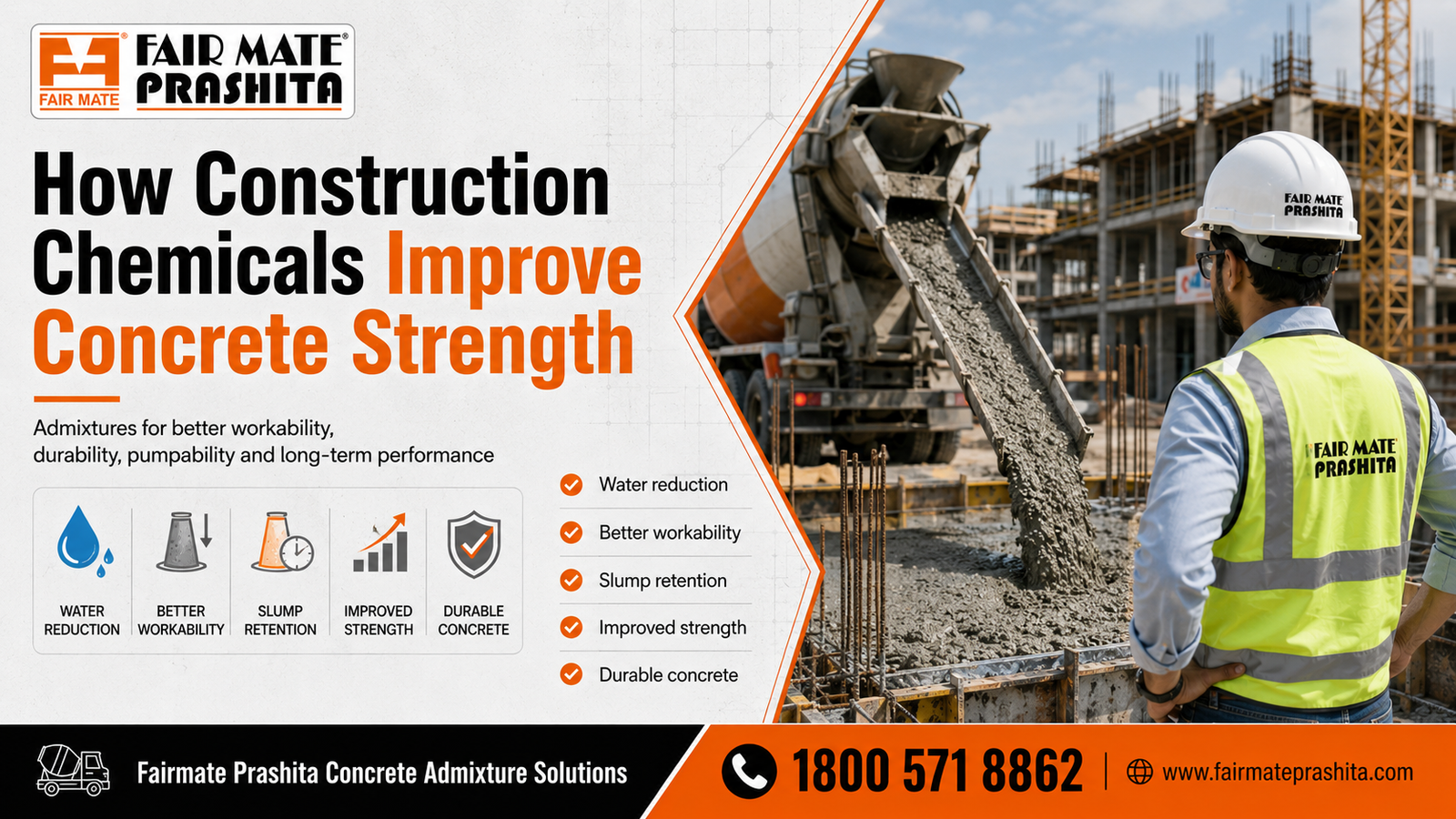
Concrete strength is one of the most important factors in any construction project. Whether it is a residential building, commercial structure, bridge, factory floor, road, basement, or infrastructure project, concrete must perform under load, weather exposure, site conditions, and long-term usage.
But concrete strength does not depend only on cement. It depends on proper mix design, water-cement ratio, aggregate quality, compaction, curing, placement method, and the correct use of construction chemicals. This is where concrete admixtures play a major role.
Fairmate Prashita offers a wide range of concrete admixture solutions under product families such as FAIRCRETE, FAIRFLO and BROCRETE, including plasticizers, superplasticizers, retarders, slump retainers, accelerators, mineral admixtures, fibers and plastering admixtures for improving concrete workability and performance. (Fairmate Prashita)
What Are Construction Chemicals in Concrete?
Construction chemicals are specially designed materials added to concrete, mortar, or cement-based systems to improve performance. In concrete, the most commonly used construction chemicals are admixtures.
Concrete admixtures are added during batching or mixing to modify the fresh and hardened properties of concrete. They help improve workability, strength, setting time, durability, pumpability, water reduction, and placement quality.
Concrete itself is made from cement, water, fine aggregate and coarse aggregate. Cement reacts with water through hydration and binds the aggregates into a hardened mass. (American Cement Association) However, site conditions are rarely perfect. Temperature changes, long transportation time, congested reinforcement, pumping distance, low water-cement ratio, and durability requirements can make concrete difficult to place and finish.
Construction chemicals help engineers and contractors manage these challenges more effectively.
Why Concrete Strength Depends on More Than Cement
Many people assume that adding more cement automatically increases concrete strength. In reality, strong concrete depends on balance.
The key factors that influence concrete strength include:
✅ Correct water-cement ratio
✅ Proper aggregate grading
✅ Good compaction
✅ Controlled workability
✅ Proper curing
✅ Suitable admixture selection
✅ Correct placement and finishing
✅ Protection from early drying or poor site conditions
If excess water is added to concrete for easier placement, strength can reduce. If concrete is too stiff, it may not compact properly, leading to honeycombing and voids. If concrete loses slump before placement, the finish and compaction may suffer.
This is why admixtures are important. They help achieve better workability without unnecessary water addition.
1. Water-Reducing Admixtures Improve Strength
One of the most important ways construction chemicals improve concrete strength is by reducing water demand.
Concrete needs water for hydration, but extra water creates capillary pores inside the hardened concrete. These pores can reduce strength and increase permeability. A lower water-cement ratio usually helps produce stronger and denser concrete when the mix is properly designed and placed.
Water-reducing admixtures and superplasticizers allow concrete to remain workable even with reduced water content. This helps improve:
✅ Compressive strength
✅ Concrete density
✅ Surface finish
✅ Durability
✅ Pumpability
✅ Reduced shrinkage risk
For RMC plants and contractors, this is especially useful because concrete must remain workable during transportation, pumping, placement and finishing.
Best Product Link:- FAIRFLO RMC 100
2. Superplasticizers Support High-Performance Concrete
Superplasticizers are high-range water-reducing admixtures used to produce flowing concrete without increasing water content.
They are useful for:
✅ High-strength concrete
✅ RMC concrete
✅ Pumped concrete
✅ Congested reinforcement areas
✅ High-rise construction
✅ Infrastructure projects
✅ Precast concrete
✅ Self-compacting concrete
When concrete needs high flow and high strength together, superplasticizers become very important. They help maintain workability while supporting a lower water-cement ratio.
This is especially useful for engineers and contractors working on columns, beams, slabs, bridges, foundations, industrial floors and heavy-duty structures.
Best Product Link:-FAIRFLO S
3. Slump Retainers Help Maintain Workability
Concrete may lose workability during transportation, especially in hot weather or long-distance delivery. When concrete reaches the site with low slump, workers may add water to make it easier to place. This can reduce strength and affect durability.
Slump-retaining admixtures help concrete maintain workability for a longer time. This is useful for:
✅ RMC supply
✅ Long travel distance
✅ Hot weather concreting
✅ Large pours
✅ Pumping applications
✅ Infrastructure projects
By controlling slump loss, these admixtures help reduce the need for site water addition and support better final concrete performance.
reference Link:- https://www.fairmateprashita.com/blog/faircrete-admixtures-enhancing-concrete-quality-in-every-pour/
4. Accelerators Help Early Strength Development
In some projects, early strength is important. For example, precast elements, repair works, road works, and fast-track construction may need quick strength gain.
Accelerating admixtures help speed up the setting and early strength development of concrete. They are useful when:
✅ Early formwork removal is required
✅ Faster project cycle is needed
✅ Cold weather slows down hydration
✅ Precast production needs faster turnover
✅ Repair work must be completed quickly
However, accelerators must be selected carefully based on cement type, temperature, mix design and project requirement.
reference Link:- https://www.fairmateprashita.com/Solutions/construction_chemicals/
5. Retarders Help Control Setting Time
In hot weather or mass concrete work, concrete may set too quickly. This can create problems during transportation, placement, finishing and joint management.
Retarding admixtures help slow down the setting time of concrete. They are useful for:
✅ Hot weather concreting
✅ Large raft foundations
✅ Long-distance concrete supply
✅ Mass concrete pours
✅ Complex placement work
✅ Extended finishing time
By controlling setting time, retarders help maintain workable concrete for longer and reduce the risk of cold joints or poor finishing.
reference Link:- https://www.fairmateprashita.com/Solutions/construction_chemicals
6. Mineral Admixtures Improve Density and Durability
Mineral admixtures such as micro silica and other supplementary materials help improve concrete density and durability. Fairmate Prashita lists FAIRMATE MICRO SILICA among its admixture product range, described for applications such as tall buildings, marine structures, shotcrete, underground construction, waterproof basements, bridges, floors and pavements. (Fairmate Prashita)
Mineral admixtures help improve concrete by:
✅ Refining pore structure
✅ Improving packing density
✅ Reducing permeability
✅ Supporting long-term durability
✅ Improving resistance against aggressive environments
Dense concrete is not only stronger but also more resistant to water ingress, chemical attack, chloride penetration and reinforcement corrosion.
Best Product Link:- FAIRMATE MICRO SILICA
7. Fibers Help Control Cracks
Concrete has high compressive strength but is weak in tension. Shrinkage, temperature variation and loading can create cracks. Fibers help control micro-cracking and improve toughness.
Fiber-based construction chemicals are useful for:
✅ Industrial floors
✅ Pavements
✅ Plastering
✅ Shotcrete
✅ Precast products
✅ Crack-control applications
Fibers do not replace structural steel reinforcement where it is required, but they help improve crack resistance and surface performance in many applications.
reference Link:- https://www.fairmateprashita.com/Solutions/construction_chemicals
8. Admixtures Improve Pumpability and Placement Quality
Strong concrete is not only about laboratory cube strength. It must also be properly placed at site.
If concrete is difficult to pump or place, it may lead to segregation, honeycombing, voids and poor compaction. These problems can reduce actual in-structure strength.
Admixtures improve pumpability by controlling flow, cohesion and workability. This helps contractors achieve:
✅ Better concrete movement through pipelines
✅ Reduced blockage risk
✅ Better compaction
✅ Uniform placement
✅ Improved finish
✅ Reduced site rejection
For high-rise buildings, large slabs, foundations and RMC projects, pumpable concrete is a major requirement.
Best Product Link:- FAIRMATE SMOOTH PUMPING AID(L)
9. Construction Chemicals Improve Durability, Not Just Strength
Concrete strength and concrete durability are connected, but they are not the same.
A concrete mix may achieve good early strength but still fail in durability if it is highly permeable, poorly cured, or exposed to aggressive conditions without protection.
Construction chemicals help improve durability by reducing water demand, improving density, controlling cracks, enhancing workability and reducing permeability.
This helps protect concrete against:
✅ Water ingress
✅ Chloride attack
✅ Sulphate exposure
✅ Reinforcement corrosion
✅ Carbonation
✅ Surface wear
✅ Long-term deterioration
For infrastructure, industrial and commercial projects, durability is as important as compressive strength.
Best Product Link:- FAIRCRETE RMW
Common Concrete Problems That Admixtures Help Reduce
The right admixture system can help reduce many common concrete problems, including:
✅ Low workability
✅ Excess water addition
✅ Slump loss
✅ Honeycombing
✅ Segregation
✅ Bleeding
✅ Low early strength
✅ Poor pumpability
✅ Shrinkage cracks
✅ Reduced durability
✅ Surface finishing issues
However, admixtures must be selected based on the actual project requirement. The same admixture is not suitable for every concrete mix.
How Engineers and RMC Plants Should Select Concrete Admixtures
Before selecting an admixture, engineers and RMC teams should check:
✅ Concrete grade
✅ Cement type
✅ Aggregate quality
✅ Required slump
✅ Retention time
✅ Placement method
✅ Pumping distance
✅ Weather condition
✅ Site application
✅ Strength requirement
✅ Durability requirement
✅ Trial mix performance
Trial mixes are very important because admixture performance may vary based on cement chemistry, aggregate shape, fines content, temperature and mixing method.
Fairmate Prashita provides technical support for product selection, application guidance and construction chemical requirements through its website support system and toll-free assistance. (Fairmate Prashita)
Conclusion
Construction chemicals play a major role in improving concrete strength, durability and site performance. They help control water demand, improve workability, maintain slump, support early strength, improve density, reduce permeability and make concrete easier to place.
For engineers, RMC plants and contractors, the right admixture is not just an additive — it is a performance tool.
By selecting suitable concrete admixture solutions, construction professionals can achieve stronger, more durable and more reliable concrete for modern building, infrastructure and industrial projects.
Explore Fairmate Prashita concrete admixture solutions for better workability, strength and long-term concrete performance.
📞 Call: 1800 571 8862
🌐 Website: www.fairmateprashita.com