
What Is Non-Shrink Grout and Where Is It Used?

What Is Non-Shrink Grout and Where Is It Used?

What Is Non-Shrink Grout and Where Is It Used?

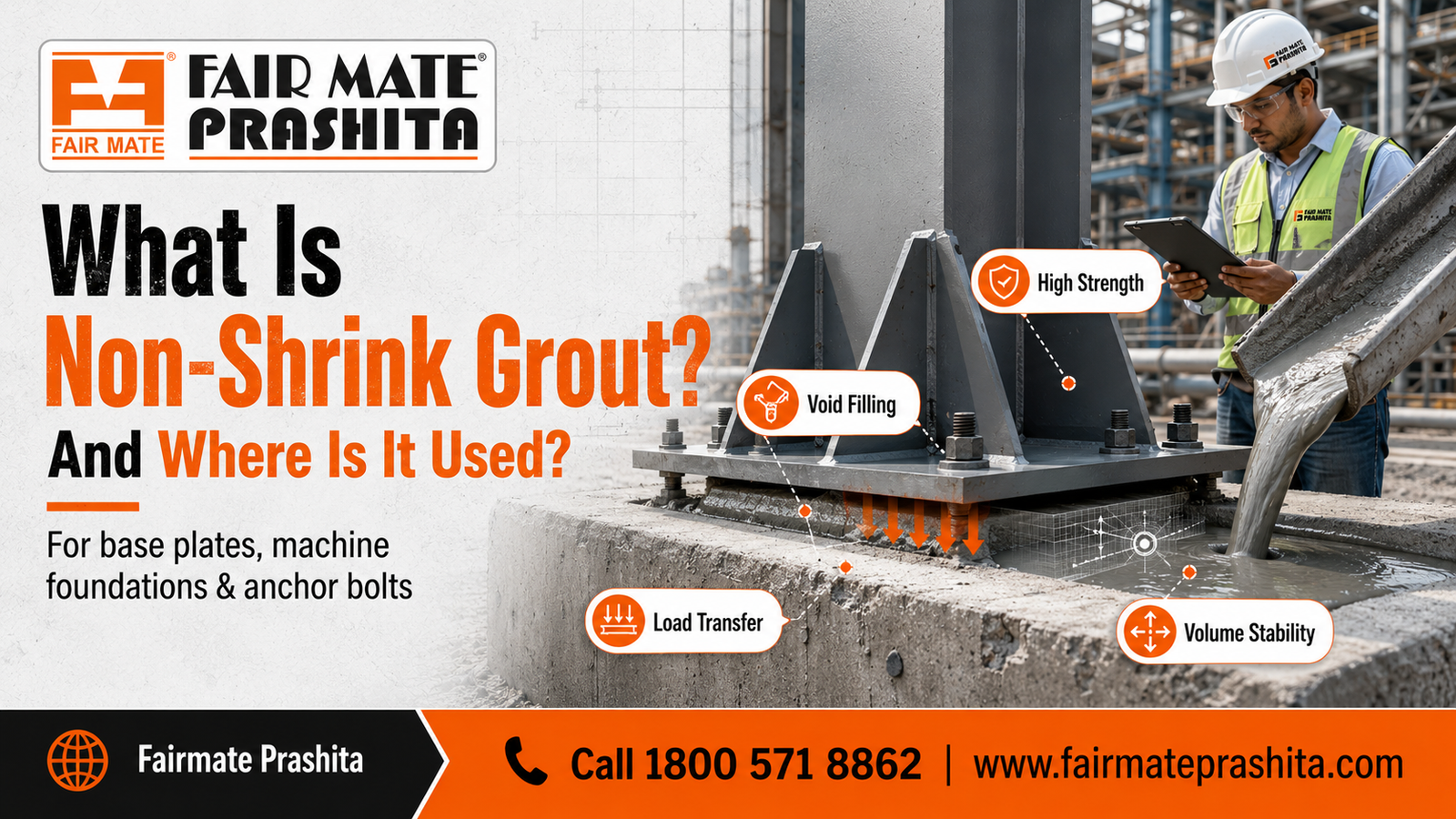
In construction, even a small void below a machine base plate, column base, anchor bolt or structural connection can create major performance problems. These voids can lead to poor load transfer, vibration, misalignment, cracking, settlement and long-term maintenance issues. This is why ordinary cement mortar is not suitable for precision grouting applications.

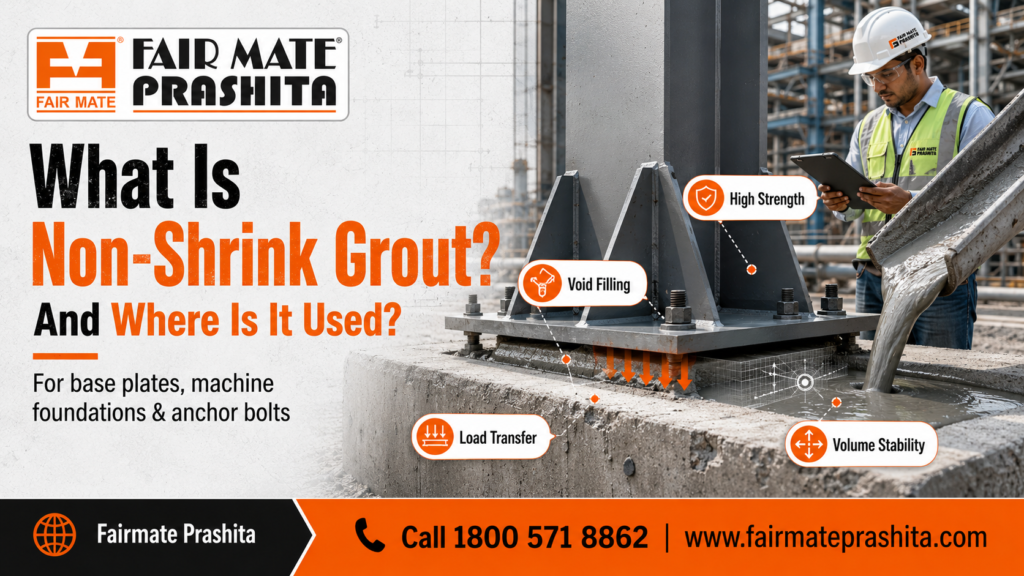
Non-shrink grout is a specially designed construction chemical used to fill gaps, cavities and spaces where strong, stable and reliable load transfer is required. Unlike ordinary mortar, non-shrink grout is engineered to maintain volume stability after placement. It flows into restricted spaces, fills voids properly and develops high strength without excessive shrinkage.

For industrial, commercial and infrastructure projects, non-shrink grout is widely used below base plates, machinery foundations, stanchion bases, precast elements, bridge bearings, anchor bolts, crane rails and structural connections. It plays a critical role in ensuring that loads are transferred evenly from steel or equipment to the concrete foundation.

Fairmate Prashita offers advanced engineering grout solutions under the FLOWGROUT range. The official engineering grout page describes FLOWGROUT as a wide range of cementitious, epoxy and polyurethane-based grouts with non-shrink, free-flowing and high-strength properties. These are used for base plate grouting, injection grouting and anchoring of rebars. (Fairmate Prashita).

What Is Non-Shrink Grout?

Non-shrink grout is a pre-packed, high-strength grouting material that is mixed with a controlled amount of water or resin component depending on the product type. It is designed to flow into gaps and cavities without segregation, bleeding or excessive shrinkage.

The term “non-shrink” does not simply mean that the material never changes volume. It means the grout is formulated to compensate for normal cementitious shrinkage and maintain proper contact with the surfaces it supports. This is important below base plates and machines because even minor gaps can reduce stability and affect load distribution.

A good non-shrink grout should offer:

  • High compressive strength
  • Free-flowing or pourable consistency
  • Good bond with concrete and steel
  • Volume stability
  • Low permeability
  • Resistance to vibration and dynamic loads
  • Easy placement in confined spaces
  • Durability under site conditions

Fairmate Prashita’s FLOWGROUT 60 is described as an ultra-high-strength, free-flowing, non-shrink cementitious grout. It is non-metallic, chloride-free and designed for general-purpose grouting under dynamic loads. The product page states that it flows under base plates and bolt pockets and attains 650 kg/cm² compressive strength at 28 days. (Fairmate Prashita)

Why Ordinary Mortar Is Not Enough

Many site failures happen because normal cement-sand mortar is used for base plate or machinery grouting. Ordinary mortar may look strong after hardening, but it can shrink, crack, bleed, segregate and fail to fill hidden voids properly.

In high-load or vibration-prone areas, ordinary mortar can lose contact with the base plate. This creates uneven load transfer. Over time, vibration can loosen anchors, damage equipment alignment and create cracks in the foundation.

Non-shrink grout is designed specifically to solve this problem. It fills gaps properly, remains stable and supports stronger contact between the foundation and the supported element. This helps improve safety, performance and durability.

Types of Non-Shrink Grout

1. Cementitious Non-Shrink Grout

This is the most commonly used type for general construction and industrial grouting. It is supplied as a ready-to-use powder and requires only measured water at site. It is suitable for base plates, columns, stanchion bases, equipment foundations and precast connections.

FLOWGROUT 40 and FLOWGROUT 60 are suitable product mentions for cementitious non-shrink grouting applications.

2. High-Strength Grout

High-strength grout is used where higher compressive strength, durability and load-bearing capacity are required. It is suitable for heavy machinery, industrial units, infrastructure projects and structural grouting.

FLOWGROUT 60 is a relevant product here because it is described as ultra-high-strength, free-flowing and non-shrink.

3. Epoxy Grout

Epoxy grout is used where extreme chemical resistance, vibration resistance, heavy loads or very high performance is required. It is commonly used for heavy-duty machinery, turbines, compressors, pumps, industrial equipment and precision alignment.

Relevant Fairmate Prashita product mentions include FLOWGROUT EP and FLOWGROUT EP(L) from the FLOWGROUT engineering grout range. The FLOWGROUT product list on the website includes FLOWGROUT EP, FLOWGROUT EP(H), FLOWGROUT EP(L), FLOWGROUT EPLV and related epoxy grout variants. (Fairmate Prashita)

4. Anchoring Grout

Anchoring grout is used for fixing anchor bolts, rebars, dowels and structural steel elements into concrete. It helps create a strong connection between steel and concrete.

Fairmate Prashita’s engineering grout product list includes ANCHORGROUT and ANCHORFIX RESIN CAPSULE, making them suitable mentions for anchoring and fixing applications. (Fairmate Prashita)

Where Is Non-Shrink Grout Used?

1. Base Plate Grouting

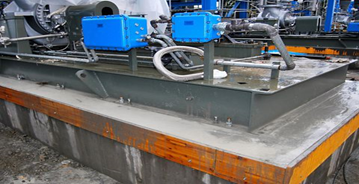
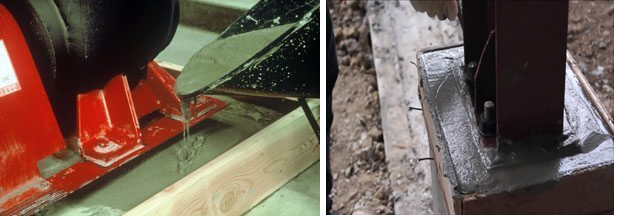
This is one of the most common uses of non-shrink grout. Steel columns, machines and equipment are mounted on base plates. The grout fills the gap between the concrete foundation and the base plate to provide uniform load transfer.

If this gap is not filled correctly, the base plate may not sit properly, causing uneven pressure, cracks or movement. Non-shrink grout ensures strong contact and stable performance.

2. Machine Foundation Grouting

Machinery such as pumps, compressors, generators, turbines, presses and industrial equipment requires stable foundations. These machines often create vibration and dynamic loads.

Non-shrink grout helps maintain alignment and transfers load safely to the foundation. For dynamic load conditions, high-strength cementitious grout or epoxy grout may be selected depending on project requirements.

3. Anchor Bolt and Bolt Pocket Grouting

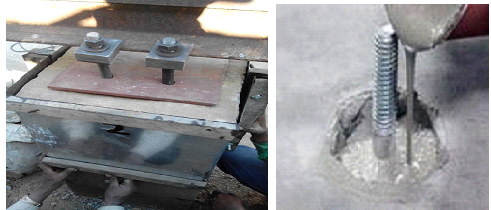
Anchor bolts need proper embedment and surrounding support. Non-shrink grout is used to fill bolt pockets and secure the bolts in position. FLOWGROUT 60 is specifically described as freely flowing under base plates and bolt pockets. (Fairmate Prashita)

4. Crane Rail and Stanchion Base Grouting

Industrial buildings, warehouses, factories and plants often use crane rails and stanchion bases. These areas are exposed to heavy loads and repeated movement. Non-shrink grout helps support load-bearing steel elements and reduces the risk of settlement or cracking.

5. Precast Concrete Connections

Precast construction requires precise connection between elements. Non-shrink grout is used for joints, sleeves, pockets and connection gaps to ensure proper bonding and load transfer.

6. Bridge Bearings and Infrastructure Work

Bridges, flyovers, metro structures and infrastructure projects require reliable grouting below bearings and structural plates. Non-shrink grout helps achieve uniform support and long-term durability in these critical areas.

7. Rebar Anchoring and Structural Fixing

When rebars, dowels or anchors are fixed into existing concrete, anchoring grout or resin capsule systems help create a strong bond. This is important in strengthening, retrofitting, repair and structural extension works.

8. Injection Grouting

Some engineering grout systems are also used for filling voids, cracks and cavities through injection methods. Fairmate Prashita’s engineering grout category includes injection grouting range products under FLOWGROUT. (Fairmate Prashita)

Benefits of Non-Shrink Grout

Non-shrink grout provides several important benefits for construction and industrial projects:

  • It fills gaps and voids effectively
  • It provides high compressive strength
  • It ensures uniform load transfer
  • It reduces risk of cracking and settlement
  • It supports machinery alignment
  • It performs better than ordinary mortar
  • It helps resist vibration and dynamic loads
  • It bonds well with concrete and steel
  • It supports long-term durability
  • It improves reliability of structural connections

For project owners and engineers, the biggest benefit is performance assurance. Non-shrink grout helps reduce the risk of hidden gaps and weak contact zones that may affect the structure or equipment later.

Correct Application Method Matters

Even the best non-shrink grout can fail if applied incorrectly. Site teams must follow correct surface preparation, mixing, placement and curing methods.

Before grouting, the concrete surface should be clean, sound and free from oil, dust, laitance and loose particles. The area should be properly shuttered to avoid leakage. Water should be measured accurately as per product requirement. Over-watering should be avoided because it can reduce strength and cause segregation.

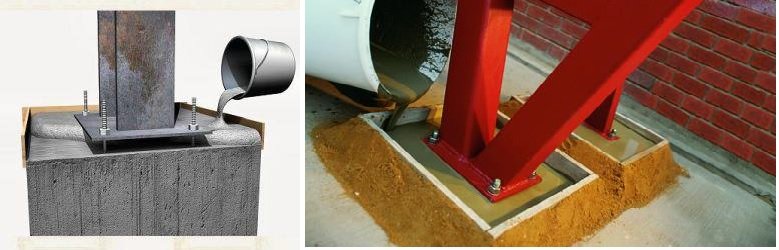
Mechanical mixing is preferred for uniform consistency. The grout should be poured continuously from one side to avoid air entrapment. After placement, curing and protection should be done as recommended.

For epoxy grout, surface preparation, mixing ratio, pot life, temperature and chemical exposure conditions must be carefully followed.

How to Select the Right Non-Shrink Grout

The right grout depends on:

  • Gap size
  • Load condition
  • Dynamic or static loading
  • Required compressive strength
  • Chemical exposure
  • Temperature condition
  • Equipment type
  • Foundation design
  • Application thickness
  • Site accessibility
  • Required setting time
  • Cementitious or epoxy requirement

For general base plate grouting, a cementitious non-shrink grout may be sufficient. For heavy industrial equipment, epoxy grout or ultra-high-strength grout may be required. For large-section grouting, aggregate-filled or special-grade grout may be preferred. For anchoring work, anchoring grout or resin capsule systems may be selected.

This is why technical consultation is important before final product selection.

Conclusion

Non-shrink grout is an essential construction chemical for precision grouting, base plate support, machine foundations, anchor bolts, bridge bearings, precast connections and industrial structural applications. It provides high strength, free flow, volume stability and reliable load transfer where ordinary mortar cannot perform.

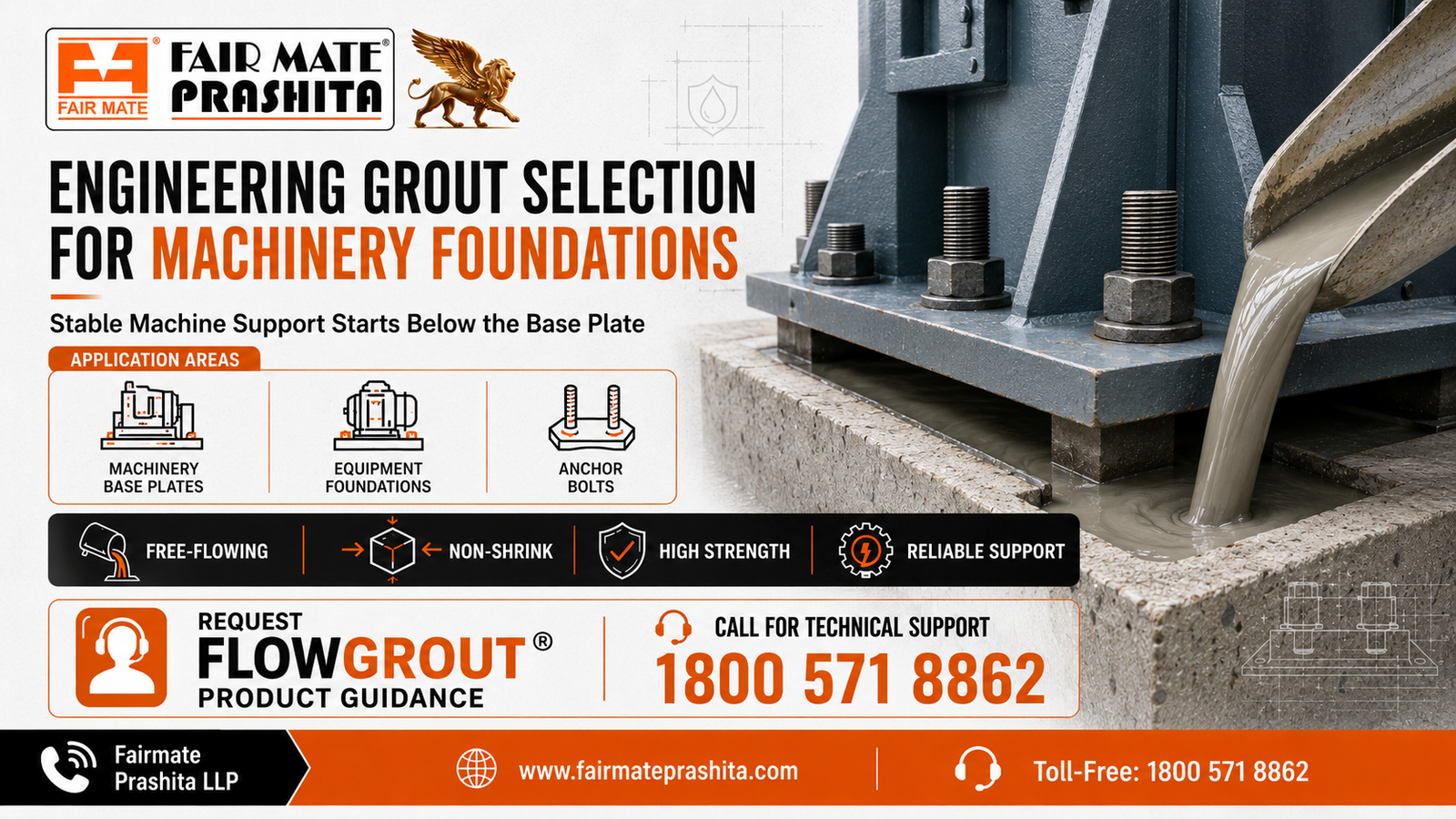
Fairmate Prashita offers engineering grout solutions under the FLOWGROUT range, including cementitious, epoxy, polyurethane, anchoring and injection grouting options. For the correct grout selection, application method, dosage and project-specific technical support, read the full guide and call 1800 571 8862.

Fairmate Prashita
Advanced Construction Chemical Solutions
Corporate Office: 2nd Floor, Sarang House, Sheetal Nagar, Akota, Vadodara, Gujarat 390020
📞 Toll Free: 1800 571 8862
🌐 Website: www.fairmateprashita.com
📧 Email: support@fairmateprashita.com

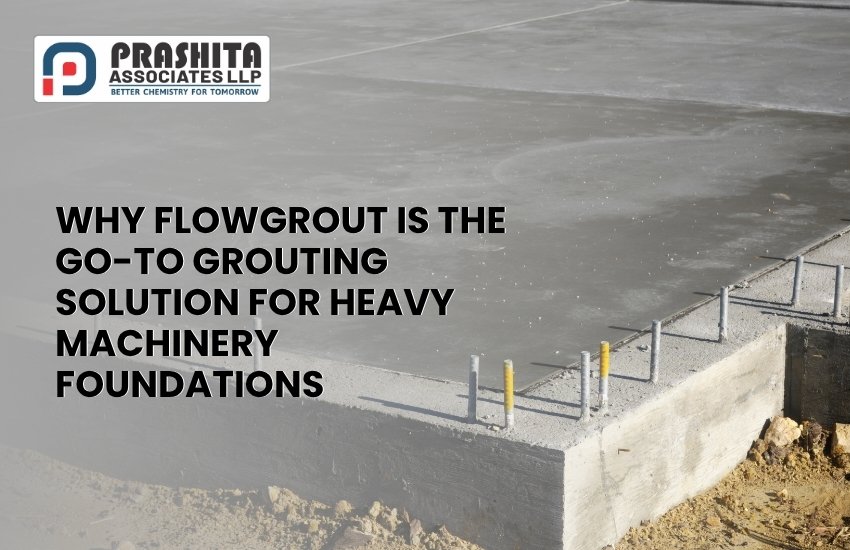
Freshly prepared concrete foundation with steel bolts, showcasing the ideal base for heavy machinery grouting using FLOWGROUT by Prashita Associates LLP.

Why FLOWGROUT is the Go-To Grouting Solution for Heavy Machinery Foundations

Industrial and infrastructure projects rely on the stability of their foundations — especially when it comes to heavy machinery. Whether it’s turbines, compressors, or large gearboxes, the base they sit on must absorb loads, vibrations, and stress over time.

This is where FLOWGROUT, offered by Fairmate Prashita LLP, stands out. Designed for precision, strength, and flowability, this non-shrink cementitious grout is ideal for both static and dynamic machinery foundations.

The FLOWGROUT range is formulated using globally trusted grouting technologies — including systems originally engineered by Fairmate — and supplied by Prashita with complete technical support.

What Is FLOWGROUT?

FLOWGROUT is a high-performance, free-flowing, non-shrink grout developed for high-strength, precision grouting applications. It’s used beneath base plates, machine pockets, anchor bolts, crane rails, and more.

The series includes multiple grades tailored for different operational conditions:

Key Features of FLOWGROUT

  • Non-shrink properties – Eliminates voids under base plates
  • Free-flowing and self-leveling – Easy to pour, even in tight spaces
  • High compressive strength – Up to 875 kg/cm² depending on grade
  • Chloride and iron-free – Prevents corrosion in steel reinforcement
  • Excellent bonding – Adheres to both steel and concrete surfaces
  • Certified performance – Conforms to BS, ASTM, and IS standards

Why It’s Ideal for Heavy Machinery

Heavy-duty machinery demands a foundation that won’t crack, shift, or deteriorate. FLOWGROUT is engineered to deliver:

🔹 1. Long-Term Load Bearing

Its high compressive strength supports concentrated loads over time without shrinkage — crucial for base plate grouting.

🔹 2. Dynamic Load Resistance

With versions like FLOWGROUT SPECIAL and FLOWGROUT EP, it handles vibration and repeated stress in rotating equipment.

🔹 3. Rapid Strength Gain

Quick setting and curing allow earlier commissioning of equipment — saving downtime.

🔹 4. Precision Placement

Its flowability ensures tight fill under machine beds, minimizing the risk of settlement.

Typical Applications

  • 🏭 Industrial Machinery Bases
  • 🚧 Bridge Bearings and Column Bases
  • 🏗️ Precast Element Grouting
  • 🚉 Metro Track Grouting and Base Rail Anchoring
  • 🏢 HVAC Equipment, Transformers, Generators

Backed by Proven Formulations

At Prashita, we ensure that FLOWGROUT maintains the same level of performance and consistency that professionals expect. Its formulation heritage comes from Fairmate’s long-standing range of grouting solutions — a brand known for quality and technical depth in construction chemicals.

Every batch supplied by Prashita is supported with:

  • Site-specific dosage and flow recommendations
  • Application tools and mixing guidance
  • Performance data sheets and certifications
  • Post-installation inspection support

It’s more than just grout — it’s a system designed for critical foundation stability.

What Makes Prashita’s FLOWGROUT Stand Out?

  • Multiple variants for different applications
  • Adapted for Indian site conditions and temperatures
  • Packaged for easy transport and storage
  • Bulk supply available for infrastructure contractors

Combined with our engineering support, it’s a go-to product for large EPCs, MEP contractors, and civil engineering consultants.

Conclusion

When machine foundations matter, compromise is not an option. FLOWGROUT delivers performance, strength, and peace of mind — making it the preferred choice for high-load, high-precision grouting.

With technology rooted in Fairmate’s reliable systems and the application expertise of Prashita Associates LLP, FLOWGROUT is helping contractors across India build stronger, safer foundations every day.

Person working on architectural blueprints with a laptop and safety helmet on the desk, representing construction planning. Text overlay reads: "Choosing the Right Engineering Grout: A Guide for Contractors and Engineers." Prashita Associates LLP logo with tagline "Better Chemistry for Tomorrow" is visible in the top-left corner.

Choosing the Right Engineering Grout: A Guide for Contractors and Engineers

Precision and strength are non-negotiable in modern construction — especially when dealing with machine bases, columns, crane rails, or precast elements. Whether static or dynamic loads are involved, the right engineering grout ensures long-term stability, vibration resistance, and safety. At Fairmate Prashita LLP, we provide a full range of high-performance grouts — designed for diverse applications, from standard static base plates to ultra-high-strength epoxy solutions. Our formulations are built using reliable Fairmate technology, trusted across industries for decades.

What Is Engineering Grout?

Engineering grout is a flowable, shrinkage-compensated material that fills voids between structural elements and their foundations. It transfers loads effectively, accommodates movement, and ensures equipment or structural elements remain secure under stress.

Types of Engineering Grouts (And Where to Use Them)

🔹 1. Cementitious Grouts – General-Purpose Precision

These are non-shrink, high-strength, free-flowing grouts made from cement, graded aggregates, and additives.

Applications:

  • Base plates of static machinery
  • Column foundations
  • Precast panels and footings
  • Transformer and crane pads

Our Range Includes:
Grouts based on Fairmate’s FLOWGROUT series, offered in different grades to suit early strength gain, flow characteristics, and pour depth.

Example: FLOWGROUT 40 is ideal for general grouting, while FLOWGROUT SPECIAL suits heavier industrial installations.

🔹 2. Epoxy Grouts – For Dynamic Loads and Extreme Environments

Epoxy grouts are three-part systems (resin, hardener, and filler) offering ultra-high compressive strength and chemical resistance.

Applications:

  • Heavy-duty rotating machinery
  • Dowel bar anchoring
  • Vibration-prone installations
  • Structural strengthening

Benefits:

  • High early strength
  • Chemical, oil, and solvent resistance
  • Suitable even in wet or underwater areas

Our epoxy grouts (inspired by Fairmate’s FLOWGROUT EP and EP(L) systems) are used in factories, bridges, and metro infrastructure.

🔹 3. Resin Anchor Grouts – For Precision and Speed

Polyester or polyurethane-based grouts are ideal for quick anchoring of bolts, bars, or inserts.

Applications:

  • Fixing machinery bolts into concrete
  • Anchoring reinforcement into columns/walls
  • Installation of railings, crash barriers, etc.

Key Features:

  • Thixotropic nature (no sag)
  • Fast setting and high pull-out strength
  • Can be used in damp conditions

Our anchoring systems are modeled on Fairmate’s ANCHORGROUT formulations, which are widely used in industrial and road infrastructure works.

🔹 4. Large Section Grouts – For Mass Pour Foundations

For larger volumes and thicker pours, special formulations with lower heat of hydration and better flow are required.

Applications:

  • Crane rail systems
  • Machine pockets
  • Large transformer beds
  • Structural infill

Prashita offers high-volume cementitious grouts based on trusted Fairmate design, tailored for mass fill jobs with expansion stability.

Choosing the Right Grout – Key Considerations

To select the right grout, engineers and contractors should consider:

FactorWhy It Matters
Load TypeStatic vs dynamic determines strength needs
Gap ThicknessFlowability and expansion control
Application SpeedFast-setting vs extended pot life
Environmental ExposureMoisture, temperature, chemicals
Installation PositionHorizontal, vertical, overhead

Our technical team at Prashita assists clients with on-site assessment, mix guidance, and dosage support for every project.

Real-World Applications of Our Grout Solutions

  • Metro Rail Systems: Dynamic epoxy grout for vibration resistance
  • Industrial Plants: Base plate grouting for heavy turbines
  • Power Stations: Transformer and generator foundation grouts
  • Bridges & Flyovers: Anchor bolt setting and column shoes
  • Precast Yards: Precision panel placement with non-shrink grout

All these applications have one thing in common — they rely on engineered grout systems developed with Fairmate’s proven formulations, customized and supplied by Prashita.

Why Choose Prashita Associates LLP?

  • ✅ Backed by Fairmate’s formulation reliability
  • ✅ Customized solutions for any load and environment
  • ✅ Full technical documentation and compliance support
  • ✅ Site-specific installation guidance from trained professionals

We don’t just provide grout — we provide peace of mind.

Conclusion

Whether you’re anchoring a column or installing a machine base, choosing the right engineering grout can make or break long-term structural integrity.

Fairmate Prashita LLP offers a complete portfolio of cementitious, epoxy, and resin-based grouts — trusted by contractors and engineered with precision. With our expertise, you’ll get the right product, for the right purpose, every time.

ANCHORGROUT

HIGH STRENGTH, THIXOTROPIC, POLYESTER GROUT

ANCHORGROUT is two components, thixotropic, polyester resin-based anchor grout. When mixed two components it gives high strength, fast setting and fast curing grout of thixotropic consistency. Designed for the anchoring of steel bars and bolts into concrete, machinery and brickwork where speed of installation and early load bearing capacity is required. The cured ANCHORGROUT is resistant to water, oils, petrol greases and mild acids and alkali solutions. ANCHORGROUT permits the production of anchors capable of high loadings.

SALIENT FEATURES
• Rapid strength gain
• Vibration resistant
• Corrosion resistant
• High early strength
• Extremely durable
• Weather resistant

APPLICATION PROCEDURE
Preparation: Hole should be formed using rotary percussive drilling techniques. Diamond drilled holes should be scrabbled. Pre-cast holes should have roughened sides. All dust and drilling debris should be removed. Bars and bolts should be degreased and all rust should be removed.

Mixing: ANCHORGROUT is supplied in pre-weighted two packs. The content of plastic bag should be emptied in metal container, mixed thoroughly to form a smooth paste. Once mixed two components use it in one operation.

Installation: The grout should be injected to the bottom of the hole to avoid entrapment of air. Due to its thixotropic nature, loss of ANCHORGROUT from the hole will be insignificant.

ANCHORGROUT can be used for a permanent installation of reinforcement doweling and starter bars, foundation bolts, base plates, hand rails, safety fences, wall tiles, railway tracks, tie back anchors and grout for tower cranes.
Due to its thixotropic nature it can be used in vertical, horizontal and overhead situations. It can be used in damp conditions. Ideal product for hole grouting having diameter max 25mm & min. 4mm.

PACKING
ANCHORGROUT is supplied in1 Kg

FLOWGROUT 60

ULTRA HIGH STRENGTH, FREE FLOWING, NON-SHRINK CEMENTITIOUS GROUT

FLOWGROUT 60 is based on specially processed cement containing fillers and additives. FLOWGROUT 60 is supplied as ready-to-use grout requiring the addition of a precise quantity of water at the site (3.750 to 4 Litre/25 Kg Grout). FLOWGROUT 60 is suitable for gap widths of between 10mm – 50mm. For thickness over 50mm. (say 75-100), cleaned washed 10mm aggregates can be incorporated at the rate of 20% of the quantity of grout used. This reduces the heat of hydration.
Expansion: Controlled expansion occurs in the unset material to ensure that the grout, when cured will continue to occupy its original volume within the confines of the voids in which it was placed. For thicker sections, it is necessary to fill out the grout with well-graded silt free aggregate to minimize heat buildup.

SALIENT FEATURES
• Prepacked, factory controlled consistent material needing only addition of water
• Shrinkage offset by expansion to ensure original volume is retained
• Free flowing, self-leveling grout
• Can withstand temperature up to 200ºC
• Easy placement and filling of underbases of machinery
• Non-metallic, non-toxic and chloride free
• Holds up to industrial machinery vibration & impact
• Extended work time for easy placement
• Excellent adhesion to concrete and steel
• Non staining
• High ultimate strength and durability

APPLICATION PROCEDURE

Surface Preparation:
• All contaminated surfaces must be cleaned thoroughly by chemical or mechanical methods.
• All bolt pockets and under bases must be free from dust, laitance, and of sound substrate. If needed, substrate with water to allow for full absorption for at least 24 hours.
• Just before the grouting is to commence, all water must be removed completely leaving the surface only damp.

Mixing: Mechanical mixing using a grout mixer or concrete mixer is recommended.
• Place 80% of the water required in a concrete mixer (100% water in case of a grout mixer).
• Slowly add the required amount of FLOWGROUT 60 while mixing continuously for 1 minute. Add balance quantity of water (20%) and mix for 3 to 5 minutes. This will provide a smooth even consistency of grout.

Bolt Packets:
• Depending on the size of the bolt pockets, 50- 100% cleaned 10mm sound aggregates by weight of grout consumption may be sealed incorporated to economies on grout and also to keep the heat of hydration low.
Under base Plate:
• Leak proof strong formwork must be provided to withstand operational stresses while grouting and all edges must be sealed with FLOWGROUT 60 troweling consistency to arrest the grout flowing out of formwork.
CURING:
• 3-4 hours after grouting, all exposed areas must be cured with wet hessian cloths (keep wet always) or water ponding wherever possible for minimum 7 days.

FLOWGROUT 60 can be used to Bolt pockets and base plate grouting of all equipment, Crane, stanchion bases and all types of machinery with dynamic load.

PACKING
FLOWGROUT 60 is supplied in 25 Kg. lined HDPE bag

FLOWGROUT 40

HIGH STRENGTH, FREE FLOW, NON-SHRINK GROUT

FLOWROUT 40 is a single pack ready use, high-strength, free-flowing and non-shrink grout.
FLOWGROUT 40 is based on specially processed types of cement containing fillers and additives. FLOWGROUT 40 is supply as ready-to-use grout requiring the addition of a precise quantity of water at the site (4.75 Litre/25 Kg grout).
Expansion: Controlled expansion occurs in the unset material to ensure that the grout, when cured will continue occupy its original volume within the confines of the voids in which it was placed. FLOWGROUT 40 is suitable for gap widths between 10mm-50mm. For widths, less than 10mm FLOWGROUT EP resin grout can be used. For thickness above 50mm. (say 75-100), cleaned washed 10mm aggregates can be incorporated at the rate of 50%-100% of the quantity of grout used. Water needs to be precisely measured for good early & final strength.

SALIENT FEATURES
• Material shrinkage is offset by expansion during green condition and later on by maintaining original volume.
• Self-leveling by nature.
• Can withstand temperature up to 200ºC
• Easy placement and filling of under bases of machinery.
• Non-metallic and chloride free.

APPLICATION PROCEDURE

Surface Preparation:
• All contaminations fully removed by chemical or mechanical methods.
• All bolt pockets and under bases must be free from dust, laitance. If needed, substrate must be hacked to provide extra mechanical key.
• The pockets and under bases must be saturated with water to allow for full absorption for at least 24 hours. Just before the grouting is to commence, all water must be removed completely leaving the surface only damp.

Mixing: Mechanical mixing using a grout mixer or concrete mixer is recommended.
• Place 80% of the water required in a concrete mixer (100% water in case of a grout mixer).
• Slowly add the required amount of FLOWGROUT 40 while mixing continuously for 1 minute. Add balance quantity of water (20%) and mix for 3 to 5 minutes. This will provide a smooth even consistency of grout.
Placing:
• The mixed grout poured immediately from one side only to avoid air pockets.
• Grouting must be continuous until the cavity is completely filled to the desired level.
• All exposed areas must be restrained by covering with wooden plates or polythene sheets with sand sprinkled on top of the sheet.
Bolt Packets:
• Depending on the size of the bolt pockets, 50- 100% cleaned 10mm sound aggregates by weight of grout consumption may be sealed incorporated to economise on grout and also to keep the heat of hydration low.
Under base Plate:
• Leak proof strong formwork must be provided to withstand operational stresses while grouting and all edges must be sealed with FLOWGROUT 40 troweling consistency to arrest the grout flowing out of formwork.
Curing:
• Within 8 hours of grouting all grouted areas must be cured with wet hessian cloth or water pounding according to the temperature for a minimum 7 days period.

It can be used in bolt pockets and base plate grouting of all rotary and static equipment, crane, stanchion based and all types of machinery in all types of industrial projects.

PACKING
FLOWGROUT 40 is supplied in 25 Kg lined HDPE bags.

FLOWGROUT HES – CEMENTITIOUS, HIGH EARLY STRENGTH, FLOWABLE FAST SETTING GROUT

Benefits
1. High early strength (even at low temperatures).
2. Very good flow characteristic.
3. Fast set times & fast strength gain.
4. Consistency can be adjusted as per requirement.
5. High 28 day strengths.
6. Does not bleed or segregate.
7. Very good impact and thermal resistance.
8. Non corrosive to steel or iron.
9. Excellent bond strength.
10. Pre-packed factory controlled to overcome site batched variations
11. Does not contains any corrosive chemicals

Description
FLOWGROUT HES is a blend of special cement, selected and graded aggregates and Fairmate admixtures, enabling it to achieve high strengths in short time frame.

Recommended Uses
FLOWGROUT HES is useful for wide range of applications where fast strength is required, like:
1. Machine bedplates.
2. Anchoring bolts.
3. Bridge bearing pads.
4. Pre-cast concrete sections.
5. Cavities, gaps and recesses.

Application Instructions
Surface Preparation: All surfaces must be clean, sound and free from dust, ice, oils, grease or other surface contaminants such as curing membranes and form release agent etc. Bolt holes and fixing pockets should be free of dirt and debris by air blasting. For maximum bond, surfaces should be abraded or roughened, preferably by mechanical means such as needle gun, grit blasting, grinding etc. All prepared surfaces must be saturated with water several hours prior to grouting, ensuring it is free of any surface water or puddles.

Temperature control :
Temperature affects setting time and rate of increase for strength. For optimum performance maintain grout, concrete and/or steel substrates within the range of 25-30ºC prior to, during, and for 48 hours after placement of the grout.

Mixing Equipment :
FLOWGROUT HES is must be mechanically mixed using a mechanical grout mixer or a suitable drum mixer. The grout mixer will reduce the chances of the mix becoming lumpy or aerated.

Mixing Method:
1) 4 Liters of clean water per 25 kg bag of grout.
2) Add the powder component to approximately 80% of the total amount water component while mixing.
3) Add the remaining 20% of the water component to the grout at a steady rate while continuing to mix.
4) Mix until the grout appears homogenous (3-5 minutes). Allow to stand so any entrapped air can escape. Do not add more water to increase flow of the grout if a mix has stiffened due to time delays. If the grout is unworkable discard.