
6 Basement Waterproofing Methods for Commercial Buildings

Basement Waterproofing Methods for Commercial Buildings

6 Basement Waterproofing Methods for Commercial Buildings
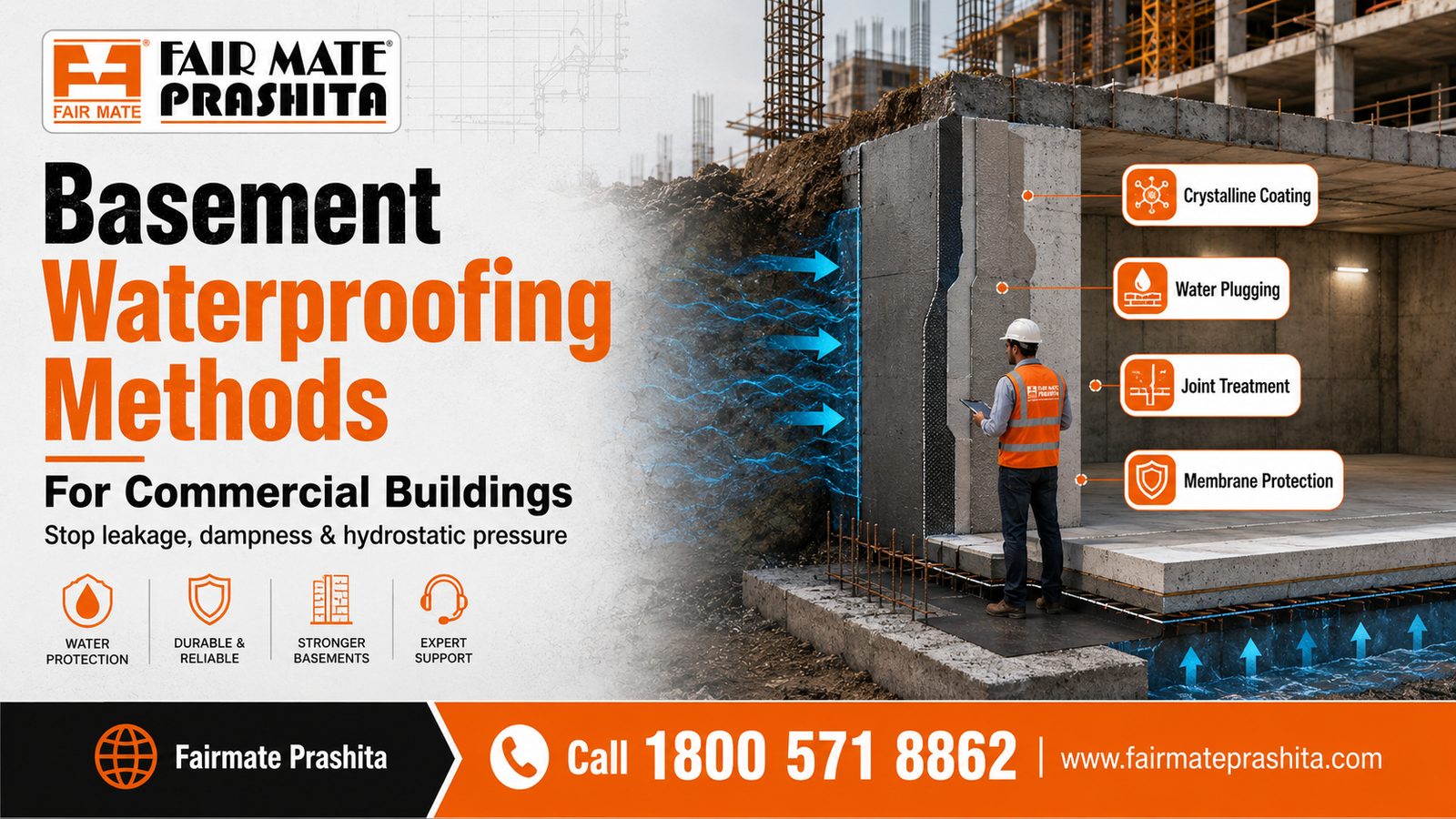
Basement waterproofing is one of the most important protection systems in commercial construction. In malls, hotels, hospitals, office buildings, factories, parking structures, warehouses and institutional projects, basements are exposed to constant moisture pressure from the surrounding soil. If waterproofing is not planned properly, water seepage, damp patches, concrete deterioration, corrosion of reinforcement, flooring failure, mould growth and long-term structural damage can occur.
For commercial buildings, basement waterproofing should not be treated as a cosmetic repair. It is a technical system that must be selected based on soil condition, water table, hydrostatic pressure, construction joints, concrete quality, retaining wall design and site exposure. A successful basement waterproofing method combines good concrete, proper joint treatment, surface preparation, leakage plugging and the correct waterproofing coating or membrane system.
Fairmate Prashita offers advanced waterproofing systems under the WATERGUARD range for basements, water tanks, retaining walls and other critical areas. These systems are designed to support builders, contractors, engineers, applicators and project consultants with practical product selection and technical guidance.

Why Basement Waterproofing Matters in Commercial Buildings

Commercial basements often serve high-value functions. They may be used for parking, electrical rooms, storage, HVAC systems, service areas, utility rooms or commercial back-end operations. Even small leakage can lead to major maintenance issues. Dampness can damage paint, plaster, flooring, electrical installations and stored materials. In severe cases, water ingress can affect concrete durability and reinforcement protection.
Basements face a different challenge compared to terraces or external walls. Water pressure does not only come from rainfall; it also comes from the surrounding ground. When groundwater pushes against the basement wall or raft slab, it creates hydrostatic pressure. This pressure can force water through cracks, honeycombs, construction joints, pipe penetrations and weak concrete areas. That is why basement waterproofing requires a system-based approach rather than a single coating.

1.Crystalline Waterproofing Method

Crystalline waterproofing is one of the most effective methods for basement concrete because it works within the concrete matrix. The material reacts with moisture and cementitious compounds to form crystals inside pores and capillaries. These crystals help block water movement through the concrete.

For basements exposed to water pressure, crystalline waterproofing is useful because it becomes part of the concrete surface and provides internal protection. It is commonly used on raft slabs, retaining walls, water tanks, lift pits and below-ground structures.

Fairmate Prashita’s WATERGUARD CRYSTALLINE is described as an easily brush-applied cementitious crystalline waterproofing coating. It is designed for well-prepared sound substrates and is applied for water tanks and basements where hydrostatic pressure exists. (Fairmate Prashita)

Best suited for:
Basement retaining walls, raft slabs, lift pits, water tanks, underground structures and concrete surfaces exposed to hydrostatic pressure.

2. Cementitious Waterproofing Coating

Cementitious waterproofing is widely used in commercial basements because it bonds well with concrete and masonry surfaces. It is practical, site-friendly and suitable for internal waterproofing where surfaces are prepared properly. Polymer-modified cementitious systems offer better flexibility, adhesion and durability compared to normal cement-based coatings.

This method is useful for basement walls, internal wet areas, retaining walls, tanks and service zones. It can be applied by brush, roller or trowel, depending on the product type.

Fairmate Prashita’s WATERGUARD A is a two-component acrylic cementitious waterproofing coating. It is described as a brush-applied polymer-modified cementitious waterproof coating that forms a tough, durable, abrasion-resistant and flexible waterproof layer with excellent adhesion. (Fairmate Prashita)

For higher performance needs, WATERGUARD A SUPER is a polymer-modified flexible cementitious waterproof coating. It is suitable for well-prepared substrates and can provide tough, durable waterproof rendering at 2–3 mm thickness for water tanks and basements. (Fairmate Prashita)

Best suited for:
Commercial basement walls, water tanks, retaining walls, internal concrete surfaces, utility rooms and service areas.

3. Fibre-Reinforced Waterproof Render

In basement areas where hydrostatic pressure is high, a simple coating may not always be enough. A thicker, fibre-reinforced waterproof render can provide additional protection. This method is especially helpful where the surface needs a more robust waterproof layer.

Fairmate Prashita’s WATERGUARD T is a trowel-applied, single-pack, fibre-reinforced waterproof cementitious render. It is described for water tanks and basements where hydrostatic pressure exists and is normally used in conjunction with WATERGUARD A as a primer. (Fairmate Prashita)

This type of waterproofing method is useful when the basement structure needs a stronger surface layer against water pressure and site wear. Proper surface cleaning, crack treatment and curing are important for performance.

Best suited for:
Basements with hydrostatic pressure, water-retaining structures, lift pits, retaining walls and heavy-duty below-ground concrete areas.

4. Water Plugging for Active Leakage

Before applying any coating or membrane, active leakage must be stopped. If running water is present through cracks, honeycombs, pipe penetrations or construction joints, coating directly over the leak will not solve the problem. The first step is to plug the leakage source.

Fairmate Prashita’s FAIRMATE WATERPLUG (S) is a fast-setting hydraulic compound that stops running water instantly. It sets in approximately 1 to 3 minutes depending on temperature and site conditions. (Fairmate Prashita)

Water plugging is especially important during basement repair projects where leakage is already visible. After plugging, the surface can be prepared for the correct waterproofing system.

Best suited for:
Active water seepage, running water points, cracks, tie-rod holes, honeycombs, basement wall leaks and emergency leakage repair.

5. PVC Water Stop for Construction Joints

Many basement leakages happen at joints, not through the main concrete body. Construction joints, contraction joints and expansion joints are weak points if not treated correctly. During new construction, PVC water stops are installed inside or outside the concrete joint to prevent water passage.

Fairmate Prashita’s WATERGUARD PVC WATER STOP is designed to stop possible leakage from construction, contraction and expansion joints in concrete elements. It is used for internal and external fixing and is resistant to abrasion and chemicals. (Fairmate Prashita)

For commercial basements, PVC water stops are important in raft-wall junctions, retaining wall joints, podium basement joints, water tanks, underground parking structures and expansion joint areas.

Best suited for:
New basement construction, raft-wall joints, retaining wall joints, expansion joints, water tanks and underground concrete structures.

6. Membrane Waterproofing Systems

For external basement waterproofing, membrane systems are often used on the positive side before backfilling. Membranes create a continuous barrier between the soil and the concrete surface. Depending on project requirements, membrane systems may include APP, SBS, TPO, EPDM, PU, polyurea or liquid-applied membranes.

Fairmate Prashita’s WATERGUARD range includes waterproofing membranes such as APP, SBS, TPO and EPDM options, along with PU, epoxy, acrylic modified coatings and liquid membranes. (Fairmate Prashita) These systems are suitable where the structure needs long-term protection from soil moisture and groundwater exposure.

For commercial projects, membrane selection depends on whether the waterproofing is being applied before backfilling, after concrete casting, on podium levels, or as part of a repair system.

Best suited for:
External basement walls, raft slabs, podiums, retaining walls, foundation areas and large commercial waterproofing projects.

Recommended Basement Waterproofing System Approach

A good basement waterproofing system should follow a proper sequence:

First, inspect the basement area and identify the source of water ingress. Second, repair cracks, honeycombs and weak concrete areas. Third, stop active leakage using a fast-setting plugging compound. Fourth, treat construction joints with the right water stop or joint system. Fifth, apply the selected waterproofing coating, render or membrane based on site exposure. Finally, protect the waterproofing layer before backfilling or finishing work.

The most common failure in basement waterproofing is not product failure but system failure. Poor surface preparation, incorrect product selection, inadequate curing, untreated joints and lack of supervision can reduce performance. That is why commercial projects should always involve technical consultation before finalizing the waterproofing method.

Final Thoughts

Basement waterproofing is a critical investment for commercial buildings. A well-designed waterproofing system protects the building from leakage, dampness, corrosion, maintenance cost and long-term structural deterioration. Whether the project requires crystalline waterproofing, cementitious coating, fibre-reinforced render, water plugging, PVC water stop or membrane waterproofing, the correct method must be selected based on site condition and water pressure.

Fairmate Prashita provides advanced construction chemical solutions for waterproofing, concrete repair, grouting, flooring, protective coatings and other building applications. For basement waterproofing product selection, application guidance or technical support, read the full guide and call 1800 571 8862.

Fairmate Prashita,
Advanced Construction Chemical Solutions
Corporate Office: 2nd Floor, Sarang House, Sheetal Nagar, Akota, Vadodara, Gujarat 390020.
📞 Toll Free: 1800 571 8862
🌐 Website: www.fairmateprashita.com
📧 Email: support@fairmateprashita.com
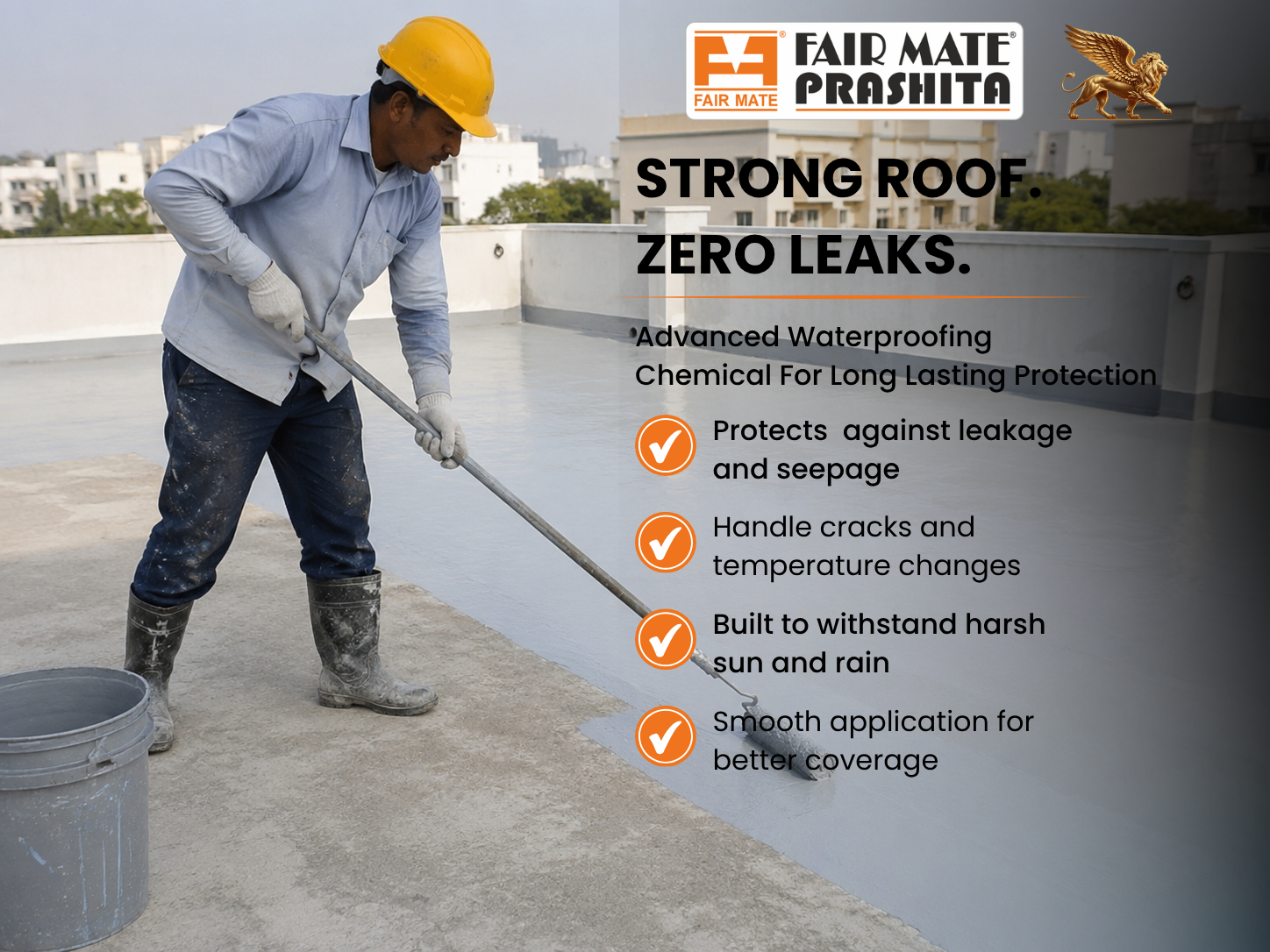
Waterproofing Chemicals for Roofs: Best Solutions for Long-Lasting Roof Protection

terrace roof waterproofing

A roof is one of the most exposed parts of any building. It faces direct sunlight, rainfall, temperature changes, wind, pollution and continuous surface movement. Over time, these conditions can create cracks, damp patches, leakage, seepage and deterioration in concrete roof slabs. That is why choosing the right waterproofing chemicals for roofs is essential for every residential, commercial and industrial structure.

Whether it is a new building, an old terrace, a commercial roof slab or an industrial facility, roof waterproofing should never be treated as a temporary repair. It is a protective system that helps stop water ingress, reduce maintenance costs and increase the service life of the structure.

At Fairmate Prashita, we offer advanced construction chemical solutions for waterproofing, concrete repair, flooring, grouting, protective coatings and structural durability. Our WATERGUARD waterproofing systems are developed to support engineers, contractors, builders and applicators with reliable roof and terrace waterproofing performance.


What Are Waterproofing Chemicals for Roofs?

Waterproofing chemicals for roofs are specially formulated materials applied on roof slabs, terraces, concrete surfaces and exposed areas to stop water penetration. These chemicals create a protective barrier over the surface or within the concrete pores, depending on the type of waterproofing system used.

A good roof waterproofing chemical should provide:

  • Strong adhesion to concrete and masonry
  • Water resistance against rain and seepage
  • Flexibility to handle thermal movement
  • Crack-bridging performance
  • UV and weather resistance for exposed terraces
  • Long-term durability under Indian climatic conditions
  • Easy application by brush, roller, spray or trowel

Modern roof waterproofing is not just about applying a coating. It is about selecting the right system based on the roof condition, surface type, crack pattern, drainage slope, exposure level and expected performance.


Why Roof Waterproofing Is Important

Roof leakage usually starts slowly. A small crack, weak joint, poor slope or untreated surface may allow water to enter the roof slab. Once water enters the concrete, it can lead to dampness, paint peeling, corrosion of reinforcement, mould growth and structural deterioration.

Proper roof waterproofing helps prevent:

  • Terrace leakage during monsoon
  • Damp patches on ceilings and walls
  • Concrete deterioration due to moisture
  • Corrosion of steel reinforcement
  • Repeated repair expenses
  • Damage to interiors, electrical systems and furniture
  • Reduced building life

For Indian weather conditions, especially during heavy rainfall and high heat exposure, roof waterproofing chemicals must be selected carefully. A roof surface expands and contracts due to temperature variation, so the waterproofing layer should remain flexible and strongly bonded.


Common Causes of Roof Leakage

Before selecting the best waterproofing chemical for a roof, it is important to understand why leakage happens. Most roof leakage problems are caused by one or more of the following issues:

1. Hairline Cracks in Concrete

Concrete naturally develops micro-cracks due to shrinkage, thermal movement or poor curing. These cracks allow water to slowly penetrate the slab.

2. Poor Surface Slope

If water remains stagnant on the terrace, it increases pressure on the surface and may enter through weak points.

3. Weak Parapet Wall Joints

The junction between the roof slab and parapet wall is one of the most common leakage points.

4. Damaged Old Waterproofing Layer

Old coatings may lose adhesion, crack or peel due to UV exposure and weathering.

5. Improper Application

Even the best roof waterproofing chemical may fail if the surface is not cleaned, cracks are not repaired or coats are not applied properly.

6. Pipe Penetrations and Drainage Outlets

Areas around pipes, rainwater outlets and joints require proper detailing. Without correct sealing, these points become leakage paths.


How to Choose the Best Waterproofing Chemical for Roofs

The best waterproofing chemical for roof protection depends on the surface condition and site requirement. There is no single product that fits every roof. Before selecting a waterproofing system, check the following points:

1. Type of Roof Surface

Concrete roof slabs, tiled terraces, metal roofs and old coated surfaces may need different preparation and product selection.

2. New Roof or Old Roof

New construction may need preventive waterproofing, while old roofs may require crack repair, surface restoration and re-waterproofing.

3. Exposure to Sunlight

For exposed terraces, UV-resistant acrylic or elastomeric coatings are preferred.

4. Water Ponding

If water remains stagnant, slope correction and proper drainage should be done before waterproofing.

5. Crack Condition

Hairline cracks, active cracks and structural cracks need different treatment methods.

6. Foot Traffic

If the roof will be used frequently, the waterproofing layer may require additional protection.

7. Application Method

Some products are brush-applied, some are roller-applied and some may require professional applicators.

For best results, a technical site inspection is recommended before final product selection.


Step-by-Step Roof Waterproofing Application Process

A good waterproofing chemical can perform properly only when applied correctly. Follow this general roof waterproofing process:

Step 1: Surface Inspection

Check the roof for cracks, hollow areas, old coating failure, water ponding, weak plaster and drainage issues.

Step 2: Surface Cleaning

Remove dust, oil, loose particles, old paint, laitance, algae and weak material from the roof surface.

Step 3: Crack Repair

Repair all visible cracks, joints, pipe penetrations and parapet junctions before waterproofing.

Step 4: Slope and Drainage Correction

Water should flow properly toward drain outlets. Waterproofing should not be used as a replacement for poor slope correction.

Step 5: Surface Dampening or Priming

Depending on the waterproofing chemical, the surface may need dampening or primer application.

Step 6: First Coat Application

Apply the first coat uniformly using brush, roller or trowel as per product guidelines.

Step 7: Second Coat Application

Apply the second coat after the first coat dries. In many systems, the second coat is applied perpendicular to the first coat for better coverage.

Step 8: Detailing at Critical Areas

Give special attention to corners, drain outlets, pipe penetrations and parapet joints.

Step 9: Curing and Protection

Allow proper drying and curing time. Avoid foot traffic or water exposure before the system is ready.

Step 10: Final Inspection

Check the full roof surface for missed areas, pinholes, cracks or weak patches.


Why Choose Fairmate Prashita for Roof Waterproofing Chemicals?

Fairmate Prashita provides advanced construction chemical solutions for waterproofing, concrete repair, grouting, flooring, protective coatings and admixtures. For roof and terrace waterproofing, our WATERGUARD range is designed to support practical site requirements with durable, easy-to-apply and performance-focused systems.

For roof and terrace waterproofing, Fairmate Prashita offers a wide range of WATERGUARD Waterproofing Systems, including WATERGUARD ROOFCOAT for acrylic roof coating, WATERGUARD LIQUID MEMBRANE for flexible liquid-applied membrane waterproofing, WATERGUARD PU LIQUID MEMBRANE for polyurethane-based waterproofing, WATERGUARD A for cementitious waterproofing coating, and WATERGUARD CRYSTALLINE for crystalline waterproofing requirements. For concrete and plaster waterproofing during construction, FAIRCRETE RMW can also be considered as an integral waterproofing additive. 

Fairmate Prashita waterproofing advantages:

  • Wide range of WATERGUARD waterproofing systems
  • Solutions for roof slabs, terraces, tanks, basements and wet areas
  • Technical support for product selection
  • Suitable systems for new construction and repair projects
  • Strong focus on durability, adhesion and water resistance
  • Support for contractors, applicators, builders and engineers
  • Trusted construction chemical expertise for Indian site conditions

Whether the issue is roof leakage, terrace seepage, dampness, cracks or preventive waterproofing, Fairmate Prashita can help you choose the right waterproofing chemical for your project.

Conclusion

Waterproofing chemicals for roofs are essential for protecting buildings from leakage, seepage, dampness and long-term structural damage. A roof is constantly exposed to rain, heat, UV rays and surface movement, so selecting the right waterproofing system is a critical decision.

For concrete roof slabs and terraces, solutions such as cementitious waterproofing coatings, acrylic waterproofing coatings, liquid waterproofing membranes and polyurethane waterproofing systems can provide strong and durable protection when applied correctly.

If you are looking for reliable roof waterproofing chemicals, terrace waterproofing chemicals or a professional roof leakage solution, Fairmate Prashita’s WATERGUARD range offers practical and performance-driven options for different site requirements.

Protect your roof before leakage becomes a costly repair.
For product guidance, technical support or waterproofing solution selection, contact Fairmate Prashita today.

Call: 1800 571 8862
Website: www.fairmateprashita.com


FAQs

1. Which is the best waterproofing chemical for roofs?

The best waterproofing chemical for roofs depends on the roof type, crack condition, exposure and leakage severity. Cementitious coatings, acrylic waterproofing coatings, liquid membranes and polyurethane coatings are commonly used for roof waterproofing.

2. Which waterproofing chemical is best for terrace leakage?

For terrace leakage, flexible waterproofing coatings such as acrylic coatings, cementitious waterproofing systems or liquid waterproofing membranes are commonly recommended. The final choice should be made after checking cracks, slope, drainage and surface condition.

3. Can waterproofing chemicals stop roof leakage permanently?

Waterproofing chemicals can provide long-term leakage protection when the correct system is selected and applied properly. Surface preparation, crack repair, slope correction and proper coating thickness are important for durable performance.

4. How many coats are required for roof waterproofing?

Most roof waterproofing systems require two or more uniform coats. Some cementitious and acrylic systems may require 2–3 coats depending on site condition and product guidelines.

5. Can waterproofing be done during monsoon?

Waterproofing should ideally be done before monsoon. Application during active rain or on unsuitable wet surfaces can affect bonding and performance. Emergency leakage treatment may be possible in some cases, but full waterproofing should be planned in dry weather.

6. Is roof waterproofing different from terrace waterproofing?

Roof waterproofing and terrace waterproofing are closely related. A terrace is usually an accessible roof surface, so it may need additional attention to foot traffic, slope, cracks, parapet joints and drainage outlets.

7. Why does roof waterproofing fail?

Roof waterproofing may fail due to poor surface preparation, wrong product selection, inadequate crack repair, low coating thickness, poor drainage, trapped moisture or incorrect application method.

GET IN TOUCH

Schedule a Call

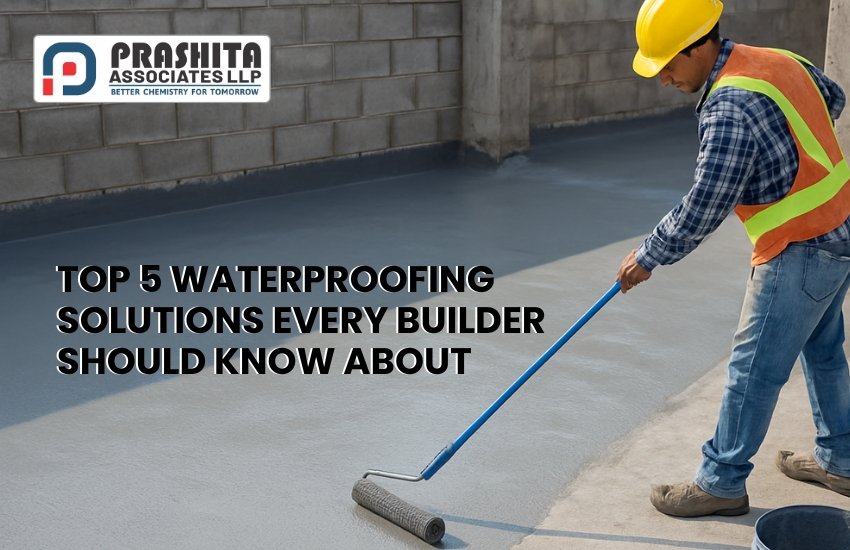
A construction worker in a yellow hard hat and reflective vest is applying a grey waterproofing coating on a concrete floor using a long-handled roller. The Prashita Associates LLP logo appears in the top-left corner, along with the text: “Top 5 Waterproofing Solutions Every Builder Should Know About.

Top 5 Waterproofing Solutions Every Builder Should Know About

Water is one of the most damaging elements a building can face. Whether it’s rising moisture, rainfall, or hydrostatic pressure, water ingress compromises durability, aesthetics, and structural integrity.

That’s why waterproofing systems have become indispensable in modern construction. At Fairmate Prashita LLP, we offer a curated range of waterproofing solutions — engineered using field-tested formulations to meet the demands of real-world conditions.

In this article, we explore five key waterproofing systems every builder, engineer, or contractor should be familiar with.

1. Crystalline Waterproofing – Internal Protection That Grows

Crystalline technology works from within the concrete itself. Once applied, the material reacts with water and cement to form insoluble crystals, sealing micro-cracks and pores internally.

✅ Ideal for:

  • Water tanks
  • Basements
  • Foundations
  • Dams and tunnels

🌟 Key Benefits:

  • Self-healing properties
  • Penetrates deep into concrete matrix
  • Becomes part of the structure
  • Long-lasting and maintenance-free

Our crystalline solutions, based on advanced formulations, are known for their deep-sealing performance and longevity in high-pressure environments.

2. Flexible Cementitious Coatings – Versatile and Durable

Cementitious waterproof coatings, modified with polymers, are a go-to choice for many residential and commercial projects. These are typically applied by brush or trowel and form a strong yet flexible barrier against water.

✅ Ideal for:

  • Bathrooms and wet areas
  • External walls
  • Roof slabs
  • Podiums and balconies

🌟 Key Benefits:

  • Simple application
  • Crack-bridging flexibility
  • Excellent adhesion to concrete
  • Breathable, yet waterproof

Our two-part polymer-modified systems ensure easy site application with robust waterproofing protection.

3. Acrylic-Based Liquid Waterproofing – Seamless Membranes

Acrylic waterproofing coatings are single-component systems designed to create seamless, elastomeric films over surfaces. These coatings are highly UV-resistant and ideal for exposed surfaces.

✅ Ideal for:

  • Terraces and podiums
  • Roof gardens
  • Pre-cast concrete panels
  • Retrofitting projects

🌟 Key Benefits:

  • UV and weather resistance
  • Excellent crack resistance
  • High elasticity
  • Easy to apply with brush or roller

Our acrylic-based coatings provide up to 10°C surface temperature reduction in exposed areas while keeping structures dry.

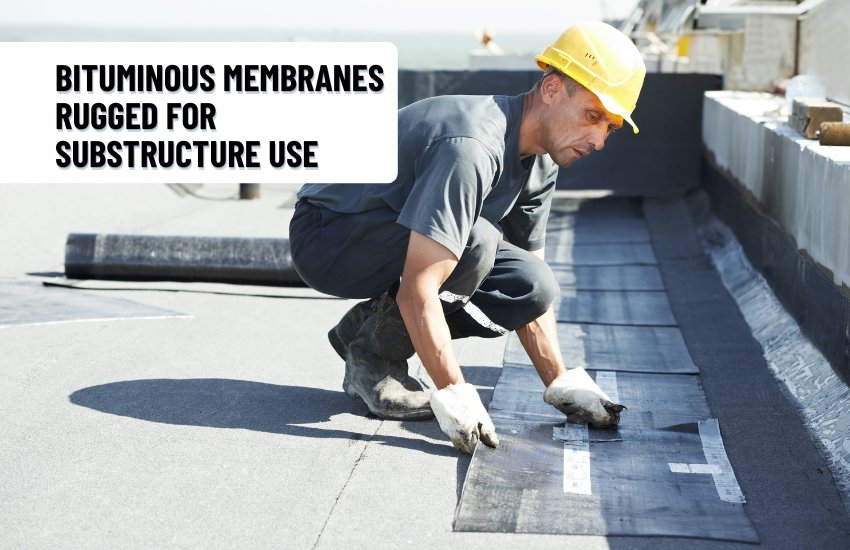
Prashita Associates A construction worker in a yellow hard hat installs a bituminous waterproofing membrane on a flat rooftop. He is kneeling on the surface, aligning the black membrane strips carefully, with rolled material in the background. A white text box reads, “Bituminous Membranes – Rugged for Substructure Use.

4. Bituminous Membranes – Rugged for Substructure Use

For critical waterproofing below ground level, bituminous torch-on membranes offer heavy-duty performance. These are APP (Atactic Polypropylene) modified membranes with high resistance to mechanical damage and water pressure.

✅ Ideal for:

  • Basements
  • Foundations
  • Retaining walls
  • Bridge decks

🌟 Key Benefits:

  • Durable and puncture-resistant
  • Long service life
  • Strong adhesion to substrates
  • Effective against groundwater pressure

Our membrane systems are supplied in standard roll formats and are supported with expert application training where needed.

5. Injection Grouts – Stopping Water at Its Source

When unexpected leakage occurs through cracks, joints, or porous substrates, injection grouts can stop the problem at the root. These are either cementitious, epoxy, or polyurethane-based and are injected under pressure.

✅ Ideal for:

  • Basement cracks
  • Cold joints
  • Precast element joints
  • Underwater sealing

🌟 Key Benefits:

  • Quick response system
  • Can stop active leaks
  • Expands to seal gaps
  • High bonding with concrete and masonry

We offer low-viscosity, high-penetration grouts for emergency sealing and long-term durability.

Why Waterproofing Matters More Than Ever

With increased monsoonal patterns, high-rise expansion, and stringent durability norms, waterproofing is no longer a luxury — it’s a necessity.

Failures in waterproofing lead to:

  • Structural deterioration
  • Paint peeling and dampness
  • Increased maintenance costs
  • Reduced building lifespan

At Fairmate Prashita LLP, our waterproofing range is backed by globally recognized chemical formulations — proven across countless infrastructure projects and customized for Indian conditions.

Final Thoughts

Choosing the right waterproofing system depends on:

  • Project type (residential, commercial, infrastructure)
  • Location (above/below ground, exposed/covered)
  • Substrate type (concrete, plaster, masonry)
  • Budget and performance needs

We’re here to help you select the most effective solution for your site requirements.

👷 Need Expert Guidance?

Prashita Associates LLP offers:

  • Waterproofing audits
  • On-site technical support
  • Application training
  • Custom product recommendations

📞 Contact our team today to explore waterproofing systems that build stronger, leak-free structures from the foundation up.

📩 Email: support@fairmateprashita.com
🌐 Website:www.fairmateprashita.com

WATERGUARD COOL COOL

SINGLE COMPONENT, ACRYLIC BASED FLEXIBLE, INSULATING CUM WATERPROOFING COATING

WATERGUARD COOL COOL is a single component, flexible, ultra violet rays, weather-resistant, and acrylic-based waterproofing coating. WATERGUARD COOL COOL provides extremely long-lasting protective coating that creates a thermal barrier that stands against severe temperatures and changes and provides long-lasting protection against wind and rain. It protects concrete against attack from atmospheric carbon dioxide, airborne chlorides, acid, rain, weathering, etc. WATERGUARD COOL COOL is ready to use, ensuring waterproofing. It also provides extremely tough decorative waterproof coating, which allows breathing on the surface.

SALIENT FEATURES
• Can be applied on vertical & horizontal surfaces
• Colours are stable
• Gives insulation properties
• Flexible, Cost effective and easy to apply
• Excellent water tightness
• Durable – high UV resistance
• Non-conductive property saves air conditioning energy cost
• Excellent adhesion to most building substrates

APPLICATION PROCEDURE
All dust, loose and friable materials, and glaze or varnish on tiles must be completely removed by mechanical means.The prepared surface should be thoroughly wetted with water for absorption, and excess water should be removed. Waterguard Cool Cool should be applied in 2/3 uniform coats after mixing the pre-weighted quantities as per technical specifications. The second coat can be applied perpendicular to the first coat after the first coat is dry. There can be overlapping of layers. It is recommended to wait for 6–8 hours before applying the second coat. Sprinkle fine aggregates immediately after the second coat of application.

WATERGUARD COOL COOL is designed for use as a thermal insulation coating and waterproofing on roof slabs and walls (new or old) of buildings.
It can also be used on the interior walls, exterior walls, and the roof of freezer rooms and cold storage facilities.

PACKING & COVERAGE
WATERGUARD COOL COOL is supplied in 1, 5, 20 kgs.
It has coverage of 4-5 m²/kg/two coats (200 microns WFT).
Coverage of WATERGUARD COOL COOL depends on the surface.

WATERGUARD A

TWO COMPONENT, ACRYLIC CEMENTITIOUS WATERPROOFING COATING

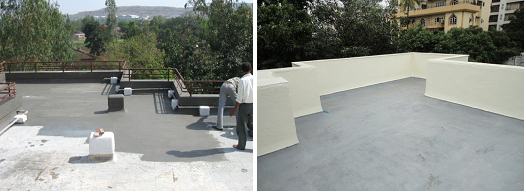
Many people are facing leakage and damp problems on their home terraces during the monsoon season. To come out of this problem we request you to use our WATERGUARD A.

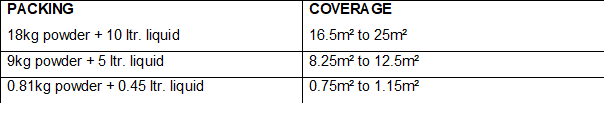
WATERGUARD A is a prepacked two-component acrylic modified cementitious waterproofing coating. One part is liquid in white color and another is powder in grey color. After mixing both components at the site it produces a mix that is easy to use. It should be applied in 2-3 uniform coats
SALIENT FEATURES
• Prepacked easy to use water proofing coating
• Non-toxic & environmental friendly
• Excellent adhesion
• Minimum surface preparation needed
• Allows surface to breath
• Approved for potable water contact
• Economical system
APPLICATION PROCEDURE
1. Surface preparation
• Make sure all the leakage and water jet points are sealed.
• Clean the surface with wire brush and remove all loose particles.
• If any cracks are visible, repair them.
2. Mixing
• Pour the liquid polymer in the container or electrical mixer.
• Slowly add powder in it and mix continuously until the required consistency is obtained.
3. Application
• Sprinkle water on the prepared surface and allow absorption. Remove excess water from the surface.
• Stir the WATERGUARD A before applying.
• Apply uniform coat of WATERGUARD A with brush, and leave it for drying.
• Apply 2nd or subsequent coat after previous coat is dried.
• Cure the surface for 3-5 days.

WATERGUARD A is used to protect the structure against the ingress of moisture. It is used in water retaining structures like water tank, swimming pools, retaining wall, bridge walls, reservoirs, dams, dock gates etc. it is also used in and around house component like roof, terrace and balconies, basement, Lift shaft etc.

FAIRMATE WATERPLUG

A FAST SETTING PLUGGING COMPOUND FOR STOPPAGE OF RUNNING WATER

FAIRMATE WATERPLUG is a blend of cement well-graded sands and special additives in dry powder form. It requires only the addition of clean water to produce a ready-to-use, ultra-rapid setting and plugging mortar. FAIRMATE WATERPLUG is based on a mixture of cement, aggregates, and special fillers which minimises the risk of thermal cracking.

SALIENT FEATURES
• Stops running water instantly
• Sets under water
• Non shrink, non-metallic
• High structural strength
• Easy to use- simply add water
• Low exothermal minimises thermal cracking.

APPLICATION PROCEDURE

SURFACE TREATMENT
• Chisel out masonry around the hole or crack to a depth and width not less than 25 mm. Ensure that the hole is wider within the wall than at the surface. (Inverted ‘V’ Groove).
• If the water pressure is high at the area to be patched, make weep holes at the base of the wall to relieve the pressure.
• All loose material & debris should be removed.

METHOD OF USAGE

• FAIRMATE WATERPLUG should be mixed with a trowel in small quantities 1:4 by volume or 1:5 by weight (water to FAIRMATE WATERPLUG).
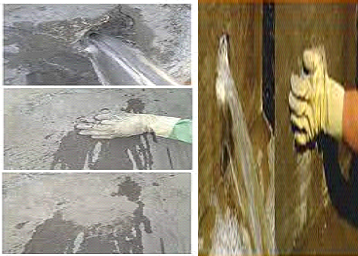
• Hold the mixed FAIRMATE WATERPLUG in the gloved hand until heat generation is felt and force the material in to the crack or void and hold tightly with palm of the hand for 3 minutes until FAIRMATE WATERPLUG sets.

FAIRMATE WATERPLUG is used as plugging mortar for fixing nozzles or grouting operations. It is also uses for arresting instant water seepages through dams, water tanks, basements, sunken pits, floor junctions.

PACKING & COVERAGE
FAIRMATE WATERPLUG is supplied in 1 kg, 5 Kg, 25 kg Bag.

WATERGUARD LIQUID MEMBRANE

POLYMER MODIFIED BITUMEN BASED FIBER REINFORCED FLEXIBLE, LIQUID APPLIED WATERPROOFING MEMBRANE

WATERGUARD LIQUID MEMBRANE is polymer-modified water based on bitumen, liquid applied, fiber reinforced flexible, damp-proof, and vapor-proof liquid membrane. WATERGUARD LIQUID MEMBRANE is highly resistant to aggressive soils and soluble salts providing an effective continuous barrier and protection against water Bourne damage. If a water flood test is to be run, the membrane should cure for a minimum of 7 days. Whilst WATERGUARD LIQUID MEMBRANE is resistant to frost, adhesion will be impaired if applied to frosted substrates.

SALIENT FEATURES
• free from solvents
• Very low permeability
• High elasticity, ensuring a permanently flexible barrier over a wide range of temperatures
• Thermally stable – irreversible chemical cure eliminates melting and flow at high temperature
• Can be applied to a range of substrates
• Outstanding resistance to oxidation and brittlement
• Fibers improve tensile strength and abrasion resistance

APPLICATION PROCEDURE
Surface preparation: All substrates must be sound, clean, dry, smooth and free from protrusions, voids, honey-combs and high spots. Presence of curing agents, paint and oil will impair adhesion.
Moss and lichen must be removed and area treated with proprietary fungicidal wash to kill spores and inhibit further growth. Following treatment wash area thoroughly with clean water and allow drying. Fillets must be provided at corners or sharp angles using 4:1 sand and cement mortar modified with a good quality bonding agent – FAIRCRETE SB (L).

Priming: Priming is not normally required on good quality, well prepared substrates.

Cracks: All shrinkage and non-structural cracks must be treated with not less than 1.5mm coating of WATERGUARD LIQUID MEMBRANE extending 75mm either side of the crack. Allow to cure overnight prior to general application.

Application: WATERGUARD LIQUID MEMBRANE should be applied by brush to obtain a continuous unbroken film. Two coats are required with the second coat applied at right angles after the first coat has dried. WATERGUARD LIQUID MEMBRANE must be protected from mechanical damage during subsequent construction or backfilling works. Any damage may be repaired by spot application. Application should be avoided if substrate temperatures are below 5ºC or rain is imminent.

Curing: Allow each coat to dry a minimum of 24 hours before re-coating. full cure may take after 7 days of application or more depending on temperature conditions. Cold temperatures will slow cure time, higher temperature may speed up cure time.

WATERGUARD LIQUID MEMBRANE is particularly suitable for a wide range of applications including wet areas, foundations, basements, terraces, retaining walls, bridge abutments, planters, inverted roofs and remedial repairs to felt, asphalt, concrete, fibreous cement or other roof structures when protected from exposure to direct sunlight.

PACKING & COVERAGE
WATERGUARD LIQUID MEMBRANE is supplied in 20 kg pails. It has a coverage of 1.5 – 2 m² per kg at 1mm WFT.
Coverage rate will vary with substrate condition and profile.

FAIRCOAT DAMPPROOF – DAMPPROOF COATING FOR INTERNAL WALLS, CEILINGS AND RCC WATER TANKS

Why do we need water proofing? There is a simple answer to this.
Water proofing is required to stop the ingress of water in the structure making it water resistant. It acts as a protective coating from other elements as well such as oil and grease, chemical attacks, acid rain etc. The dual purpose of Faircoat Damproof allows us to achieve both our purposes of waterproofing and protective coating.

Faircoat Dampproof is best suited when used to protect the internal wall, ceilings etc from all possible attacks of dampness, leakage to the structure & also when you need an antimicrobial coating. It is widely used to prevent any leakage of oil and chemicals from bund areas where large quantity of such harmful substance is stored. We all have come across external walls where graffiti art is done which is extremely difficult to remove. Faircoat Damproof is the absolute solution, as it is easily cleanable and hygienic. Hence, maintaining the clean look of the structure.
Being environmental friendly and of very low odour is it easy to apply.

Faircoat Dampproof is a 2 component material off white colour material. The Base and hardener is required to be mixed using a mechanical tool. The component can be thinned down by adding water to it, not more than 20-30% by volume of total material. To make the surface more even and to achieve a putty like finish add white cement by 20-30%.

Before applying Faircoat Dampproof to the structure it is necessary to make sure that the substrate is completely free from any kind of contamination such as oil, grease, paint etc. After the surface cleaning is complete, it is required to fill all the hole on the substrate cause by air trapped on the face of the formwork during pouring or any kind of pin holes present using Fairscreed VF (a concrete repair compound).

Minimum two coats are required to achieve the desired results. The pot life of Faircoat Dampproof is 80 minutes at 20ºC. Apply the first coat using a spray (airless), brush or roller. After the application of first coat to achieve a non slip finish spread silica sand on the wet surface and let the surface dry for a minimum of 18 hours before applying 2nd coat. The overall thickness of both the coats shall be 200-250 micron, with and approximate coverage of 0.20 – 0.25kg/m2.
In case the substrate is in damp condition a priming material such as Safecore WB primer shall be applied before the application of 1st coat of Faircoat Dampproof.

Salient Features:
• Provides excellent resistance to water, oil , grease and other solvents etc
• Odourless material
• It is Non flammable, Non toxic and Non- Hazardous
• It is easily cleanable and possesses anti fungal properties
• It can be applied on both dry and damp surfaces
• Have good adhesion to concrete

Polyurethane Coating for Protecting Multistory Buildings

Waterproofing is a fundamental construction requirement. Modern buildings are waterproof, using membranes and coatings to protect the integrity of the structure. However, every year a large number of households and commercial premises report damage and problems that may be associated with inadequate waterproofing of buildings. If you do not stop the penetration of water on time, it will cause serious damage to the building. The service life of a structure depends on its stability, and this is what affects the ingress of water. Therefore, the waterproofing of the building is very important, and in recent times more attention has been paid to it.
Polyurethane is a rather popular choice for waterproof coatings due to its ease of installation. Unlike other waterproofing systems, polyurethane application requires comparatively less skill and supervision. FAIRMATE offers innovative technologies for waterproofing all types of structures. One such product is WATERGUARD PU MEMBRANE.

Properties of WATERGUARD PU MEMBRANE
It is a polyurethane based liquid applied single component elastomeric waterproofing membrane. It cures by reaction with atmospheric moisture to form a tough, elastomeric, waterproof membrane. The product is designed for use on horizontal and vertical surfaces, covered by a protective screed or render.
WATERGUARD PU MEMBRANE is used to provide continuous, seamless, water and vapour proof membrane for concrete. Typical applications will include roofs, podiums, balconies, floor slabs, suspended floors, patios, bathrooms, inspection pits, swimming pools and bridge decks. Properties include the following:
• Excellent crack bridging properties up to 2mm
• Resists deterioration from dilute acids and alkali, oil, salts, bacteria, and common fuels.
• Gives long term resistance to ponded water
• Membrane can stretch with movement in the substrate due to high elongation
• Single component, Easy to applied by roller, brush, or airless spray

Application Areas
Foundations & Basement: WATERGUARD PU MEMBRANE can be applied as waterproofing barrier in basement & foundation, which will enable it to resist attack by penetration of surrounding moisture.
Kitchens & bathrooms: WATERGUARD PU MEMBRANE can be applied as waterproofing coating in Kitchens & wet areas like bathrooms, which will enable it to resist attack by ingress of water.
Car Park decks & terraces: As it gives long term resistance to ponded water, it can be applied as waterproofing barrier in car Park decks & terraces which are directly exposed to weather.

For more details visit: www.fairmate.com or email: enquiry@fairmate.com

WATERGUARD MAGIC- BIOCHEMICALLY MODIFIED WATERPROOFING COATING

Concrete has potential to be one of the longest lasting materials in history – the Egyptian pyramids in Ancient Egypt were even constructed from a primitive form of concrete, and they’re still standing strong. Why shouldn’t your home, or any other concrete structure you own, exhibit the same longevity? The number one arch enemy of concrete is water. Not only can water create harmful health risks with the growth of mold and mildew and create numerous problems for homeowner’s foundations but it can also be a carrier for salts and chlorides that can damage reinforcing steel in concrete leading to spalling and cracking.
Waterproofing is basically a process designed to prevent water from penetrating into a structure. Typically waterproofing is done in various layers and stages to create multiple barriers so that water cannot penetrate into the structure. A structure is waterproofed by the use of membranes and coatings to protect contents underneath or within as well as protecting structural integrity. Thus, protection from weather, seepages from ground and vertical travel of water in a structure can be well protected by the correct application of waterproofing system.

Factors Affecting a Building

Every building can be referred to as a living thing as it also addresses the problems of deterioration if proper care is not taken and maintenance is not involved. In this way, some natural factors like air, water, climate, wind and humidity govern the life of building, apart from the occupancy load. Water (through humidity and rains) is the prime source of degrading or harming a structure, right from its foundation to its plaster if the structure is not well protected from it. Water through its capillary action enters and hampers the strength of concrete, thereby making it susceptible to corrosion. This is observed in building through the development of cracks on plaster, rot formation on walls and presence of moisture on ceiling.
This leads to expensive structural repair works, damage or loss of interior finishes and goods, operational downtime, or serious impact on the internal environment from damp and condensation.

The selection of the appropriate waterproofing method, the project specific design of the chosen waterproofing system and its correct installation on site are key elements in minimizing the Total Cost of Ownership. A waterproofing system typically amounts to less than 1% of the total core constructions cost, yet the selection of a high quality waterproofing solution can easily save this amount or more, in future maintenance and repair costs over the service life of the structure.
Conventional waterproofing is either a liquid applied waterproofing coating or a preformed elastomeric membrane where they can temporarily help to reduce water and within a period of time those coatings or membranes are delaminated. Since they are unable to penetrate but instead coat the surface it is more like putting a band-aid on the problem instead of sealing from within.

FAIRMATE provides full range of technologies and solutions for waterproofing of structures. Fairmate has brought one revolutionary product WATERGUARD MAGIC which is a biochemically modified chemical solution that provides long-term waterproofing and durability benefits to concrete. It penetrates into concrete and reacts with free calcium and water to form a calcium silicate gel complex in cracks, pores and capillaries. This gel creates a sub-surface barrier against the ingress of water and contaminants such as chloride ions. WATERGUARD MAGIC will seal existing leaking cracks to 2.00mm. In the matrix the product remains reactive when in contact with water to provide autogenous healing properties to future hairline cracks.

Advantages of WATERGUARD MAGIC are as follows
• Permanently seals cracks up to 2.00mm.
• Reseals future hairline cracking.
• Reduction of chloride diffusion coefficient (ASTM C 1202) by 89% to 3.5
(10-12 m2/s).
• Water permeability (DIN1048) reduced by 70% to 5.0 (10-12 m/s) at 10kg/cm².
• Increases surface hardness from 6 to 8 on Moh’s scale.
• Reduces scaling in freeze-thaw environments by 89% at 50 cycles.
• Allows 84.1% moisture vapor permeability.
• Non Toxic – Certified suitability for potable water.
• It is giving 100 years warranty with no further maintenance cost.

WATERGUARD MAGIC can be used to the following areas
• Rooftops & Podium Decks
• Car-parks
• Road & Rail Bridge Decks
• Wharf Decks & Marine Structures
• Airport Runways, Taxiways, Aprons
• Water Retaining Structures

SPECIALTY APPLICATION
• Tiled areas (not terracotta or glass-glazed)
• Tiled shower recesses
• Facades
• Pre-cast elements & panels
• Cement Tiles
• Terrace
• Water tank

FAIRMATE’s experience is combined with more than 40 years of experience from all around the world, in providing successful waterproofing solutions for various civil engineering structures. FAIRMATE’s waterproofing experts are able to support our customers from initially determining the best waterproofing solutions through detailed designing of structure, to on-site support for successful installation and completion of waterproofing. This also includes the repair and rehabilitation for waterproofing of existing structures.