
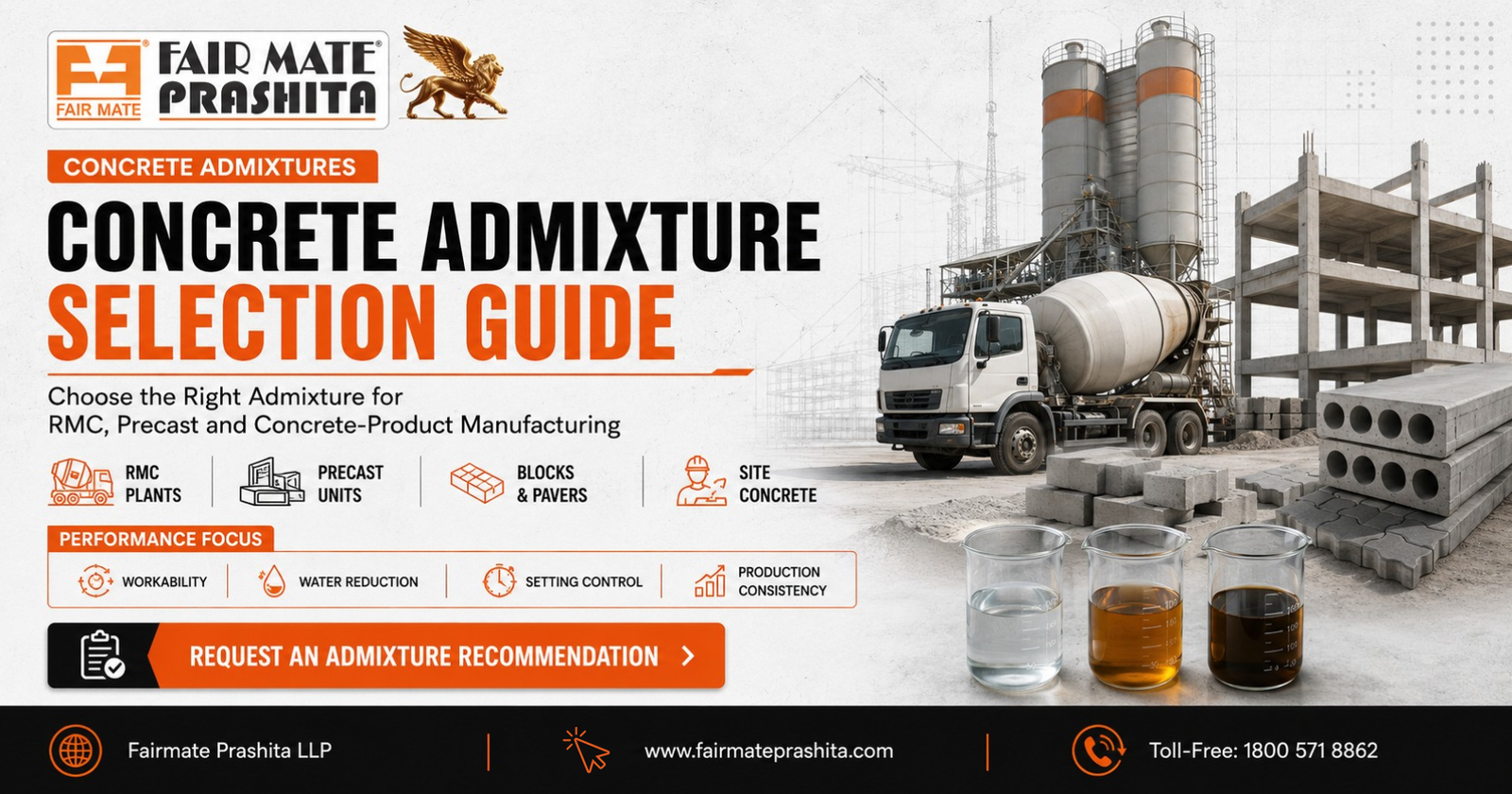
Concrete Admixture Types: Uses, Benefits & Selection Guide for Better Concrete Performance

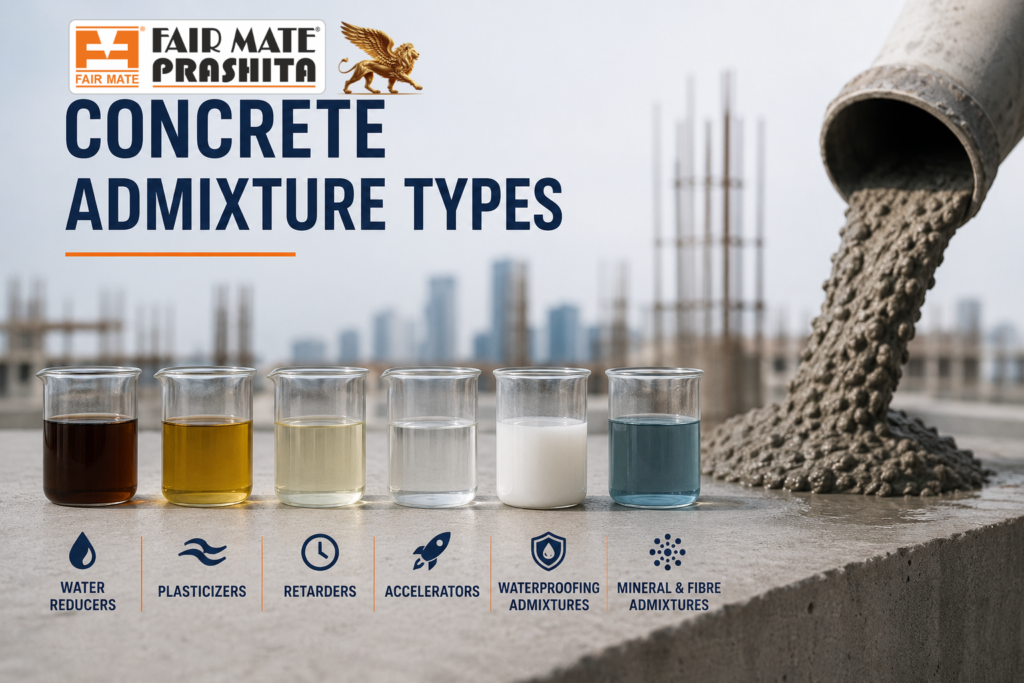
Concrete admixture types infographic showing water reducers, plasticizers, retarders, accelerators, waterproofing admixtures and mineral fibre admixtures for modern concrete construction by Fairmate Prashita.

Concrete is one of the most widely used construction materials in the world. But modern concrete is no longer just a mixture of cement, sand, aggregate, and water. Today, engineers, contractors, builders, RMC plants, and infrastructure companies use advanced concrete admixtures to improve workability, strength, durability, setting time, pumpability, and long-term performance.

Understanding different concrete admixture types is important because every project has different site conditions. Some projects need high workability, some need early strength, some need delayed setting time, and some need reduced permeability. The right admixture helps concrete perform better without unnecessarily increasing cement or water content.

At Fairmate Prashita, we provide advanced construction chemical solutions for concrete admixtures, waterproofing systems, grouts, repair mortars, flooring, protective coatings, and other site-performance requirements. Our concrete admixture solutions are designed to support modern construction with better workability, durability, and technical reliability.


What Are Concrete Admixtures?

Concrete admixtures are special materials added to concrete during mixing to improve its fresh or hardened properties. They are used in small quantities but can create a major improvement in concrete performance.

Concrete admixtures help control:

  • Workability
  • Setting time
  • Water demand
  • Slump retention
  • Pumpability
  • Strength development
  • Durability
  • Permeability
  • Segregation and bleeding
  • Surface finish

In simple words, admixtures help concrete become easier to place, stronger, more durable, and more suitable for specific site conditions.


Why Concrete Admixtures Are Important in Modern Construction

In earlier construction practices, workers often added extra water to concrete when the mix became stiff. This made placement easier, but it reduced strength, increased porosity, and affected long-term durability.

Modern construction cannot depend on such methods. High-rise buildings, bridges, roads, tunnels, industrial floors, precast elements, and RMC projects require controlled concrete performance. This is where concrete admixtures become essential.

The right admixture can help achieve:

  • Better workability without excess water
  • Higher compressive strength
  • Improved concrete density
  • Reduced water-cement ratio
  • Better pumpability for high-rise construction
  • Reduced honeycombing
  • Controlled setting time
  • Better finishing
  • Improved durability in aggressive environments
  • Lower maintenance and repair costs

Concrete admixtures are especially useful for RMC plants, infrastructure projects, industrial construction, precast concrete, mass concrete, and high-performance concrete.


Major Concrete Admixture Types

There are different types of concrete admixtures based on their function. Below are the most commonly used concrete admixture types in construction.


1. Water Reducing Admixtures

Water reducing admixtures are used to reduce the amount of water required in a concrete mix while maintaining the required workability. These admixtures improve the flow of concrete without increasing the water-cement ratio.

Uses

Water reducing admixtures are commonly used in:

  • RCC structures
  • Residential buildings
  • Commercial buildings
  • RMC concrete
  • Pumpable concrete
  • Precast concrete
  • Slabs, beams, columns, and foundations

Benefits

  • Reduces water demand
  • Improves workability
  • Enhances strength
  • Reduces porosity
  • Improves surface finish
  • Helps achieve better compaction
  • Reduces shrinkage and bleeding

Water reducing admixtures are suitable when the project requires improved concrete quality without adding extra water.


2. Plasticizers

Plasticizers are one of the most commonly used concrete admixture types. They improve the workability of concrete and make the mix easier to place and compact.

Plasticizers are useful for normal concrete where moderate improvement in workability is required. They are commonly used for M20, M25, and general RCC concrete applications.

Uses

  • General RCC work
  • Slabs and beams
  • Footings and columns
  • Site-mixed concrete
  • Low to medium grade concrete
  • Better compaction in reinforcement areas

Benefits

  • Improves flow of concrete
  • Reduces water requirement
  • Improves compaction
  • Reduces honeycombing
  • Enhances surface finish
  • Improves concrete quality

Plasticizers are a practical and economical solution for improving everyday concrete performance.


3. Superplasticizers

Superplasticizers are high-range water reducing admixtures used when concrete needs very high workability and strength. They are commonly used in high-performance concrete, RMC, precast concrete, self-compacting concrete, and heavily reinforced structures.

Superplasticizers allow concrete to flow easily without adding excess water. This helps maintain strength and durability while improving placement.

Uses

  • High-rise buildings
  • RMC plants
  • Precast concrete
  • Bridges and flyovers
  • Self-compacting concrete
  • Pumpable concrete
  • High-strength concrete
  • Congested reinforcement areas

Benefits

  • Provides high workability
  • Reduces water-cement ratio
  • Improves early and final strength
  • Enhances pumpability
  • Reduces segregation
  • Improves surface finish
  • Supports high-performance concrete

Superplasticizers are ideal where concrete must remain workable, strong, and durable under demanding site conditions.


4. Retarding Admixtures

Retarding admixtures are used to slow down the setting time of concrete. These admixtures are especially useful in hot weather, long-distance transportation, large pours, and RMC applications.

In hot weather, concrete can set too quickly, making placement and finishing difficult. Retarders help keep concrete workable for a longer time.

Uses

  • Hot weather concreting
  • RMC transportation
  • Mass concrete pours
  • Raft foundations
  • Dams and large structures
  • Long-distance concrete delivery
  • Large industrial slabs

Benefits

  • Delays setting time
  • Extends workability
  • Reduces cold joints
  • Improves placement time
  • Supports mass concreting
  • Helps in hot climatic conditions

Retarding admixtures are useful when concrete requires controlled setting and extended working time.


5. Accelerating Admixtures

Accelerating admixtures are used to speed up the setting and early strength development of concrete. These admixtures are useful when faster construction progress is required.

They are commonly used in repair works, precast production, cold weather concreting, and projects where early formwork removal is needed.

Uses

  • Fast-track construction
  • Precast concrete
  • Road repair
  • Concrete repair work
  • Cold weather concreting
  • Early strength requirement
  • Emergency repair applications

Benefits

  • Speeds up setting time
  • Improves early strength
  • Reduces construction time
  • Helps early demoulding
  • Supports repair and maintenance work
  • Useful in low temperature conditions

Accelerating admixtures are suitable when quick strength gain and faster project execution are required.


6. Slump Retaining Admixtures

Slump retaining admixtures are used to maintain concrete workability for a longer period. These are very important in RMC and long-distance concrete transportation.

Concrete may lose slump during transit due to time, temperature, cement type, and site delays. Slump retaining admixtures help maintain consistency until placement.

Uses

  • Ready-mix concrete
  • Long-distance concrete transportation
  • High-rise pumping
  • Hot weather concreting
  • Delayed placement sites
  • Infrastructure projects

Benefits

  • Maintains workability
  • Reduces need for water addition
  • Improves pumpability
  • Helps avoid site rejection
  • Reduces slump loss
  • Supports consistent concrete quality

Slump retaining admixtures are highly useful for RMC plants and large construction projects.


7. Air Entraining Admixtures

Air entraining admixtures introduce tiny, controlled air bubbles into concrete. These air bubbles improve resistance against freeze-thaw cycles and enhance durability in certain environmental conditions.

Although air entraining admixtures are more common in cold climates, they may also be used in specific applications where durability and workability improvement are required.

Uses

  • Pavements
  • Roads
  • Exposed concrete
  • Cold-region structures
  • Concrete exposed to freeze-thaw conditions
  • Durable infrastructure applications

Benefits

  • Improves freeze-thaw resistance
  • Enhances workability
  • Reduces bleeding
  • Improves durability
  • Helps protect concrete in harsh environments

Air entraining admixtures should be used carefully because excessive air can reduce concrete strength.


8. Waterproofing Admixtures

Waterproofing admixtures reduce water permeability and help improve concrete resistance against moisture ingress. These admixtures are used in concrete and plaster where water resistance is required throughout the depth of the mix.

Uses

  • Water tanks
  • Basements
  • Roof slabs
  • Bathrooms
  • External plaster
  • Retaining walls
  • Foundations
  • Concrete exposed to moisture

Benefits

  • Reduces permeability
  • Improves water resistance
  • Protects reinforcement
  • Enhances durability
  • Improves cohesion and compaction
  • Helps reduce seepage problems

Fairmate Prashita’s FAIRCRETE RMW is an integral waterproofing additive for concrete and plaster. It improves workability, reduces permeability throughout the depth of concrete, protects rebars, maintains strength, increases durability, and improves plasticity, cohesion, placing, compaction, and finishing.


9. Mineral Admixtures

Mineral admixtures are finely divided materials added to concrete to improve strength, durability, workability, or resistance to aggressive conditions. Common examples include fly ash, silica fume, ground granulated blast furnace slag, and other pozzolanic materials.

Uses

  • High-performance concrete
  • Mass concrete
  • Durable structures
  • Marine structures
  • Industrial floors
  • Infrastructure projects

Benefits

  • Improves long-term strength
  • Enhances durability
  • Reduces heat of hydration
  • Improves workability
  • Reduces permeability
  • Supports sustainable construction

Mineral admixtures are often used where long-term durability and lower heat generation are important.


10. Fibre Admixtures

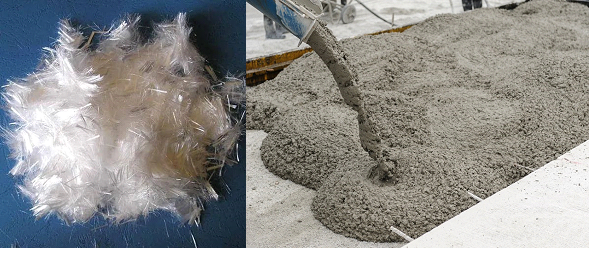
Fibre admixtures are used to improve crack resistance, impact resistance, and toughness of concrete. These fibres may be synthetic, steel, polypropylene, macro, or micro fibres depending on the project requirement.

Uses

  • Industrial floors
  • Pavements
  • Shotcrete
  • Tunnel linings
  • Precast elements
  • Crack control applications

Benefits

  • Reduces plastic shrinkage cracks
  • Improves impact resistance
  • Enhances toughness
  • Helps control micro-cracking
  • Improves durability of concrete surfaces

Fibre admixtures are useful where concrete is exposed to movement, impact, abrasion, or shrinkage stress.


How to Select the Right Concrete Admixture Type

Selecting the correct admixture depends on the project requirement, mix design, cement type, aggregate quality, temperature, transportation time, and placement method.

Before selecting a concrete admixture, check:

  • Required concrete grade
  • Required slump
  • Water-cement ratio
  • Setting time requirement
  • Ambient temperature
  • Transportation distance
  • Pumping height or distance
  • Reinforcement congestion
  • Early strength requirement
  • Durability requirement
  • Exposure condition
  • Compatibility with cement and other materials

A trial mix is always recommended before final site use. The same admixture can perform differently with different cement brands, aggregate sources, water quality, and mix proportions.


Concrete Admixture Selection Guide

Project RequirementRecommended Admixture Type
Better workabilityPlasticizer or water reducing admixture
High strength concreteSuperplasticizer
Long-distance RMC supplySlump retaining admixture
Hot weather concretingRetarding admixture
Fast setting or early strengthAccelerating admixture
Reduced water permeabilityWaterproofing admixture
Crack controlFibre admixture
Durable mass concreteMineral admixture
Pumpable concreteSuperplasticizer or PCE-based admixture
Dense reinforced concreteHigh-range water reducer

Common Mistakes to Avoid While Using Concrete Admixtures

Even the best concrete admixture may fail if it is not used correctly.

Avoid these common mistakes:

  • Adding admixture without trial mix
  • Using wrong dosage
  • Adding extra water at site
  • Mixing admixture directly with dry cement without proper procedure
  • Ignoring cement compatibility
  • Not checking slump retention
  • Using expired or improperly stored admixture
  • Not following manufacturer’s technical data sheet
  • Mixing multiple admixtures without compatibility testing
  • Using the same admixture for every project without evaluation

Concrete admixtures should always be used with proper technical guidance and controlled dosage.


Why Choose Fairmate Prashita for Concrete Admixtures?

Fairmate Prashita offers a wide range of concrete admixture solutions for modern construction requirements. Our admixture range supports improved workability, slump retention, reduced water-cement ratio, setting control, durability, waterproofing, and better concrete performance.

Fairmate Prashita offers a complete Concrete Admixtures range for modern concrete performance. Depending on project requirements, engineers and RMC plants can explore FAIRCRETE HP for water reduction, FAIRFLO for high-range superplasticizing performance, FAIRFLO RMC 100 and BROCRETE TRANSIT for slump retention and transit concrete, FAIRCRETE NC for early strength and acceleration, FAIRCRETE AE for air entrainment, FAIRCRETE RMW for integral waterproofing, FAIRMATE MICRO SILICA for mineral admixture applications, and FAIRFIBRE MACRO for fibre-reinforced concrete applications. 

Fairmate Prashita Admixture Advantages

  • Wide range of concrete admixture products
  • Solutions for RMC, RCC, precast, infrastructure, plaster, and waterproofing applications
  • Support for workability, strength, durability, and setting control
  • Technical guidance for product selection
  • Suitable for builders, contractors, engineers, applicators, and project consultants
  • Practical site-focused support for Indian construction conditions
  • Trusted construction chemical expertise

Fairmate Prashita’s concrete admixture range includes solutions for normal plasticizing, superplasticizing, slump retention, waterproofing, acceleration, retardation, fibre reinforcement, and mineral admixture applications.


Conclusion

Understanding different concrete admixture types helps engineers, contractors, builders, and RMC plants choose the right solution for better concrete performance. Whether the project requires workability, high strength, waterproofing, early strength, slump retention, or long-term durability, the right admixture can make concrete more reliable and economical.

Concrete admixtures are not just optional additives. They are performance-enhancing construction chemicals that help modern concrete meet demanding project requirements.

For technical guidance, product selection, and concrete admixture solutions, contact Fairmate Prashita for reliable construction chemical support.

Website:www.fairmateprashita.com
Toll Free: 18005718862


FAQs

1. What are the main concrete admixture types?

The main concrete admixture types include water reducing admixtures, plasticizers, superplasticizers, retarding admixtures, accelerating admixtures, air entraining admixtures, waterproofing admixtures, mineral admixtures, and fibre admixtures.

2. Which admixture is used to improve concrete workability?

Plasticizers and superplasticizers are commonly used to improve concrete workability without adding excess water.

3. Which admixture is best for high strength concrete?

Superplasticizers or high-range water reducing admixtures are generally used for high strength concrete because they reduce water-cement ratio while maintaining high workability.

4. Which admixture is used in RMC concrete?

RMC concrete commonly uses plasticizers, superplasticizers, water reducing admixtures, retarders, and slump retaining admixtures depending on transportation time and site requirement.

5. What is the use of retarding admixture?

Retarding admixtures slow down the setting time of concrete. They are useful in hot weather concreting, mass concrete, and long-distance concrete transportation.

6. What is the use of accelerating admixture?

Accelerating admixtures speed up the setting time and early strength development of concrete. They are used in repair works, precast concrete, and fast-track construction.

7. Can admixtures increase concrete strength?

Yes, some admixtures help increase concrete strength by reducing water demand, improving compaction, reducing porosity, and improving the water-cement ratio.

GET IN TOUCH

Schedule a Visit

FAIRCRETE W

CHLORIDE BASED ACCELERATING PLASTICISER

Accelerating admixtures affect the rates of reactions between cement and water to give an overall increase in the hydration rate. Thus, the use of accelerators in concrete provides a shortening of setting time and/or an increase in early strength development.
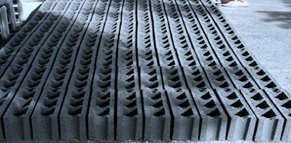
FAIRCRETE W is Chloride based plasticiser for Accelerating the setting time of plain cement concrete for early development of strength. It is ideal for providing increased resistance to frost damage during and after construction of hollow blocks.

SALIENT FEATURES OF FAIRCRETE W,

• Increases the rate of strength development.
• Increases density.
• Accelerates the hardening of floors and screeds.
• Accelerates the setting time of concrete.
• Resistant to freezing in cold weather concreting.
• Can be used for P.C.C. Work.
• Ideal for hollow blocks and concrete bricks.
• Allows continue placing of concrete at low temperature.

HOW TO MIX,
FAIRCRETE W should be directly added to the mix preferably with the mixing water. The optimum dosage rate should be determined by site trials.

FAIRCRETE W can be used,
• Resist the effect of frost.
• Increase the rate of strength development.
• Concreting can be done in cold weather, Mass concreting under seawater, and concrete hollow block manufacturing.

DOSAGE & PACKING

• 600 ml to 1000 ml per 50 kg of cement.
• 1,5,10,50,100ltr. carboys.

FAIRPLAST IP

WATERPROOF PLASTER ADDITIVE

FAIRPLAST IP is high workable mortar plasticizer cum waterproof plaster additive in powder form which should be dry mixed in a mortar. It gives better consistency, prolonged workability, and smooth & creamy mortar even with harsh sand. It introduces air into the mortar in the form of extremely fine and evenly dispersed bubbles. This entrained air imparts improved workability which, due to the stability of the tiny bubbles, prevents premature stiffening and avoids the need for repeated “knocking up”.
The hardened mortar bubbles provide a cautionary effect in screeds or renders. Capillary channels are also made discontinuous by the formation of bubbles, thus reducing the penetration of water.

SALIENT FEATURS OF FAIRPLAST IP,
• Prolonged workability, ease to handle mortar.
• Easier spreading of mortar and easy placing of bricks and blocks
• Reduces mortar droppings from surface
• Greater resistance to frost damage during construction
• Protection against freeze-thaw damage after construction
• Reduces permeability hence ensures waterproof plaster
• Increases yield of mortar results into cost benefits
• Reduces drying shrinkage cracks.
• Chloride free and hence no risk of corrosion.

FAIRPLAST IP is suitable for use with sand/cement plaster where it is required to reduce permeability. It can also be used in external plastering of roof and balcony screeds, plastering of basements and tanks, and external masonry walls.

HOW TO MIX:
Measure required quantity of sand, aggregate with cement. Then sprinkle proper amount of FAIRPLAST IP over the cement. Mix properly and then add required quantity of water to it.

PACKING & DOSAGE
200gms pouch, 1 kg pouch, 5kg, 25kg HDPE bags.
Dosage: 200gms per 50 kg cement.

FAIRFIBRE

FIBRE REINFORCEMENT FOR CONCRETE AND MORTAR

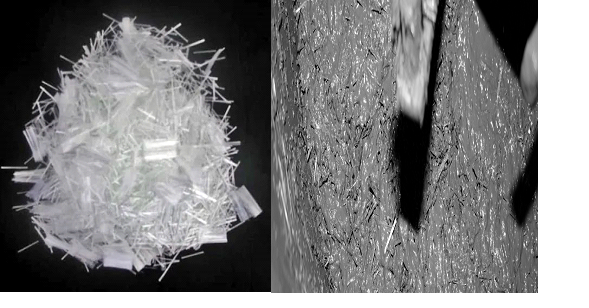
Fiber-reinforcement concrete and mortar are ideal for improving the durability and toughness performance of concrete and mortar. Fibers in concrete help reduce shrinkage cracks, increase strength, and increase energy absorption. FAIRFIBRE is a unique specially treated chemically inert fiber reinforcement for concrete and mortar which instantly disperses into the mix.

FAIRFIBRE is recommended where the objective is to control temperature/shrinkage cracking while improving basic durability. Also, it improves the tensile and compressive strength of concrete and mortar, minimizes cracks, and reduces permeability in the mix. It reduces the rate of heat evolution, spreading heat of hydration over a longer period & reducing thermal cracking effects. FAIRFIBRE is non-toxic and non-flammable.

FAIRFIBRE is easily and instantly disperses in to the mix. It reduces permeability hence ensures water tightness & reduces density & ensures more yield of mix & also reduces number of construction joints in floor.

SALIENT FEATURS OF FAIRFIBRE,
There are multiple reasons for adding fibers in concrete,
• Improves tensile and compressive strength
• Arrest drying shrinkage cracks
• Minimises steel reinforcement in industrial floors
• Improves durability
• Free from corrosive substances.
• Good resistance to impact and abrasion.
• Increases fatigue resistance & toughness.
• Non-corrosive, non-magnetic, chemically inert and 100% alkali proof so no reaction with aggregate and cement alkalies

It can be used for internal plaster, External plaster, Concrete repairs, Terrace slab, driveways, sidewalks, Industrial floors, Concrete roads, precast concrete, railway sleepers etc.

PACKING & DOSAGE
For optimum performance 125gms pack should be used with 50 kg. of cement. Generally it should be used 0.2% to 0.6% by weight of cement depending on the required performance. FAIRFIBRE is supplied in 125gms & 900gms pack

FAIRFIBRE P

POLYESTERFIBRE REINFORCEMENT FOR CONCRETE AND MORTAR

Normally concrete structures have high compressive strength but low tensile strength. Polyester fiber increases the properties of concrete such as compressive strength, tensile strength, impact strength & abrasion resistance. Fibers provide support to concrete in all directions by equally distributing throughout the matrix. It also prevents the problem of corrosion.
FAIRFIBRE P is a specially designed polyester fiber that instantly disperses out through the mix and improves and increases the compressive & tensile strength of concrete and mortar. It highly improves the durability of the structure and prevents the shrinkage cracks which are developed during curing making the concrete structure and plaster stronger. It prevents moisture from entering through out the concrete and mortar structures. FAIRFIBRE P also works as a secondary reinforcement in concrete.

SALIENT FEATURES,
• Prevents shrinkage cracks
• Improves tensile and compressive strength
• Reduces water permeability
• Helps prevent the corrosion of steel for primary reinforcement of concrete and mortar
• Improves life of structure
• Reduces density ensures more yield of mix.
• Minimises steel reinforcement in industrial floors
• Cost effective
• Environmental friendly
• Non-hazardous
• Disperses and separates in the dry ready mix easily
• Economical
• Increases flexibility of concrete

It is used for Concrete blocks, Railway sleeper, Roads & pavements, Bridges & dams. It is also use for Slabs, Footings, Foundation, walls and tanks, Manhole covers & tiles etc., PCC & RCC plastering, Pipes & beams.
PACKING & DOSAGE
FAIRFIBRE P is supplied in 125 gms pack. The addition rate of FAIRFIBRE P varies with grade of concrete and mortar. For optimum performance 125 gms pack should be used with 50 kg. of cement.

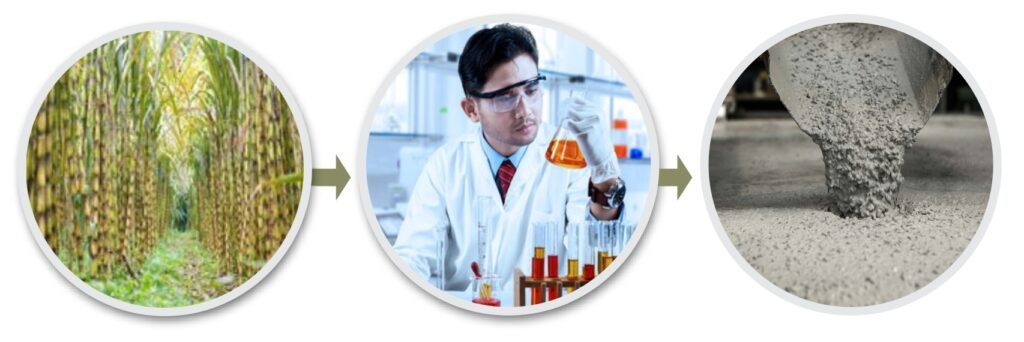
SUGARCANE TO SUPER PLASTICIZER (Bio-based PCE)

We are very proud to announce that Fairmate Chemicals is making the complete range of polycarboxylate ether with a capacity of 40,000 MT per year. We have also developed bio-based PCE that reduces the environmental impact to a great extent. Hence, our entire range of BROCRETE products is made from bio-based PCE.

The availability of renewable raw materials is a concern for all. The need to reduce the carbon footprint in the construction chemical industry has pushed us to use environmentally friendly bio-based raw materials for producing superplasticizers with a low carbon footprint. Sugarcane by-products after sugar production can be effectively used for making superplasticizers for concrete.

Considering we are using the material which has no particular use after sugar production. We are reducing waste and making an effective bio-based product for the better. Raw materials used for manufacturing superplasticizers based on crude oil have a carbon content of more than 80% compared to bio-based raw materials.

By using bio-based materials for making superplasticizers, we are moving towards an environmentally friendly and sustainable product.

PERVIOUS CONCRETE

Pervious Concrete is a special type of concrete that has a high porosity so that water can percolate through it easily. The major advantage of this type of concrete is that it can be used in the areas where it is very important to remove the stagnant and there is no proper draining facility for removal of water.

The pervious concrete is made only by implementation of course aggregates and cement for binding the aggregates. The fine aggregates are not used so that the pores between the course aggregates are not blocked. This pore serves as a gateway for the water to percolate through the concrete substrate.

Pervious concrete is used in parking area, subways and residential streets and walkways. The pervious concrete s used in a wide range for stromwater management. It is one of the sustainable product and concrete of future generation.

History Pervious concrete was first used in the 1800s in Europe as pavement surfacing and load bearing walls. It can also reduce city temperatures and alleviate urban hot island phenomena. Pervious concrete was first invented in Britain in 1824. It was first introduced into the United States in the mid-1970s and has since been rapidly developed. The Sponge City was introduced in China in approximately 2012.

Need of Pervious Concrete A large amount of rain water ends up falling on impervious surfaces such as parking lots, drive ways, sidewalks rather than soaking into soil. This creates an imbalance to the natural ecosystem and leads to the host of problems such as erosion, flood, and groundwater level depletion and pollution of rivers. The best solution to avoid this is to alter the impervious construction surface such as concrete and asphalt by the pervious concrete. Pervious concrete also acts as a filter which removes the debris from the flood to enter into the rivers and ground water and recharge the water level.

Properties of Pervious Concrete It has just enough cement paste to bind the aggregate with each other. The aggregates that are used should be only course aggregate and fine aggregate is avoided.

Fresh Concrete Property: The plastic pervious concrete mixture is stiff compared to traditional concrete. The slump that is measured is 30 mm which is enough for placing the concrete.
However, slump of pervious concrete has no correlation with its workability it is not be specified as an acceptance criterion.

Hardened Concrete Property:
The density of the concrete is found to be 1800 kg/M3.
The void contents of the pervious concrete ranges from 20 to 25%.
Permeability:
Typical flow rates for water through pervious concrete are 120 L/m²/min.

Application
1.Low-volume pavements and parking lots
2.Residential roads, alleys, and driveways
3.Sound barriers
4.Slope stabilization structures
5.Sidewalks and pathways
6.Patios, tennis courts, swimming pool decks
7.Pavement edge drains and gutters
8.Seawalls, reefs and other hydraulic structures
9.Sidewalks and pathways
10.Foundations / floors for greenhouses, fish hatcheries, aquatic amusement centers, and zoos
11.Swimming pool decks

Benefits
1.Reduces runoff from site.
2.Helps in unchanging ground water.
3.Eliminates need for retention ponds & other costly storm water management practices.
4.Provides for more efficient use of land development.
5.Water resources are conserved.
6.Adjacent trees and vegetation are allowed more rainwater.
7.The permeability of pervious concrete provides increased safety for drivers

Video Link:

READYCON –Ready to use Premixed Concrete

Readycon is a proportional blend of high quality materials including well graded fine and coarse aggregates, ordinary portland cement & special concrete admixtures. After mixing with water at site Readycon is designed to produce a concrete mix that’s easy to work with & provides excellent strength.
Readycon make it particularly suited for concrete jobs in & around home small concrete projects like sidewalk or driveway repairs, bags of premixed concrete can be a money saving alternative to buying ready mix bulk concrete.
It is used in construction of columns, beams, decks, Mass concreting, can be used in floor laying
Works with efficiency for pavement concrete,
Salient features

• Hard wearing and durable
• Ready to use – just add water
• High performance product
• Convenient & easy to use
• No effect on concrete setting in winter season
• Assured quality
• Factory controlled hence consistent quality
• No waste
• No noise
• No dust

READYCON Mix is ideally suited for many home maintenance and renovation requirements such as building path ways, mower strips, fish ponds, securing posts and clothes hoists in the ground, small concrete slabs, and small project brick work footings and repair work to concrete.

APPLICATIONS
• First add half of water in the mixing container of the total qty.
• Then Open a bag of READYCON and pour it into your mixing container.
• Turn the mixer on and allow the concrete to mix for about a minute and then add the water as necessary.
• Mix the concrete for about 5-7 minutes, until a uniform, workable consistency is achieved.
• If additional water is needed, add small amounts of water sparingly, and allow mixing properly.
• Keep the mixer running and dump the concrete into a wheelbarrow for transporting to your work area.

PROPERTIES:
Density: 2.2 kg/lit
Flexural Strength: 3 to 5 Mpa increased.
YIELD
• 50.0 kg bag yields approximately 0.68 cu ft

COVERAGE:
45 X 50 kg bag required one cubic meter.
INFORMATIONS

Packing:- 50kg Bags

Quantity Coverage:- The addition of 4.5 liters of water to a 50kgs bag of READYCON according to the site requirements & workability will produce around

Speciality Concrete Admixture – Polycarboxylate Ether

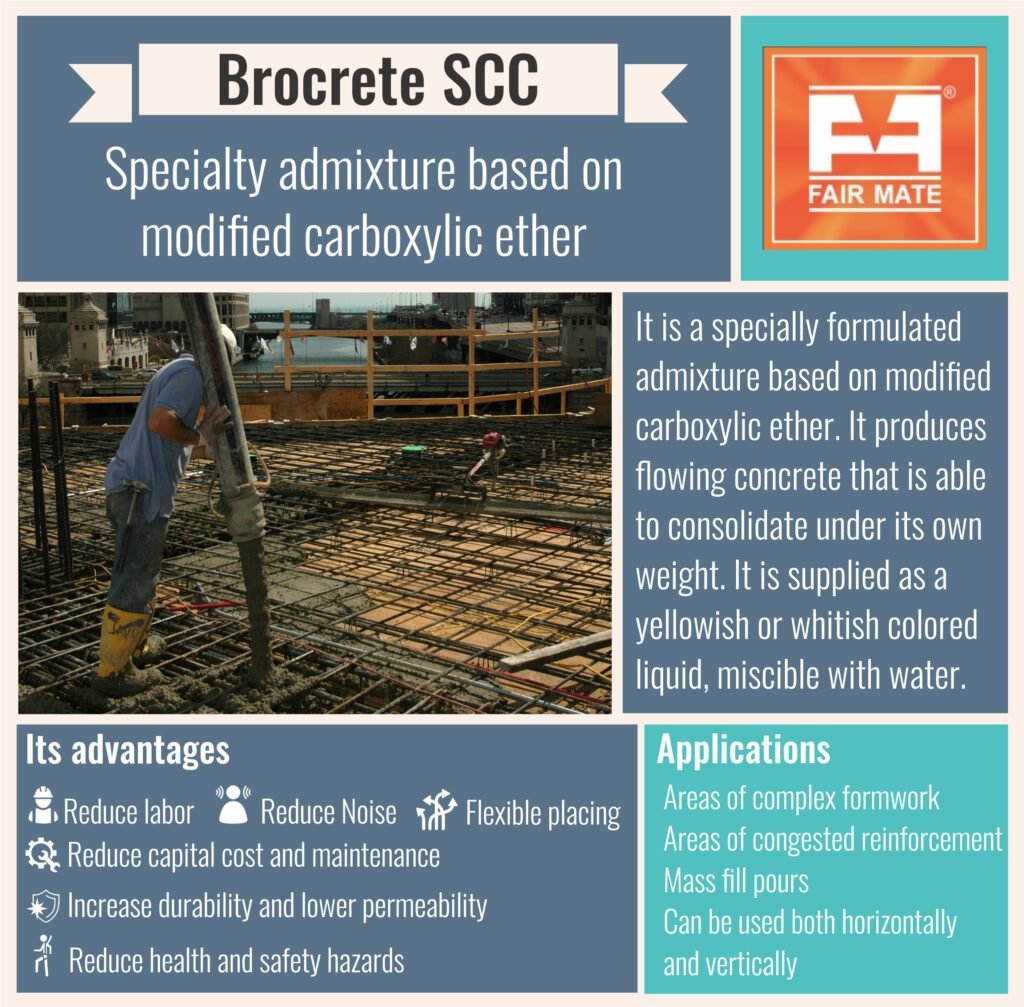
Chemical admixtures are usually added as liquids or powders in relatively small quantities and may be used to modify the properties during the plastic or hardened state of concrete. Chemical admixtures can be divided into five types: accelerating, retarding, water reducing/plasticizing, air-entraining, and waterproofers. One such chemical admixture specially developed is the Modified carboxylic ether admixture. It offers much larger flexibility in molecular design. Polycarboxylate ethers (PCE) contain groups with polyoxyalkylene, especially polyethylene or polypropylene glycol groups as well as carboxylic acid and/or carboxylic acid anhydride monomers. Fairmate is also manufacturing this product. Fairmate’s Brocrete SCC is a specially formulated admixture based on modified carboxylic ether. It produces flowing concrete that can consolidate under its own weight. It is supplied as a yellowish or whitish colored liquid, miscible with water. It is specifically designed to flow easily through highly congested, heavily reinforced areas.

Benefits of Brocrete SCC

● Reduce labour – due to the ease of placement, large pour sizes are achievable with reduced labour and plant requirements
● Noise – eliminating traditional methods of placing and finishing concrete reduces noise, which is particularly important in inner-city and built-up residential areas
● Flexible placing – ideal for jobs with difficult access where longer pumping distances are involved
● Health and Safety – reduced labour and plant requirements lead to reduced health and safety hazards
● Reduce capital cost and maintenance on formwork
● Increase durability and lower permeability

Applications of Brocrete SCC

● Areas of complex formwork
● Areas of congested reinforcement
● Mass fill pours
● Can be used both horizontally and vertically

Packing and Dosage of BROCRETE SCC

It is supplied in 50, 100, 200, 225 kg carboys, and in bulk quantity on request. The normal dosage is about 0.6%-1.5% by weight of cementitious material. However, the optimum dosage is to be determined by site trials.

Fairmate range of admixtures

Fairmate produces a variety of chloride-free and chloride-based concrete admixtures for increasing the workability of concrete which includes Normal plasticizers, Superplasticizers, Retarders, Slump retainers and Accelerators etc. It also includes Fourth generation concrete Admixtures which ensure very high slump retention and early strength. It also includes mineral admixtures like Micro silica, Fly Ash, Cellulose fiber, Polypropylene fibre & Steel fibre. Admixtures for plasters for better consistency.

For more details visit: www.fairmate.com

Email: enquiry@fairmate.com

FAIRCRETE 17

HIGH PERFORMANCE HARDENER, STRENGTHENER AND DENSIFIER FOR CONCRETE FLOOR

Description

Faircrete 17 is a silicate based clear liquid densifier when applied on concrete surfaces penetrates into the micro channels and seals against water and chemical attack and improves abrasion resistance.

Benefits

• Superior in performance over Sodium based systems
• Seals micro-channels in concrete against water penetration and chemical attack.
• Hardens – making concrete stronger and abrasion resistant.
• Dust proofs-creating a cleaner, healthier environment.
• Permanent – One penetrating application.
• Easy maintenance. Makes cleaning easier. Reduces staining.
• Satin sheen to concrete.

Recommended Uses

FAIRCRETE 17 is used for surface hardening of new and old concrete to prevent dust generation and to reduce wear, particularly on exposed concrete. Typical areas of application include warehouses, factories, platforms, car parks, corridors etc., on both new and existing concrete surfaces.

Application Instructions

Surface Preparation:
The substrate shall be thoroughly cleaned of all foreign materials such as bond breakers, curing agents, form release oils, dust, construction laitance by light mechanical grinding if required. Clean the surface with a high pH detergent and wash thoroughly. The surface shall be saturated with water and later excess water has to be removed.

Application:

A low pressure, high volume sprayer shall be used to apply FAIRCRETE 17 so as to form a glistening sheen and to ensure complete saturation of the surface. Enough FAIRCRETE 17 shall be applied to keep the surface wet for at least 20 minutes.

If applying by hand, spread the sprayed material with a lambs wool roller once or twice and then stop spreading. If spread excessively, it tends to dry in streaks. After 20 minutes, the excess material shall be removed and the surface shall be allowed to dry for 1 – 2 hrs. The floor is ready to use after the surface is dry. A light lithium residue may form on the surface after the floor is dry. This is the excess FAIRCRETE 17 liquid floor hardener which was not absorbed and can be removed by a stiff broom or power sweeper. For an immediate shine, FAIRCRETE 17 shall be allowed to dry overnight and then polished with a high speed buffer equipped with a black pad, followed by a red pad.

Sealing / Overcoating / Striping:

The treated surface can also be painted for striping as there will be no chemical incompatibility between FAIRCRETE 17 treated surface and these paints.

Maintenance:

Floors treated with FAIRCRETE 17 benefits from good routine maintenance. Regular scrubbing with a high pH detergent is recommended and can increase the shine. Tyre marks can be removed with a citrus type of cleaner. Oils and acids should be removed properly to prevent damage.

Packing and Coverage

Packing : FAIRCRETE 17 is supplied in 20 & 200 ltr containers.
Coverage : Spray applied – 10 – 12m² per Ltr on power trowelled surfaces. On textured surfaces the coverage will be much lower.