
Protective Coatings for Concrete and Steel: Complete Guide | Fairmate Prashita
Protective Coatings for Concrete and Steel: Complete Guide
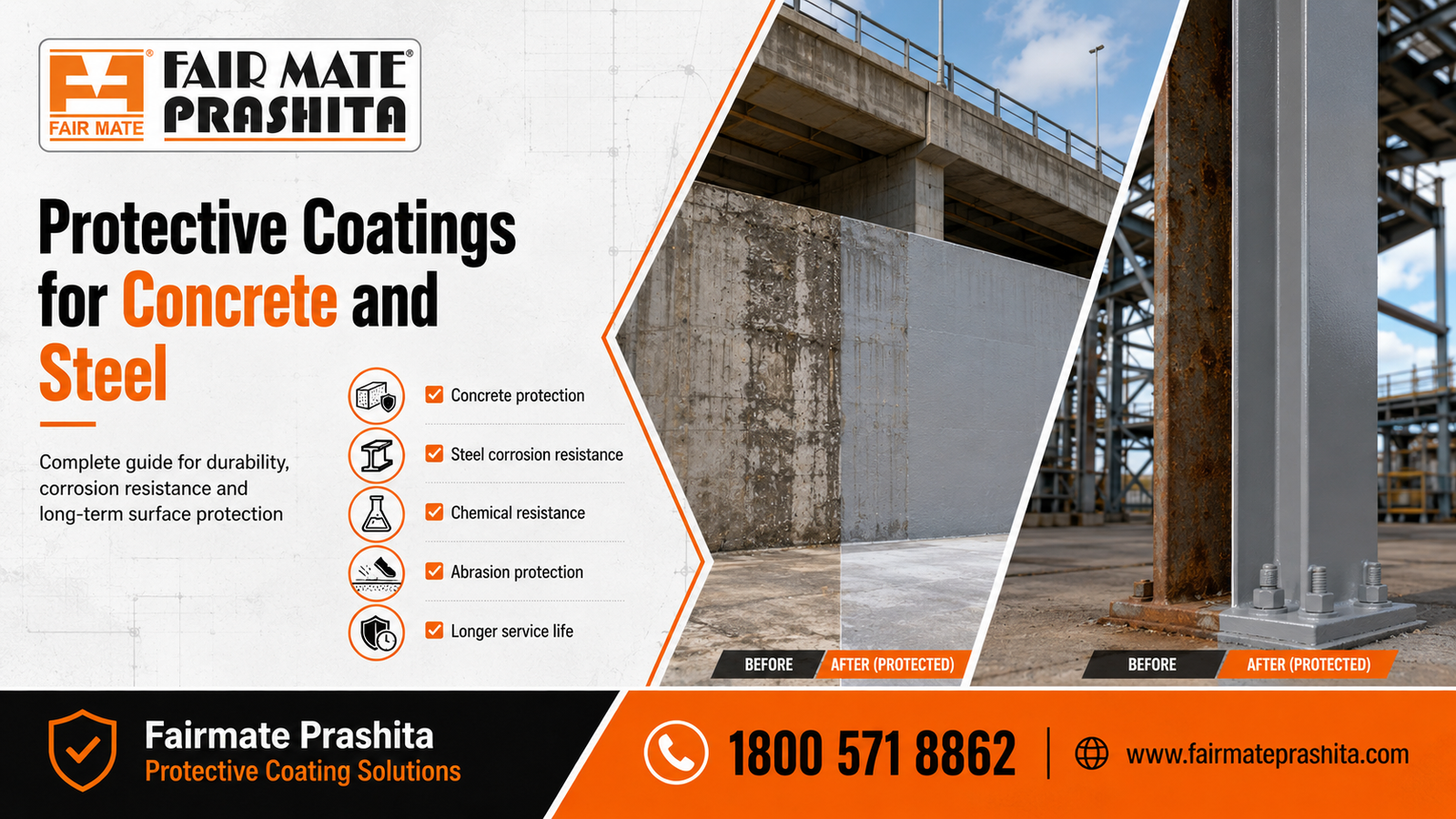
Concrete and steel are two of the most important materials used in modern construction and industrial infrastructure. From factories, warehouses, bridges, basements, water-retaining structures and parking areas to manufacturing plants and utility zones, these materials are exposed to moisture, chemicals, abrasion, carbonation, corrosion and weathering.
Protective coatings help create a durable barrier between the surface and the surrounding environment. For engineers, contractors and industrial buyers, the right coating system can improve service life, reduce maintenance cost and protect critical assets from early deterioration.
Fairmate Prashita offers construction chemical solutions including industrial flooring and protective coating systems for long-term site performance. (Fairmate Prashita)
What Are Protective Coatings?
Protective coatings are specially designed surface-applied systems used to protect concrete and steel from environmental, mechanical and chemical damage.
They are not only applied for appearance. Their main purpose is performance protection.
A good protective coating system can help improve:
✅ Surface durability
✅ Resistance to moisture ingress
✅ Resistance to chemicals and abrasion
✅ Protection against corrosion
✅ Cleanability and maintenance
✅ Long-term structural performance
✅ Aesthetic appearance of industrial and commercial spaces
For concrete and steel surfaces, coating selection should be based on exposure condition, surface condition, traffic load, chemical contact, temperature, moisture level and expected service life.
Why Protective Coatings Are Important for Concrete
Concrete is strong in compression, but it is naturally porous. Water, carbon dioxide, chlorides, sulphates and chemicals can enter through pores, cracks or weak surface zones. Over time, this may lead to reinforcement corrosion, surface scaling, cracking, dampness, dusting and durability loss.
Protective coatings for concrete help reduce direct exposure to aggressive elements.
They are commonly used for:
✅ Industrial floors
✅ Parking decks
✅ Basements
✅ Water tanks
✅ Factory walls and floors
✅ Chemical storage areas
✅ Utility rooms
✅ Commercial buildings
✅ Infrastructure structures
✅ Concrete repair protection
AMPP notes that concrete assets are coated to protect them against harsh service environments, and coating performance depends heavily on correct surface preparation. (ampp.org)
Why Protective Coatings Are Important for Steel
Steel is widely used in factories, structural frames, tanks, pipelines, platforms, equipment foundations and industrial infrastructure. However, when steel is exposed to moisture and oxygen, corrosion may begin.
Corrosion can reduce steel thickness, weaken structural performance, damage appearance and increase maintenance cost.
Protective coatings for steel help create a barrier against:
✅ Moisture
✅ Oxygen
✅ Industrial fumes
✅ Chemical splashes
✅ Weather exposure
✅ Salt-laden environments
✅ Abrasion and wear
For steel, coating selection must consider surface preparation grade, corrosion environment, dry film thickness, primer compatibility and topcoat performance.
Common Types of Protective Coatings
Different coating systems are used depending on project requirement. The most common types include:
1. Epoxy Coatings
Epoxy coatings are widely used for concrete and steel protection because of their strong adhesion, chemical resistance and durability.
They are suitable for:
✅ Industrial floors
✅ Warehouses
✅ Production areas
✅ Concrete protection
✅ Steel structures
✅ Chemical handling zones
Epoxy coatings are preferred where strength, bonding and chemical resistance are important.
2. Polyurethane Coatings
PU coatings are known for flexibility, UV resistance and abrasion resistance, depending on the system type.
They are suitable for:
✅ Exposed surfaces
✅ Parking areas
✅ Industrial floors
✅ Protective topcoats
✅ Areas requiring better weather resistance
3. Anti-Carbonation Coatings
Anti-carbonation coatings are mainly used on concrete surfaces to reduce carbon dioxide penetration and protect reinforcement from corrosion risk.
They are suitable for:
✅ RCC structures
✅ Bridges
✅ Exterior concrete walls
✅ Infrastructure projects
✅ Repair and rehabilitation work
4. Cementitious Protective Coatings
Cementitious coatings are used for concrete protection, waterproofing support and surface protection in specific applications.
They are suitable for:
✅ Water-retaining structures
✅ Basements
✅ Wet areas
✅ Concrete protection zones
5. Anti-Corrosive Coatings
Anti-corrosive coatings are used on steel surfaces to protect against rust and industrial exposure.
They are suitable for:
✅ Steel structures
✅ Tanks
✅ Pipelines
✅ Plant equipment
✅ Fabrication units
✅ Industrial sheds
Surface Preparation: The Most Important Step
Protective coating failure often starts before the coating is applied. Poor surface preparation is one of the biggest reasons for peeling, blistering, debonding, pinholes and premature failure.
For concrete, the surface must be checked for:
✅ Dust and laitance
✅ Oil, grease and contamination
✅ Weak or loose concrete
✅ Cracks and honeycombing
✅ Moisture condition
✅ Surface profile
✅ Previous coating compatibility
For steel, the surface must be checked for:
✅ Rust
✅ Mill scale
✅ Oil and grease
✅ Dust
✅ Existing coating failure
✅ Surface profile after blasting or cleaning
Concrete surface preparation standards highlight the need for a clean, sound, dry and properly profiled surface before applying coating or lining systems. (relisleeve.com)
How Protective Coatings Improve Durability
Protective coatings improve durability by limiting the contact between the structure and damaging external conditions.
They can help protect against:
✅ Water ingress
✅ Reinforcement corrosion
✅ Chemical attack
✅ Surface abrasion
✅ Carbonation
✅ Dusting
✅ Weathering
✅ Industrial contamination
✅ Cleaning chemical exposure
In industrial and infrastructure projects, durability is not optional. A failed coating can lead to downtime, repair cost, production disturbance and safety concerns.
This is why product selection and application quality must be treated as technical decisions, not only commercial decisions.
Key Areas Where Protective Coatings Are Used
Protective coatings are useful across many construction and industrial segments.
Industrial Projects
Factories, manufacturing units, warehouses, chemical plants, food processing units and utility buildings need coatings that support durability, cleanability and surface protection.
Commercial Buildings
Parking areas, service zones, basements, ramps, terrace equipment areas and exposed RCC surfaces require protective systems for long-term performance.
Infrastructure Projects
Bridges, flyovers, tunnels, water-retaining structures, treatment plants and marine-adjacent structures require protection from aggressive environments.
Steel Fabrication and Equipment
Steel tanks, platforms, pipelines, machinery bases and structural members need anti-corrosive protection to reduce rusting and maintenance frequency.
Common Protective Coating Failure Reasons
Protective coating problems can happen due to poor selection, poor preparation or poor application.
Common reasons include:
✅ Wrong coating system selection
✅ Poor surface cleaning
✅ Moisture trapped below coating
✅ Inadequate surface profile
✅ Application on weak substrate
✅ Incorrect mixing ratio
✅ Wrong application thickness
✅ Poor curing conditions
✅ Chemical exposure before full cure
✅ Incompatible primer or topcoat
To avoid failure, the project team should follow manufacturer guidance, conduct proper inspection and ensure applicators are trained for the selected system.
How to Select the Right Protective Coating
Before selecting a coating system, engineers and industrial buyers should evaluate:
✅ Surface type: concrete or steel
✅ Indoor or outdoor exposure
✅ Chemical exposure level
✅ Traffic and abrasion load
✅ Moisture condition
✅ Temperature during application
✅ Required finish
✅ Expected service life
✅ Maintenance schedule
✅ Application method
✅ Site shutdown time available
A coating used for a parking deck may not be suitable for a chemical storage area. Similarly, a steel structure exposed to industrial fumes may need a different system than an indoor equipment frame.
Correct coating selection should always be based on site condition and performance requirement.
Protective Coatings and Maintenance Planning
Protective coatings reduce maintenance, but they do not remove the need for inspection.
A proper maintenance plan should include:
✅ Regular surface inspection
✅ Checking cracks, peeling or blistering
✅ Cleaning chemical spills quickly
✅ Repairing damaged coating areas early
✅ Recoating before major failure
✅ Monitoring steel corrosion signs
✅ Checking water ponding areas
Early repair of coating damage can prevent larger surface failure and reduce long-term cost.
Fairmate Prashita Protective Coating Support
Fairmate Prashita supports engineers, contractors, applicators and industrial buyers with construction chemical solutions for concrete protection, industrial flooring, waterproofing, repair, grouting and protective coating requirements. (Fairmate Prashita)
Our technical team can help guide product selection based on surface type, project condition and performance requirement.
For coating support, connect with Fairmate Prashita.
📞 Call: 1800 571 8862
🌐 Website: www.fairmateprashita.com
Best Product Links:-
- SAFECORE PUD
Best anchor text: polyurethane dispersion protective coating
Use in section: Common types of protective coatings - SAFECORE ANTICORROSIVE COAT
Best anchor text: anti-corrosive coating for steel and rebars
Use in section: Why protective coatings are important for steel - SAFECORE EP PRIMER
Best anchor text: epoxy primer for protective coating systems
Use in section: Surface preparation and primer compatibility - FAIRCOAT ELASTOMERIC
Best anchor text: elastomeric protective coating
Use in section: Protective coatings for exterior concrete surfaces
Conclusion
Protective coatings are essential for improving the durability, service life and performance of concrete and steel structures. They protect surfaces from moisture, corrosion, chemicals, abrasion, carbonation and industrial exposure.
For engineers and industrial buyers, the right coating system can reduce maintenance cost, improve safety and extend asset life. However, coating performance depends on correct product selection, proper surface preparation, skilled application and regular inspection.
Whether the project involves concrete floors, steel structures, basements, parking areas, factories, warehouses or infrastructure assets, protective coatings should be selected with a clear technical approach.
Request coating support from Fairmate Prashita for the right protective coating solution for your project.
