
Concrete Repair Mortar and Crack Repair Product Selection Guide
Concrete Repair Mortar and Crack Repair Product Selection Guide
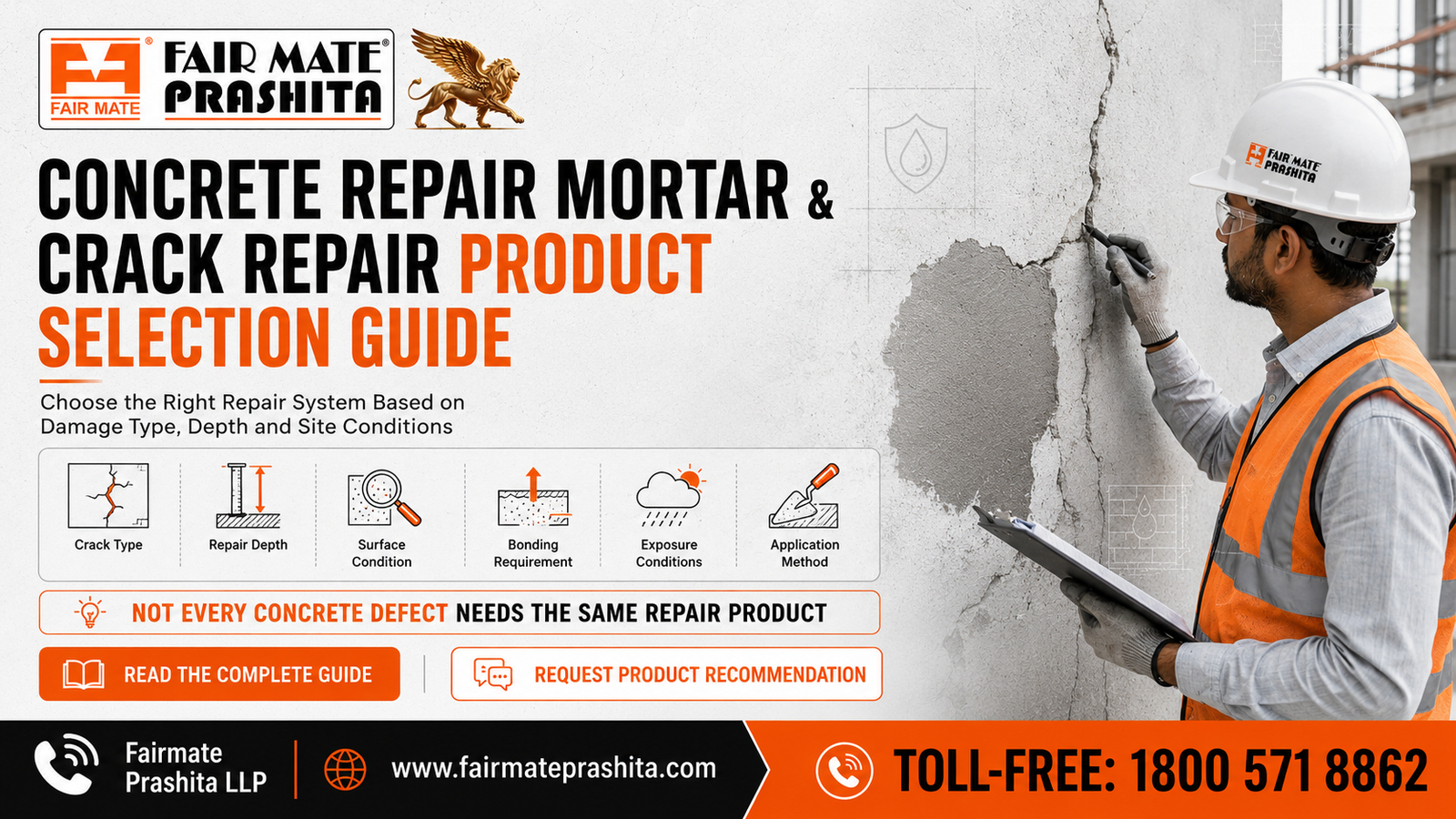
Concrete cracks, spalling, damaged edges and surface deterioration are common problems in residential, commercial, industrial and infrastructure structures. However, not every concrete defect should be treated using the same repair material.
A narrow surface crack may require a compatible crack-filling product. A damaged floor edge may require a fast-setting repair mortar. Deep concrete loss around reinforcement may require a structural repair mortar or flowable micro-concrete.
Selecting a product only by looking at the visible damage can result in temporary repairs, recurring cracks, debonding or continued water ingress. A reliable concrete repair begins with correct diagnosis, suitable surface preparation and selection of a repair material that matches the site condition.
This guide explains the main factors contractors, engineers and builders should consider when selecting concrete repair mortar and crack-repair products.
1. Identify the Type of Concrete Damage
The first step is to determine what kind of defect is present.
Common concrete defects include:
- Hairline surface cracks
- Wider cementitious cracks
- Active or moving cracks
- Dormant cracks
- Spalled concrete
- Loose or delaminated concrete
- Broken floor and pavement edges
- Surface blowholes and blemishes
- Exposed reinforcement
- Deep loss of concrete section
- Damage caused by impact or abrasion
Each condition may require a different repair approach.
For example, filling a visible crack may be appropriate when the surrounding concrete is sound and the crack is suitable for cementitious treatment. However, crack filling alone will not solve a problem involving loose concrete, corroded reinforcement or continuing structural movement.
Where the cause or structural significance is uncertain, the area should be assessed by a qualified engineer before repair work begins.
2. Determine Whether the Crack Is Active or Dormant
Cracks should not be classified only by width.
An active crack may continue to open, close or move because of:
- Thermal expansion and contraction
- Structural loading
- Settlement
- Vibration
- Drying shrinkage
- Movement at joints
- Foundation-related changes
A dormant crack has generally stabilised and is not expected to experience significant further movement.
Rigid cementitious crack-filling materials are generally more suitable for appropriate dormant cracks. Active cracks may require a flexible treatment, joint system or engineered repair procedure capable of accommodating movement.
Applying a rigid material over an active crack may lead to the crack reappearing beside or through the repaired area.
3. Check the Repair Depth and Size
Repair depth is a major factor in product selection.
Thin surface correction
Small surface imperfections, pinholes, blowholes and minor irregularities may require a fine fairing coat rather than a general patch repair mortar.
Fairing coats are commonly used before applying protective coatings or decorative finishes. Their purpose is to create a smooth and consistent concrete surface.
Localised patch repair
Shallow or medium-depth repairs on walls, columns, slabs and concrete edges may require a hand-applied cementitious repair mortar.
The selected material should be suitable for the repair orientation and specified layer thickness.
Deep structural repair
Deep repairs, significant section loss and congested areas around reinforcement may require a flowable repair micro-concrete placed inside properly sealed formwork.
A product suitable for hand application may not flow effectively into deep or inaccessible areas.
4. Match the Product to the Application Orientation
Concrete repairs may be horizontal, vertical or overhead.
A flowable material can perform well in a formed horizontal or deep repair, but it may not be suitable for an exposed vertical surface. Similarly, a stiff vertical repair mortar may not flow beneath reinforcement or into narrow voids.
Product selection should consider:
- Horizontal floor repair
- Vertical wall or column repair
- Beam-side repair
- Overhead soffit repair
- Form-and-pour application
- Hand-applied patch repair
- Thin finishing application
Always confirm the recommended orientation and application thickness in the current Technical Data Sheet.
5. Evaluate the Substrate Condition
Repair mortar must bond to sound concrete.
Before application, contractors should remove:
- Loose concrete
- Weak or friable material
- Dust and debris
- Oil and grease
- Old coatings
- Laitance
- Unsound previous repairs
- Corrosion products around reinforcement
The repair perimeter should be formed properly so that the new material does not finish at weak, feathered edges unless the selected product specifically permits it.
Depending on the repair system, the substrate may require pre-wetting, a bonding slurry or a specified bonding agent.
Even a high-performance repair mortar may fail when applied over contaminated, dusty or weak concrete.
6. Consider Bond Strength and Compatibility
The repair material and original concrete should work together as a system.
Important compatibility factors include:
- Bond strength
- Compressive strength
- Modulus and stiffness
- Shrinkage behaviour
- Thermal movement
- Permeability
- Application thickness
- Exposure conditions
Selecting the strongest available mortar is not always the correct approach. A repair material that is excessively rigid compared with the surrounding concrete may create stress concentrations near the repair boundary.
The objective should be suitable and compatible performance, not simply the highest numerical strength.
7. Control Shrinkage and Water Addition
Shrinkage can lead to:
- Fine cracks
- Debonding
- Separation at repair edges
- Water-entry paths
- Loss of contact
- Reduced durability
Prepacked repair mortars improve control because the cement, aggregates, fillers and additives are proportioned during manufacturing.
However, site practices remain important.
Contractors should:
- Measure water accurately
- Follow the stated mixing range
- Mix mechanically where recommended
- Avoid adding extra water for easier finishing
- Avoid retempering material that has started to set
- Respect the stated application thickness
- Compact the mortar properly
- Complete the required curing procedure
Excessive water may initially improve workability, but it can reduce strength and increase porosity and shrinkage.
8. Select According to Return-to-Service Requirements
Some repairs must be completed where prolonged shutdowns are not practical.
Examples include:
- Industrial floors
- Factory movement areas
- Warehouses
- Pavements
- Loading zones
- Commercial access routes
- Maintenance areas
A fast-setting repair mortar may be appropriate where early finishing or reduced disruption is required.
Fairmate Prashita’s CEMSCREED FAST REPAIR is developed for fast repairs to suitable concrete and plaster surfaces, including concrete floors and pavements where operational disruption needs to be reduced.
The required return-to-service time should always be confirmed against the latest product data and site temperature.
9. Consider the Exposure Conditions
A repair material should be selected for the environment in which it will perform.
Consider:
- Internal or external exposure
- Wet or dry conditions
- Traffic and abrasion
- Impact
- Chemical contact
- Heat and temperature variation
- Water-retaining conditions
- Marine or chloride exposure
- Subsequent waterproofing or coating
An external repair exposed to rain and temperature changes faces different requirements from an internal wall repair.
Similarly, an industrial floor exposed to abrasion may require a different system from a fairing repair beneath a protective coating.
10. Select the Correct Repair Product Category
A complete concrete repair range may include several product types.
Crack-repair mortar
Suitable for compatible, prepared cementitious cracks on horizontal or vertical surfaces.
Fairmate Prashita’s CRACKSEAL SUPER is a prepacked, high-strength and fast-setting crack-repair mortar for suitable cementitious crack-treatment applications.
Fast-setting repair mortar
Suitable for concrete floors, pavements and local repairs where work needs to progress quickly.
CEMSCREED FAST REPAIR is designed for suitable concrete and plaster repairs where fast setting and reduced disruption are important.
Fairing coat
Used for thin-layer correction of surface blemishes, blowholes and irregularities before protective coating or finishing.
CEMSCREED FAIRING COAT is intended for suitable surface finishing and fairing applications.
Structural repair mortar or micro-concrete
Used where deeper repair, section rebuilding or placement around reinforcement is required.
CEMSCREED HM(F) is a free-flowing, fibre-containing, non-shrink repair micro-concrete for suitable structural repair and difficult-to-place areas.
Epoxy repair mortar
Used where high early strength, abrasion resistance or impact resistance is important.
FAIRSCREED R is an epoxy-based repair mortar for suitable industrial and heavy-duty repair applications.
Final product selection should always be confirmed against the current TDS and project requirements.
11. Do Not Ignore Reinforcement Corrosion
Spalling often occurs because reinforcement has started corroding.
When reinforcement is exposed, the repair process may involve:
- Removing unsound concrete around the steel
- Cleaning corrosion and contaminants
- Assessing the loss of steel section
- Replacing or supplementing steel where specified
- Applying reinforcement protection where required
- Rebuilding the concrete section using a suitable repair material
- Curing and protecting the completed repair
Simply covering corroded steel with fresh mortar may allow deterioration to continue beneath the repaired surface.
12. Follow Correct Curing and Protection Procedures
Repair work is not complete immediately after finishing.
Curing helps control moisture loss and supports proper strength development. Poor curing may contribute to:
- Surface cracking
- Weak development
- Dusting
- Reduced durability
- Premature repair failure
The repaired area should be protected according to product instructions and environmental conditions.
Depending on exposure, the completed repair may also require waterproofing, a protective coating or another surface-protection treatment.
Concrete Repair Product Selection Checklist
Before selecting a repair product, confirm:
- What caused the damage?
- Is the crack active or dormant?
- Is the surrounding concrete sound?
- Is reinforcement exposed?
- What is the repair depth?
- Is the application horizontal, vertical or overhead?
- Is formwork required?
- What strength and return-to-service time are needed?
- Will the area face water, traffic, abrasion or chemicals?
- Is a protective coating required after repair?
- Has the latest TDS been reviewed?
Conclusion
Concrete repair should not be treated as a cosmetic patching exercise.
The right product depends on crack movement, repair depth, substrate condition, reinforcement condition, exposure, application orientation and performance requirements.
Correct diagnosis and preparation help determine whether the site needs:
- Crack filling
- Fast patch repair
- Surface fairing
- Structural repair mortar
- Flowable micro-concrete
- Epoxy repair
- A complete rehabilitation system
Fairmate Prashita provides concrete repair products and technical guidance for contractors, builders, consultants and project teams.
For the latest Technical Data Sheet or a project-specific product recommendation, contact:
Fairmate Prashita LLP
Advanced Construction Chemical Solutions
🌐 www.fairmateprashita.com
📞 Toll-Free: 1800 571 8862