

Concrete Admixture Types: Uses, Benefits & Selection Guide for Better Concrete Performance
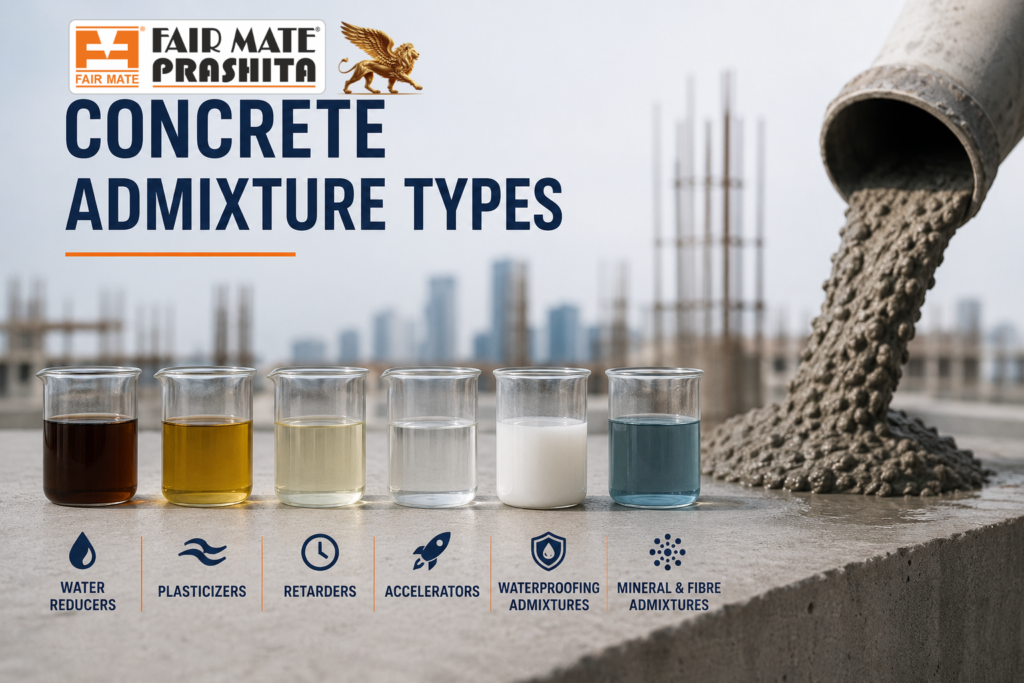
Concrete is one of the most widely used construction materials in the world. But modern concrete is no longer just a mixture of cement, sand, aggregate, and water. Today, engineers, contractors, builders, RMC plants, and infrastructure companies use advanced concrete admixtures to improve workability, strength, durability, setting time, pumpability, and long-term performance.
Understanding different concrete admixture types is important because every project has different site conditions. Some projects need high workability, some need early strength, some need delayed setting time, and some need reduced permeability. The right admixture helps concrete perform better without unnecessarily increasing cement or water content.
At Fairmate Prashita, we provide advanced construction chemical solutions for concrete admixtures, waterproofing systems, grouts, repair mortars, flooring, protective coatings, and other site-performance requirements. Our concrete admixture solutions are designed to support modern construction with better workability, durability, and technical reliability.
What Are Concrete Admixtures?
Concrete admixtures are special materials added to concrete during mixing to improve its fresh or hardened properties. They are used in small quantities but can create a major improvement in concrete performance.
Concrete admixtures help control:
- Workability
- Setting time
- Water demand
- Slump retention
- Pumpability
- Strength development
- Durability
- Permeability
- Segregation and bleeding
- Surface finish
In simple words, admixtures help concrete become easier to place, stronger, more durable, and more suitable for specific site conditions.
Why Concrete Admixtures Are Important in Modern Construction
In earlier construction practices, workers often added extra water to concrete when the mix became stiff. This made placement easier, but it reduced strength, increased porosity, and affected long-term durability.
Modern construction cannot depend on such methods. High-rise buildings, bridges, roads, tunnels, industrial floors, precast elements, and RMC projects require controlled concrete performance. This is where concrete admixtures become essential.
The right admixture can help achieve:
- Better workability without excess water
- Higher compressive strength
- Improved concrete density
- Reduced water-cement ratio
- Better pumpability for high-rise construction
- Reduced honeycombing
- Controlled setting time
- Better finishing
- Improved durability in aggressive environments
- Lower maintenance and repair costs
Concrete admixtures are especially useful for RMC plants, infrastructure projects, industrial construction, precast concrete, mass concrete, and high-performance concrete.
Major Concrete Admixture Types
There are different types of concrete admixtures based on their function. Below are the most commonly used concrete admixture types in construction.
1. Water Reducing Admixtures
Water reducing admixtures are used to reduce the amount of water required in a concrete mix while maintaining the required workability. These admixtures improve the flow of concrete without increasing the water-cement ratio.
Uses
Water reducing admixtures are commonly used in:
- RCC structures
- Residential buildings
- Commercial buildings
- RMC concrete
- Pumpable concrete
- Precast concrete
- Slabs, beams, columns, and foundations
Benefits
- Reduces water demand
- Improves workability
- Enhances strength
- Reduces porosity
- Improves surface finish
- Helps achieve better compaction
- Reduces shrinkage and bleeding
Water reducing admixtures are suitable when the project requires improved concrete quality without adding extra water.
2. Plasticizers
Plasticizers are one of the most commonly used concrete admixture types. They improve the workability of concrete and make the mix easier to place and compact.
Plasticizers are useful for normal concrete where moderate improvement in workability is required. They are commonly used for M20, M25, and general RCC concrete applications.
Uses
- General RCC work
- Slabs and beams
- Footings and columns
- Site-mixed concrete
- Low to medium grade concrete
- Better compaction in reinforcement areas
Benefits
- Improves flow of concrete
- Reduces water requirement
- Improves compaction
- Reduces honeycombing
- Enhances surface finish
- Improves concrete quality
Plasticizers are a practical and economical solution for improving everyday concrete performance.
3. Superplasticizers
Superplasticizers are high-range water reducing admixtures used when concrete needs very high workability and strength. They are commonly used in high-performance concrete, RMC, precast concrete, self-compacting concrete, and heavily reinforced structures.
Superplasticizers allow concrete to flow easily without adding excess water. This helps maintain strength and durability while improving placement.
Uses
- High-rise buildings
- RMC plants
- Precast concrete
- Bridges and flyovers
- Self-compacting concrete
- Pumpable concrete
- High-strength concrete
- Congested reinforcement areas
Benefits
- Provides high workability
- Reduces water-cement ratio
- Improves early and final strength
- Enhances pumpability
- Reduces segregation
- Improves surface finish
- Supports high-performance concrete
Superplasticizers are ideal where concrete must remain workable, strong, and durable under demanding site conditions.
4. Retarding Admixtures
Retarding admixtures are used to slow down the setting time of concrete. These admixtures are especially useful in hot weather, long-distance transportation, large pours, and RMC applications.
In hot weather, concrete can set too quickly, making placement and finishing difficult. Retarders help keep concrete workable for a longer time.
Uses
- Hot weather concreting
- RMC transportation
- Mass concrete pours
- Raft foundations
- Dams and large structures
- Long-distance concrete delivery
- Large industrial slabs
Benefits
- Delays setting time
- Extends workability
- Reduces cold joints
- Improves placement time
- Supports mass concreting
- Helps in hot climatic conditions
Retarding admixtures are useful when concrete requires controlled setting and extended working time.
5. Accelerating Admixtures
Accelerating admixtures are used to speed up the setting and early strength development of concrete. These admixtures are useful when faster construction progress is required.
They are commonly used in repair works, precast production, cold weather concreting, and projects where early formwork removal is needed.
Uses
- Fast-track construction
- Precast concrete
- Road repair
- Concrete repair work
- Cold weather concreting
- Early strength requirement
- Emergency repair applications
Benefits
- Speeds up setting time
- Improves early strength
- Reduces construction time
- Helps early demoulding
- Supports repair and maintenance work
- Useful in low temperature conditions
Accelerating admixtures are suitable when quick strength gain and faster project execution are required.
6. Slump Retaining Admixtures
Slump retaining admixtures are used to maintain concrete workability for a longer period. These are very important in RMC and long-distance concrete transportation.
Concrete may lose slump during transit due to time, temperature, cement type, and site delays. Slump retaining admixtures help maintain consistency until placement.
Uses
- Ready-mix concrete
- Long-distance concrete transportation
- High-rise pumping
- Hot weather concreting
- Delayed placement sites
- Infrastructure projects
Benefits
- Maintains workability
- Reduces need for water addition
- Improves pumpability
- Helps avoid site rejection
- Reduces slump loss
- Supports consistent concrete quality
Slump retaining admixtures are highly useful for RMC plants and large construction projects.
7. Air Entraining Admixtures
Air entraining admixtures introduce tiny, controlled air bubbles into concrete. These air bubbles improve resistance against freeze-thaw cycles and enhance durability in certain environmental conditions.
Although air entraining admixtures are more common in cold climates, they may also be used in specific applications where durability and workability improvement are required.
Uses
- Pavements
- Roads
- Exposed concrete
- Cold-region structures
- Concrete exposed to freeze-thaw conditions
- Durable infrastructure applications
Benefits
- Improves freeze-thaw resistance
- Enhances workability
- Reduces bleeding
- Improves durability
- Helps protect concrete in harsh environments
Air entraining admixtures should be used carefully because excessive air can reduce concrete strength.
8. Waterproofing Admixtures
Waterproofing admixtures reduce water permeability and help improve concrete resistance against moisture ingress. These admixtures are used in concrete and plaster where water resistance is required throughout the depth of the mix.
Uses
- Water tanks
- Basements
- Roof slabs
- Bathrooms
- External plaster
- Retaining walls
- Foundations
- Concrete exposed to moisture
Benefits
- Reduces permeability
- Improves water resistance
- Protects reinforcement
- Enhances durability
- Improves cohesion and compaction
- Helps reduce seepage problems
Fairmate Prashita’s FAIRCRETE RMW is an integral waterproofing additive for concrete and plaster. It improves workability, reduces permeability throughout the depth of concrete, protects rebars, maintains strength, increases durability, and improves plasticity, cohesion, placing, compaction, and finishing.
9. Mineral Admixtures
Mineral admixtures are finely divided materials added to concrete to improve strength, durability, workability, or resistance to aggressive conditions. Common examples include fly ash, silica fume, ground granulated blast furnace slag, and other pozzolanic materials.
Uses
- High-performance concrete
- Mass concrete
- Durable structures
- Marine structures
- Industrial floors
- Infrastructure projects
Benefits
- Improves long-term strength
- Enhances durability
- Reduces heat of hydration
- Improves workability
- Reduces permeability
- Supports sustainable construction
Mineral admixtures are often used where long-term durability and lower heat generation are important.
10. Fibre Admixtures
Fibre admixtures are used to improve crack resistance, impact resistance, and toughness of concrete. These fibres may be synthetic, steel, polypropylene, macro, or micro fibres depending on the project requirement.
Uses
- Industrial floors
- Pavements
- Shotcrete
- Tunnel linings
- Precast elements
- Crack control applications
Benefits
- Reduces plastic shrinkage cracks
- Improves impact resistance
- Enhances toughness
- Helps control micro-cracking
- Improves durability of concrete surfaces
Fibre admixtures are useful where concrete is exposed to movement, impact, abrasion, or shrinkage stress.
How to Select the Right Concrete Admixture Type
Selecting the correct admixture depends on the project requirement, mix design, cement type, aggregate quality, temperature, transportation time, and placement method.
Before selecting a concrete admixture, check:
- Required concrete grade
- Required slump
- Water-cement ratio
- Setting time requirement
- Ambient temperature
- Transportation distance
- Pumping height or distance
- Reinforcement congestion
- Early strength requirement
- Durability requirement
- Exposure condition
- Compatibility with cement and other materials
A trial mix is always recommended before final site use. The same admixture can perform differently with different cement brands, aggregate sources, water quality, and mix proportions.
Concrete Admixture Selection Guide
| Project Requirement | Recommended Admixture Type |
| Better workability | Plasticizer or water reducing admixture |
| High strength concrete | Superplasticizer |
| Long-distance RMC supply | Slump retaining admixture |
| Hot weather concreting | Retarding admixture |
| Fast setting or early strength | Accelerating admixture |
| Reduced water permeability | Waterproofing admixture |
| Crack control | Fibre admixture |
| Durable mass concrete | Mineral admixture |
| Pumpable concrete | Superplasticizer or PCE-based admixture |
| Dense reinforced concrete | High-range water reducer |
Common Mistakes to Avoid While Using Concrete Admixtures
Even the best concrete admixture may fail if it is not used correctly.
Avoid these common mistakes:
- Adding admixture without trial mix
- Using wrong dosage
- Adding extra water at site
- Mixing admixture directly with dry cement without proper procedure
- Ignoring cement compatibility
- Not checking slump retention
- Using expired or improperly stored admixture
- Not following manufacturer’s technical data sheet
- Mixing multiple admixtures without compatibility testing
- Using the same admixture for every project without evaluation
Concrete admixtures should always be used with proper technical guidance and controlled dosage.
Why Choose Fairmate Prashita for Concrete Admixtures?
Fairmate Prashita offers a wide range of concrete admixture solutions for modern construction requirements. Our admixture range supports improved workability, slump retention, reduced water-cement ratio, setting control, durability, waterproofing, and better concrete performance.
Fairmate Prashita offers a complete Concrete Admixtures range for modern concrete performance. Depending on project requirements, engineers and RMC plants can explore FAIRCRETE HP for water reduction, FAIRFLO for high-range superplasticizing performance, FAIRFLO RMC 100 and BROCRETE TRANSIT for slump retention and transit concrete, FAIRCRETE NC for early strength and acceleration, FAIRCRETE AE for air entrainment, FAIRCRETE RMW for integral waterproofing, FAIRMATE MICRO SILICA for mineral admixture applications, and FAIRFIBRE MACRO for fibre-reinforced concrete applications.
Fairmate Prashita Admixture Advantages
- Wide range of concrete admixture products
- Solutions for RMC, RCC, precast, infrastructure, plaster, and waterproofing applications
- Support for workability, strength, durability, and setting control
- Technical guidance for product selection
- Suitable for builders, contractors, engineers, applicators, and project consultants
- Practical site-focused support for Indian construction conditions
- Trusted construction chemical expertise
Fairmate Prashita’s concrete admixture range includes solutions for normal plasticizing, superplasticizing, slump retention, waterproofing, acceleration, retardation, fibre reinforcement, and mineral admixture applications.
Conclusion
Understanding different concrete admixture types helps engineers, contractors, builders, and RMC plants choose the right solution for better concrete performance. Whether the project requires workability, high strength, waterproofing, early strength, slump retention, or long-term durability, the right admixture can make concrete more reliable and economical.
Concrete admixtures are not just optional additives. They are performance-enhancing construction chemicals that help modern concrete meet demanding project requirements.
For technical guidance, product selection, and concrete admixture solutions, contact Fairmate Prashita for reliable construction chemical support.
Website:www.fairmateprashita.com
Toll Free: 18005718862
FAQs
1. What are the main concrete admixture types?
The main concrete admixture types include water reducing admixtures, plasticizers, superplasticizers, retarding admixtures, accelerating admixtures, air entraining admixtures, waterproofing admixtures, mineral admixtures, and fibre admixtures.
2. Which admixture is used to improve concrete workability?
Plasticizers and superplasticizers are commonly used to improve concrete workability without adding excess water.
3. Which admixture is best for high strength concrete?
Superplasticizers or high-range water reducing admixtures are generally used for high strength concrete because they reduce water-cement ratio while maintaining high workability.
4. Which admixture is used in RMC concrete?
RMC concrete commonly uses plasticizers, superplasticizers, water reducing admixtures, retarders, and slump retaining admixtures depending on transportation time and site requirement.
5. What is the use of retarding admixture?
Retarding admixtures slow down the setting time of concrete. They are useful in hot weather concreting, mass concrete, and long-distance concrete transportation.
6. What is the use of accelerating admixture?
Accelerating admixtures speed up the setting time and early strength development of concrete. They are used in repair works, precast concrete, and fast-track construction.
7. Can admixtures increase concrete strength?
Yes, some admixtures help increase concrete strength by reducing water demand, improving compaction, reducing porosity, and improving the water-cement ratio.
GET IN TOUCH