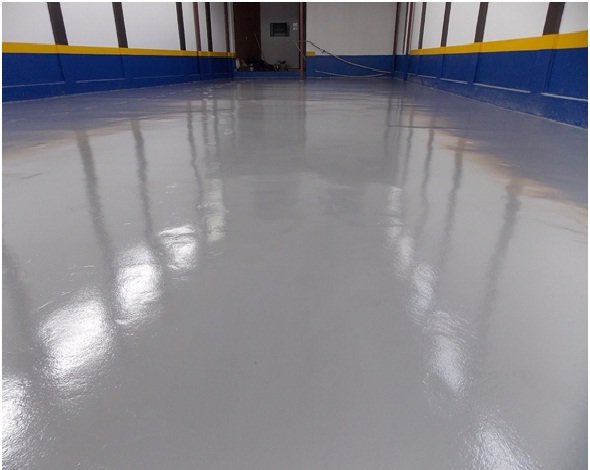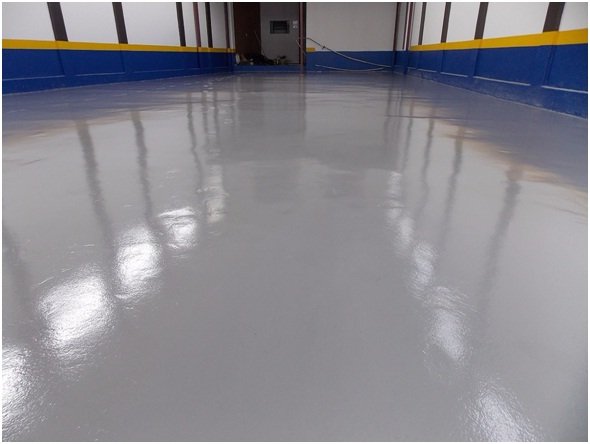

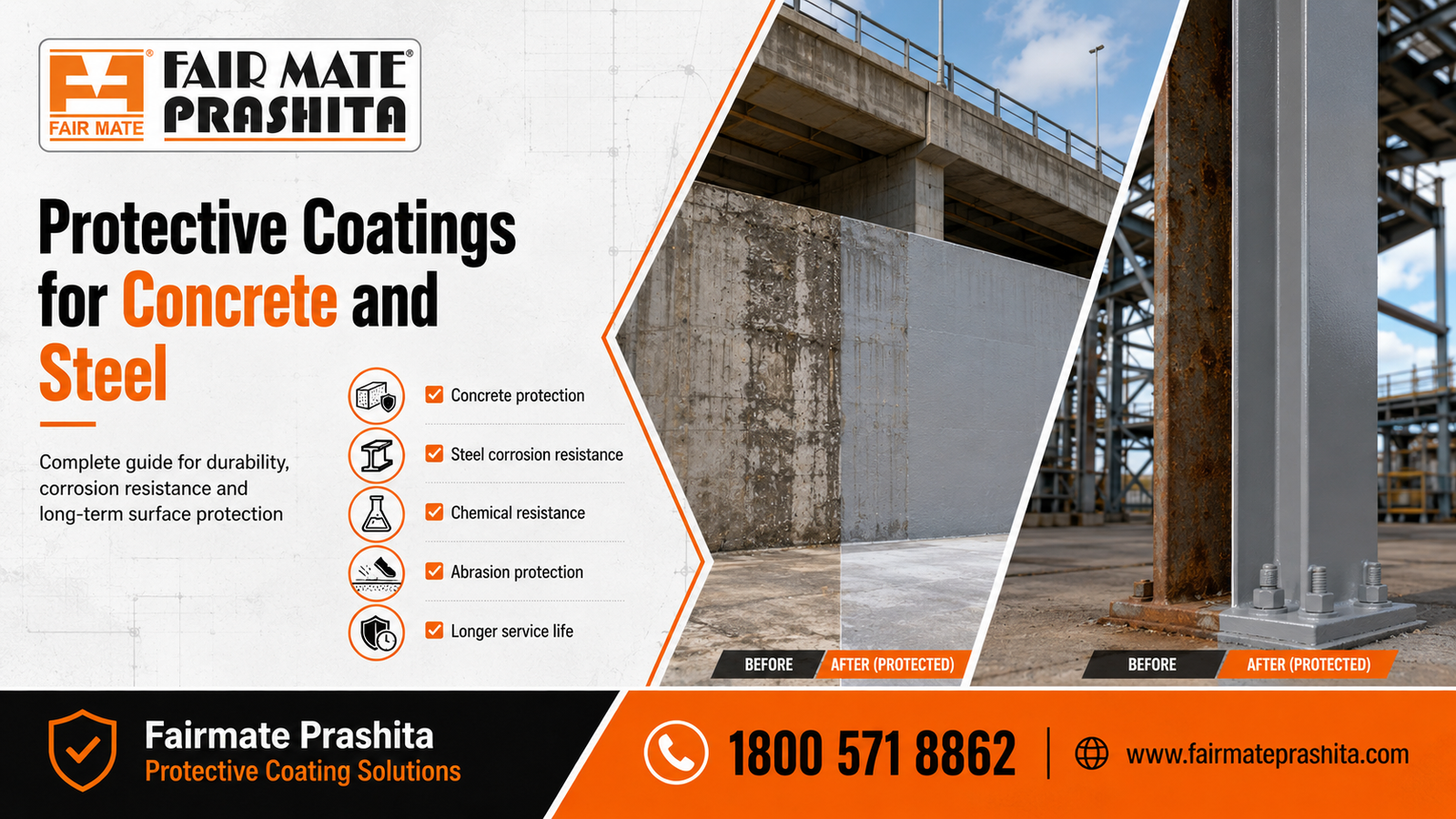
Fairmate Prashita protective coatings for concrete and steel surfaces in industrial and infrastructure projects

Protective Coatings for Concrete and Steel: Complete Guide | Fairmate Prashita
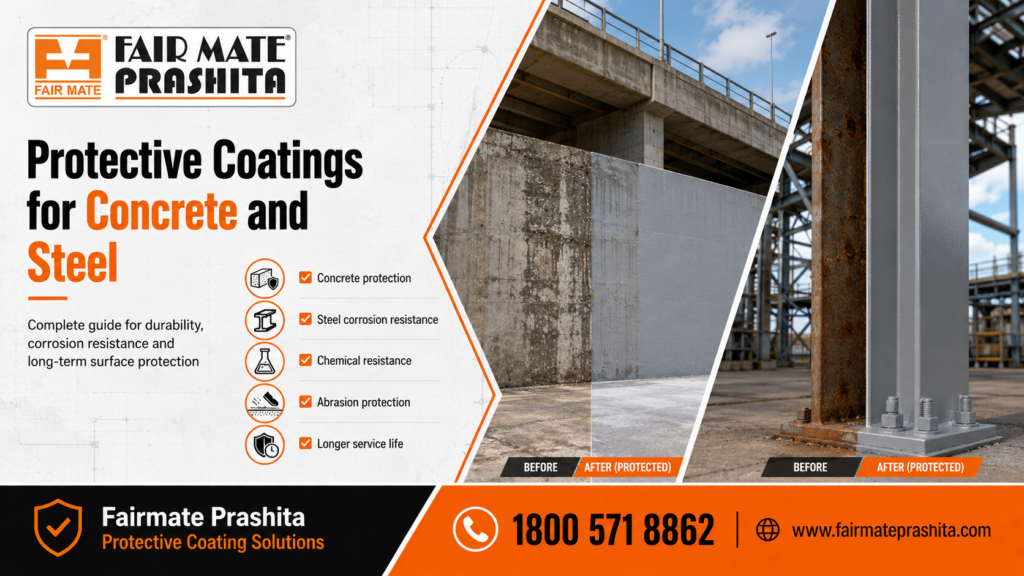
Fairmate Prashita protective coatings for concrete and steel surfaces in industrial and infrastructure projects

Protective Coatings for Concrete and Steel: Complete Guide

Concrete and steel are two of the most important materials used in modern construction and industrial infrastructure. From factories, warehouses, bridges, basements, water-retaining structures and parking areas to manufacturing plants and utility zones, these materials are exposed to moisture, chemicals, abrasion, carbonation, corrosion and weathering.

Protective coatings help create a durable barrier between the surface and the surrounding environment. For engineers, contractors and industrial buyers, the right coating system can improve service life, reduce maintenance cost and protect critical assets from early deterioration.

Fairmate Prashita offers construction chemical solutions including industrial flooring and protective coating systems for long-term site performance. (Fairmate Prashita)


What Are Protective Coatings?

Protective coatings are specially designed surface-applied systems used to protect concrete and steel from environmental, mechanical and chemical damage.

They are not only applied for appearance. Their main purpose is performance protection.

A good protective coating system can help improve:

✅ Surface durability
✅ Resistance to moisture ingress
✅ Resistance to chemicals and abrasion
✅ Protection against corrosion
✅ Cleanability and maintenance
✅ Long-term structural performance
✅ Aesthetic appearance of industrial and commercial spaces

For concrete and steel surfaces, coating selection should be based on exposure condition, surface condition, traffic load, chemical contact, temperature, moisture level and expected service life.


Why Protective Coatings Are Important for Concrete

Concrete is strong in compression, but it is naturally porous. Water, carbon dioxide, chlorides, sulphates and chemicals can enter through pores, cracks or weak surface zones. Over time, this may lead to reinforcement corrosion, surface scaling, cracking, dampness, dusting and durability loss.

Protective coatings for concrete help reduce direct exposure to aggressive elements.

They are commonly used for:

✅ Industrial floors
✅ Parking decks
✅ Basements
✅ Water tanks
✅ Factory walls and floors
✅ Chemical storage areas
✅ Utility rooms
✅ Commercial buildings
✅ Infrastructure structures
✅ Concrete repair protection

AMPP notes that concrete assets are coated to protect them against harsh service environments, and coating performance depends heavily on correct surface preparation. (ampp.org)


Why Protective Coatings Are Important for Steel

Steel is widely used in factories, structural frames, tanks, pipelines, platforms, equipment foundations and industrial infrastructure. However, when steel is exposed to moisture and oxygen, corrosion may begin.

Corrosion can reduce steel thickness, weaken structural performance, damage appearance and increase maintenance cost.

Protective coatings for steel help create a barrier against:

✅ Moisture
✅ Oxygen
✅ Industrial fumes
✅ Chemical splashes
✅ Weather exposure
✅ Salt-laden environments
✅ Abrasion and wear

For steel, coating selection must consider surface preparation grade, corrosion environment, dry film thickness, primer compatibility and topcoat performance.


Common Types of Protective Coatings

Different coating systems are used depending on project requirement. The most common types include:

1. Epoxy Coatings

Epoxy coatings are widely used for concrete and steel protection because of their strong adhesion, chemical resistance and durability.

They are suitable for:

✅ Industrial floors
✅ Warehouses
✅ Production areas
✅ Concrete protection
✅ Steel structures
✅ Chemical handling zones

Epoxy coatings are preferred where strength, bonding and chemical resistance are important.

2. Polyurethane Coatings

PU coatings are known for flexibility, UV resistance and abrasion resistance, depending on the system type.

They are suitable for:

✅ Exposed surfaces
✅ Parking areas
✅ Industrial floors
✅ Protective topcoats
✅ Areas requiring better weather resistance

3. Anti-Carbonation Coatings

Anti-carbonation coatings are mainly used on concrete surfaces to reduce carbon dioxide penetration and protect reinforcement from corrosion risk.

They are suitable for:

✅ RCC structures
✅ Bridges
✅ Exterior concrete walls
✅ Infrastructure projects
✅ Repair and rehabilitation work

4. Cementitious Protective Coatings

Cementitious coatings are used for concrete protection, waterproofing support and surface protection in specific applications.

They are suitable for:

✅ Water-retaining structures
✅ Basements
✅ Wet areas
✅ Concrete protection zones

5. Anti-Corrosive Coatings

Anti-corrosive coatings are used on steel surfaces to protect against rust and industrial exposure.

They are suitable for:

✅ Steel structures
✅ Tanks
✅ Pipelines
✅ Plant equipment
✅ Fabrication units
✅ Industrial sheds


Surface Preparation: The Most Important Step

Protective coating failure often starts before the coating is applied. Poor surface preparation is one of the biggest reasons for peeling, blistering, debonding, pinholes and premature failure.

For concrete, the surface must be checked for:

✅ Dust and laitance
✅ Oil, grease and contamination
✅ Weak or loose concrete
✅ Cracks and honeycombing
✅ Moisture condition
✅ Surface profile
✅ Previous coating compatibility

For steel, the surface must be checked for:

✅ Rust
✅ Mill scale
✅ Oil and grease
✅ Dust
✅ Existing coating failure
✅ Surface profile after blasting or cleaning

Concrete surface preparation standards highlight the need for a clean, sound, dry and properly profiled surface before applying coating or lining systems. (relisleeve.com)


How Protective Coatings Improve Durability

Protective coatings improve durability by limiting the contact between the structure and damaging external conditions.

They can help protect against:

✅ Water ingress
✅ Reinforcement corrosion
✅ Chemical attack
✅ Surface abrasion
✅ Carbonation
✅ Dusting
✅ Weathering
✅ Industrial contamination
✅ Cleaning chemical exposure

In industrial and infrastructure projects, durability is not optional. A failed coating can lead to downtime, repair cost, production disturbance and safety concerns.

This is why product selection and application quality must be treated as technical decisions, not only commercial decisions.


Key Areas Where Protective Coatings Are Used

Protective coatings are useful across many construction and industrial segments.

Industrial Projects

Factories, manufacturing units, warehouses, chemical plants, food processing units and utility buildings need coatings that support durability, cleanability and surface protection.

Commercial Buildings

Parking areas, service zones, basements, ramps, terrace equipment areas and exposed RCC surfaces require protective systems for long-term performance.

Infrastructure Projects

Bridges, flyovers, tunnels, water-retaining structures, treatment plants and marine-adjacent structures require protection from aggressive environments.

Steel Fabrication and Equipment

Steel tanks, platforms, pipelines, machinery bases and structural members need anti-corrosive protection to reduce rusting and maintenance frequency.


Common Protective Coating Failure Reasons

Protective coating problems can happen due to poor selection, poor preparation or poor application.

Common reasons include:

✅ Wrong coating system selection
✅ Poor surface cleaning
✅ Moisture trapped below coating
✅ Inadequate surface profile
✅ Application on weak substrate
✅ Incorrect mixing ratio
✅ Wrong application thickness
✅ Poor curing conditions
✅ Chemical exposure before full cure
✅ Incompatible primer or topcoat

To avoid failure, the project team should follow manufacturer guidance, conduct proper inspection and ensure applicators are trained for the selected system.


How to Select the Right Protective Coating

Before selecting a coating system, engineers and industrial buyers should evaluate:

✅ Surface type: concrete or steel
✅ Indoor or outdoor exposure
✅ Chemical exposure level
✅ Traffic and abrasion load
✅ Moisture condition
✅ Temperature during application
✅ Required finish
✅ Expected service life
✅ Maintenance schedule
✅ Application method
✅ Site shutdown time available

A coating used for a parking deck may not be suitable for a chemical storage area. Similarly, a steel structure exposed to industrial fumes may need a different system than an indoor equipment frame.

Correct coating selection should always be based on site condition and performance requirement.


Protective Coatings and Maintenance Planning

Protective coatings reduce maintenance, but they do not remove the need for inspection.

A proper maintenance plan should include:

✅ Regular surface inspection
✅ Checking cracks, peeling or blistering
✅ Cleaning chemical spills quickly
✅ Repairing damaged coating areas early
✅ Recoating before major failure
✅ Monitoring steel corrosion signs
✅ Checking water ponding areas

Early repair of coating damage can prevent larger surface failure and reduce long-term cost.


Fairmate Prashita Protective Coating Support

Fairmate Prashita supports engineers, contractors, applicators and industrial buyers with construction chemical solutions for concrete protection, industrial flooring, waterproofing, repair, grouting and protective coating requirements. (Fairmate Prashita)

Our technical team can help guide product selection based on surface type, project condition and performance requirement.

For coating support, connect with Fairmate Prashita.

📞 Call: 1800 571 8862
🌐 Website: www.fairmateprashita.com


Best Product Links:-

  1. SAFECORE PUD
    Best anchor text: polyurethane dispersion protective coating
    Use in section: Common types of protective coatings
  2. SAFECORE ANTICORROSIVE COAT
    Best anchor text: anti-corrosive coating for steel and rebars
    Use in section: Why protective coatings are important for steel
  3. SAFECORE EP PRIMER
    Best anchor text: epoxy primer for protective coating systems
    Use in section: Surface preparation and primer compatibility
  4. FAIRCOAT ELASTOMERIC
    Best anchor text: elastomeric protective coating
    Use in section: Protective coatings for exterior concrete surfaces

Conclusion

Protective coatings are essential for improving the durability, service life and performance of concrete and steel structures. They protect surfaces from moisture, corrosion, chemicals, abrasion, carbonation and industrial exposure.

For engineers and industrial buyers, the right coating system can reduce maintenance cost, improve safety and extend asset life. However, coating performance depends on correct product selection, proper surface preparation, skilled application and regular inspection.

Whether the project involves concrete floors, steel structures, basements, parking areas, factories, warehouses or infrastructure assets, protective coatings should be selected with a clear technical approach.

Request coating support from Fairmate Prashita for the right protective coating solution for your project.
CEMSCREED FAIRING COAT

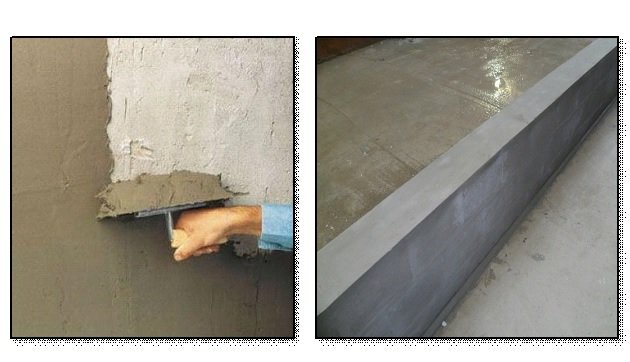
CEMSCREED FAIRING COAT is acrylic polymer modified cement based fairing coat. Its main purpose is to prepare concrete surfaces prior to application of a protective coating system. It just requires addition of sufficient quantity water and ready to use. When it is applied on concrete surface, it fills the surface irregularities up to 3mm. The specially selected and formulated polymer present in CEMSCREED FAIRING COAT eliminates the curing for internal application.

CEMSCREED FAIRING COAT is ideal for filling blow holes and all surface blemishes on concrete. It can be used on concrete structures like beam, slab, column, concrete walls, etc.

SALIENT FEATURES
•Requires only the addition of mixing water
•Excellent adhesion to concrete
•Excellent resistance to freeze / thaw action and carbonation
•Reduces ingress of water borne salts, such as chlorides
•Reduces atmospheric / chemical attack
•Reduce shrinkage
•Ensures good fair-faced concrete

APPLICATION PROCEDURE

1. Surface preparation
•Remove all dust, dirt, loose particles from the surface by means of oil free compressed air.
•Remove any corrosion deposits, paint coating, oil, grease, and algae by means of wire brush or any appropriate liquid.
•Wet the surface with water and remove access water before application of CEMSCREED FAIRING COAT.

2. Mixing
•Small quantity mixing can be done in drum mixer or bucket.
•Add 1 part of water in a clean container and slowly add 3 parts of CEMSCREED FAIRING COAT in it.
•Thoroughly mix it until homogeneous and smooth mix is achieved.
•For large quantity mixing, must be done in mechanical mixer.
•Add 8.75 litre of water in mixer drum and operate the machine.
•Now add 25kg bag of CEMSCREED FAIRING COAT in that mixer and continuously mix it for 3-5 minutes until homogeneous mix is achieved.

3. Application
•Apply prepared mixture on surface in 3mm thickness with help of steel trowel.
•Let it set partly, after that, apply a smooth coat over it.
•For very smooth surface, water can be sprinkled over it before final coating.

FAIRCOAT Anti-Carbonation, Protective, Decorative Coatings for Interior & Exterior concrete surfaces

In today world, concrete is the most used material / product in construction industry. Concrete structures exposed to atmospheric carbon dioxide emitted from various sources, in presence of moisture / water, atmospheric carbon dioxide diffuses slowly through the concrete and the process of carbonation is initiated, the pH of concrete slowly turns acidic and starts rusting the reinforcing steel bars. Anti-carbonation coatings are used as surface treatments that have a high resistance to carbon dioxide. They shield the concrete from carbonation by acting as a barrier. For example, Fairmate’s ‘FAIRCOAT’ is well known and is protecting several renowned structures in India.
Features of FAIRCOAT Anti-Carbonation Coatings
FAIRCOAT is a smooth protective, decorative anti-carbonation coating for interior & exterior surfaces with exceptional weathering characteristics. It is based on aliphatic elastomeric acrylic. It has been specially designed for the decoration and protection of concrete against attack from atmospheric carbon dioxide, airborne chlorides, acid rain, weathering etc. When it is applied on surface, it forms a flexible layer allows the surface to breath and acts as carbon dioxide barrier thus protecting the concrete in aggressive weather conditions. Properties include the following:

• Anti-carbonation properties
• Excellent waterproof coating
• High flexibility with crack bridging capabilities up to 2mm
• UV resistant
• Excellent bonding characteristic with the substrate
• Chloride ion diffusion is zero as per ASTM C 1202
• Resistance to carbon dioxide diffusion is > 50mm thickness of equivalent air layer as per EN 1062
• Non-toxic and non-flammable
• Good weathering properties (anti-algal & anti-fungal).

Concrete is a highly alkaline material and if un-carbonated it has a pH in the region of 12.6. Carbonation starts on the surface of the concrete and can ultimately reach the depth of the steel reinforcement within the concrete. The alkaline state of the concrete provides a passive resistive layer to the surface of the steel reinforcement that prevents corrosion.
Once concrete comes into contact with carbon dioxide and other pollutants within the air, then a reaction may occur. Carbon dioxide can form carbonic acid with the water in the cement that then neutralizes the alkaline state of the concrete. If this happens, then carbonation moves through the concrete as a front that gradually reduces the pH value to 8pH; neutral is 7pH. However, corrosion to the reinforcement can occur if the pH value falls below 11pH.
Carbonation occurs when carbon dioxide reacts with calcium hydroxide of concrete and deposits as calcium carbonate, which reduces the protection of embedded steel reinforcement. This, in turn, results in reinforcing steel becoming susceptible to attack by water and oxygen, causing corrosion of the steel and eventually spalling of the concrete.

Application Areas
Existing Building & Bridges: It can be applied as a protective coating in existing buildings and bridges to protect them from carbon dioxide, air borne chloride, and rain.
New Buildings & Bridges: FAIRCOAT can be applied as an anti-carbonation coating in new buildings and bridges, which will enable it to resist attack by carbon dioxide, airborne chloride, and rain.
Interior Decoration of Buildings: As FAIRCOAT is non-flammable and has excellent waterproof characteristics, it can be used in interior decoration.
To achieve effective anti-carbonation coating, a two-coat application is recommended. FAIRCOAT covers 3-4m2 per kg with a recommendation of two coats for a dark shade. The surface texture and porosity must be taken into account while estimating quantities.
For more details visit: www.fairmate.com or email: enquiry@fairmate.com

SAFECORE WB COATING

HIGH PERFORMANCE WATER DISPERSIBLE EPOXY COATING FOR FLOORS AND WALLS WITH ABRASION AND CHEMICAL RESISTANCE.

Description
SAFECORE WB COATING is a high performance, water dispersible Epoxy coating for the treatment of floors and walls.It is a user and environment friendly product.It contains no solvents and a very low odor during application. SAFECORE WB COATING canbe easily applied by brush, roller or airless spray.It provides a decorative look and abrasion chemically resistant coating with excellent durability.

Recommended Uses
 Can be used for floor coating in food factories, abattoirs, dairies, laboratories etc.
 As a chemically resistant coating for bund areas.
 As an anti-graffiti coating. As a hygienic, easily cleanable surface on walls, ceilings etc.

Advantage
 May be applied to dry or damp surfaces.
 Available in a range of colours.
 Low odour.
 Can be easily applied.
 Excellent resistance to water, oils, skydrol, petrol, dilute acids and alkalis, many solvents, etc.
 Very good adhesion to concrete.
 Hygienic and easily cleaned.

Application Instructions
Surface Preparation:
Concrete surfaces shall be a minimum of 21 days old and/or the residual moisture content shall be below 6%. Ensure that the concrete is clean and free from dust, laitance, grease, oil, curing compound, existing paint finishes, etc. Blow holes and defective concrete shall be made good using a proprietary repair compound FAIRSCREED VF.

Suitable mechanical treatment such as vacuum grit blasting, or chemical treatment such as acid etching is recommended to ensure a clean, uncontaminated surface.

Equipment Cleaning:
Clean all equipment with SAFECORE TOOL CLEAN, prior to curing of the resin.

Curing:
Allow to cure for a minimum of 24 hours @ 20ºC prior to foot traffic, and for a minimum of 48 hours prior to normal traffic. Full chemical resistance will be achieved following 7 days cure @ 20ºC.

Limitations:
Do not apply to wet or uncured concrete surfaces. Do not apply at temperatures of 3ºC or less. In poorly ventilated areas forced extraction must be provided.

Mixing:
Pour the contents of the BASE component into the HARDENER container and mix by mechanical means until uniform color and appearance is obtained. The mixed material should be thinned by the addition of water maximum up to 5% by volume of total material potable water.

SAFECORE WB COATING

HIGH PERFORMANCE WATER DISPERSIBLE EPOXY COATING FOR FLOORS AND WALLS WITH ABRASION AND CHEMICAL RESISTANCE

Description
SAFECORE WB COATING is a high performance, water dispersible Epoxy coating for the treatment of floors and walls.It is a user and environment friendly product.It contains no solvents and a very low odor during application. SAFECORE WB COATING canbe easily applied by brush, roller or airless spray.It provides a decorative look and abrasion chemically resistant coating with excellent durability.

Recommended Uses
• Can be used for floor coating in food factories, abattoirs, dairies, laboratories etc.
• As a chemically resistant coating for bund areas.
• As an anti-graffiti coating. As a hygienic, easily cleanable surface on walls, ceilings etc.

Advantage
• May be applied to dry or damp surfaces.
• Available in a range of colours.
• Low odour.
• Can be easily applied.
• Excellent resistance to water, oils, skydrol, petrol, dilute acids and alkalis, many solvents, etc.
• Very good adhesion to concrete.
• Hygienic and easily cleaned.

Application Instructions
Surface Preparation:
Concrete surfaces shall be a minimum of 21 days old and/or the residual moisture content shall be below 6%. Ensure that the concrete is clean and free from dust, laitance, grease, oil, curing compound, existing paint finishes, etc. Blow holes and defective concrete shall be made good using a proprietary repair compound FAIRSCREED VF.

Suitable mechanical treatment such as vacuum grit blasting, or chemical treatment such as acid etching is recommended to ensure a clean, uncontaminated surface.

Equipment Cleaning:
Clean all equipment with SAFECORE TOOL CLEAN, prior to curing of the resin.

Curing:
Allow to cure for a minimum of 24 hours @ 20ºC prior to foot traffic, and for a minimum of 48 hours prior to normal traffic. Full chemical resistance will be achieved following 7 days cure @ 20ºC.

Limitations:
Do not apply to wet or uncured concrete surfaces. Do not apply at temperatures of 3ºC or less. In poorly ventilated areas forced extraction must be provided.

Mixing:
Pour the contents of the BASE component into the HARDENER container and mix by mechanical means until uniform color and appearance is obtained. The mixed material should be thinned by the addition of water maximum up to 5% by volume of total material potable water.

Application:
Apply by brush, roller or airless spray to the prepared surface at a nominal rate of 0.20 to 0.25 kg/m² per coat, equivalent to a dry film thickness of 100 – 125 microns. A minimum two coat treatment is recommended, applying subsequent coats after a minimum interval of 18 hours curing. Ensure good ventilation after application, as this speeds up the physical drying stage of the curing process.

Note:
For absorbent surfaces, it is recommended that a priming coat of SAFECORE WB PRIMER, should be applied at a nominal rate of 0.20 Kg/m², prior to the coating application.

Should a non-slip finish is required, a suitable silica sand should be scattered onto the first coat of SAFECORE WBCOATING whilst still wet. The following day any excess sand may be swept from the surface using a clean brush prior to application of the second coat.

Coverage : A 5 Kg pack is sufficient to prime 25 m² of surface.

FAIRCOAT E-GREEN

Environment friendly protective and Decorative coating for interiors and Exteriors

THE BASIS OF ECO FRIENDLY PAINTS
Natural ingredients are at the heart of the unique qualities of FAIRCOAT E-GREEN. The binder is liquid silicate whose structural form and hardness is perfectly compatible with its inorganic colorants and the inorganic concrete and masonry structures it is applied to.

PENETRATION PROPERTY
The principle strength of silicate paints is their penetration within the substrate. This results in a solid mineral and insoluble compound of paint and substrate (concrete, natural stone, marble, etc). The cross-section through the render shows this penetration, which is also known as silification. This chemical bond locks the paints into the subsurface as opposed to organic coatings that sit on the surface.

FACTORS AFFECTING PENETRATION DEPTH
While penetration depth may not be critical for many architectural applications, greater penetration will have a significant effect on strength and durability of applications on cement based substrates, porous stone and traffic bearing surfaces. Penetration depth is influenced by the substrate’s pore structure and permeability, moisture content and surface preparation.

When FAIRCOAT E-GREEN is applied to suitable substrates, it penetrates and reacts to form a hard, insoluble silicate. It can also increase substrate hardness, particularly in cementitious materials. When applied to materials containing Portland cement, the silicate reacts with incompletely hydrated cement particles, converting unreacted calcium hydroxide (CaOH2 or hydrated lime) to harder calcium silicate hydrates.

WATER VAPOUR PERMEABILITY
The high water vapour permeability of silicate paints is due to their crystalline nature which ensures that humidity present in the masonry can freely pass from the substrate. Thus water cannot build up between the paint and the substrate – which normally leads to paint cracking/ blistering and being pushed off the surface. Instead, the substrate remains dry and the breathability of the building is maintained.

INCOMBUSTIBILITY
FAIRCOAT E-GREEN do not burn, unlike emulsion and other organic based paints. In the event of a fire breaking out, damage to the substrate is reduced and the paint does not give off any toxic fumes.

NO FUNGUS, ALGAE OR MOLD
The pure inorganic inert composition and high pH of silicate paints prevents any fungi, algae or mold growth, thus assuring a hygenic and clean paint layer. The absence of surface condensation due to the coatings high water vapor permeability, promotes a clean, healthy environment. Traditional organic paints provide smooth film coatings that do not breathe, attract moisture and fungi, algae and mold spores. Toxic mold growth is the number one health problem in building structures today. FAIRCOAT E-GREEN can improve the health of the building environment.

REGULATION OF TEMPERATURE
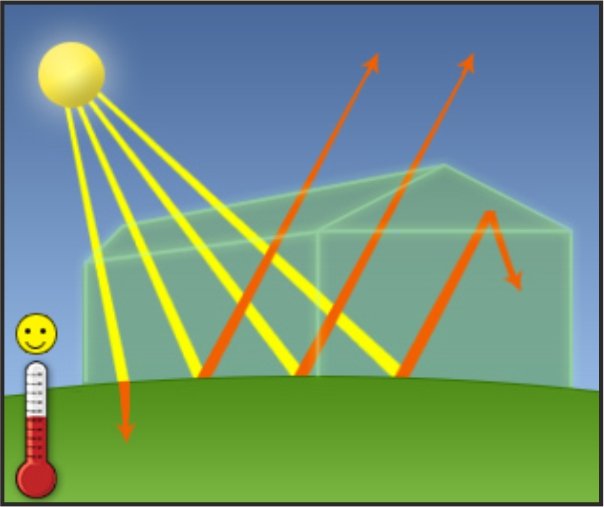
Silicate paints have a micro-crystalline structure, which reflects lightand heat. In hot climates this reflective property reduces the thermalstress on the structure and reduces the amount of cracking the substratewould normally undergo.

LIGHT FASTNESS
Neither harsh climates nor high UV radiation can alter the color of a FAIRCOAT E-GREEN Redecoration in the same color shade is possible after many years. Traditional organic paint coatings are subject to UV deterioration from day one, breaking down the paint film which changes the color and causes the coating to fail. Silicate paints have an extremely long life providing important economies over the long term.

ENVIRONMENTALLY SAFE
This water based Silicate paints are harmless to the environment, consisting of natural mineral compounds including quartz, inorganic mineral colorants and liquid silicate used as a binder. Silicate paints represent a technology which has no detrimental effects on the environment in terms of manufacturing as well as in terms of application. Under fire conditions no toxic fumes evolve as the FAIRCOAT E-GREEN does not ignite.

Thus FAIRCOAT E-GREEN is Breathable, Moisture Resistant, Does not contribute to growth of mold, algae or mildew, Durable and UV Resistant; does not yellow, fade or peel.

FAIRCOAT

PROTECTIVE, DECORATIVE, ANTI-CARBONATION COATING FOR EXTERIOR / INTERIOR SURFACES

DESCRIPTION

FAIRCOAT is ready to use aliphatic elastomeric based coating containing special polymers and fillers. FAIRCOAT provides extremely tough protective decorative coating that allows surface to breathe. FAIRCOAT has been specially designed for the decoration and protection of concrete against attack from atmospheric carbon dioxide, airborne chlorides, acid rain, weathering etc. FAIRCOAT is non-flammable and hence can be used in interiors also. FAIRCOAT has excellent adhesion to the substrate and cures to form a flexible film that allows the surface to breath and acts as carbon dioxide barrier thus protecting the concrete in aggressive weather conditions. It has excellent gap bridging ability and does not age with time, and forms an extremely durable film.

BENEFITS

• Anti-carbonation properties
• Good weathering properties (Anti algal and anti-fungal)
• Excellent bond with concrete substrate
• Forms flexible film
• Gap bridging properties
• Allows substrate to breath
• Choice of colours
• Single pack, brush applied
• Non-toxic/Non-flammable
• Excellent waterproof coating
• Economical

USES INCLUDE

• FAIRCOAT provides a smooth decorative durable coating for concrete and masonry surfaces like big commercial buildings, public places, residential building etc.

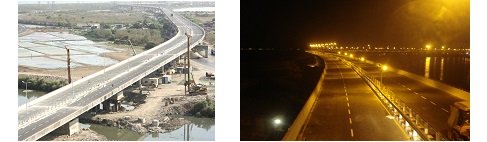
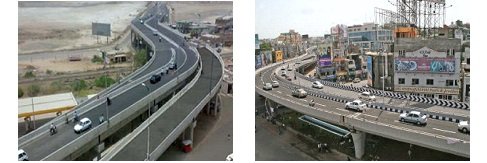
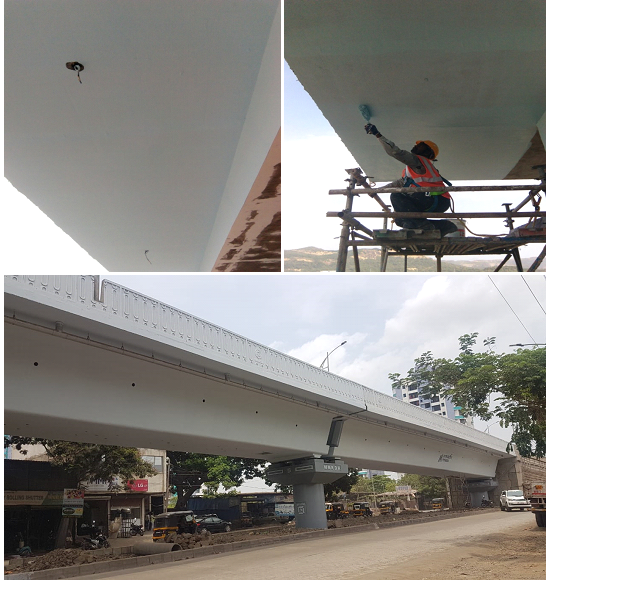
Longest fly over of India at Hyderabad, P V Narasimha Rao Elevated Expressway protected with FAIRCOAT- Anti carbonation coating.

Eastern Freeway Flyover, Mumbai (17 km signal free freeway) is the 2nd largest flyover in the country protected with FAIRCOAT- Anti carbonation coating.

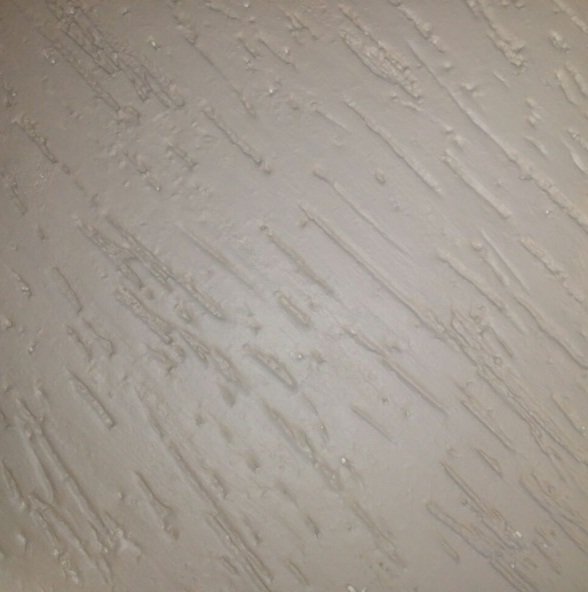
FAIRCOAT SCREED

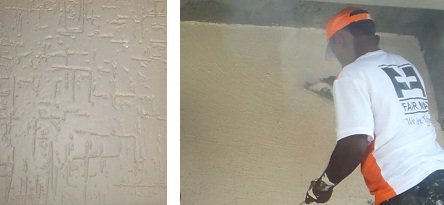
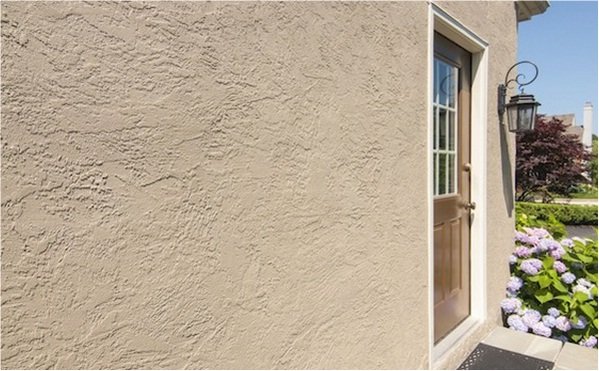
TEXTURED PROTECTIVE, DECORATIVE, ANTI-CARBONATION ACRYLIC SCREED FOR EXTERIOR / INTERIOR SURFACES

Benefits
1. Gives a textured finish
2. Anti-carbonation properties
3. Good weathering properties
4. Excellent bond.
5. Forms tough acrylic plaster
6. Allows substrate to breathe
7. Choice of colours
8. Single pack, Trowel applied
9. Non toxic/Non flammable
10. Excellent waterproof coating

Description

FAIRCOAT SCREED is ready to use acrylic based screed containing special polymers and fillers. It is a textured protective, decorative anti-carbonation screed for interior and exterior surfaces with exceptional weathering characteristics.

Recommended Uses

FAIRCOAT SCREED is used to provide a textured decorative durable coating for concrete and masonry surfaces. One coat application is recommended with a thickness of 1.5 to 2 mm.

Application Instructions

Surface Preparation :
Substrates must be clean, sound and free from dust and loose particles. All holes and cracks must be filled with a suitable filler. All traces of oil, grease or other contaminations must be removed. The new concrete surfaces must be atleast 14 days old before coating. If in doubt, allow full curing to take place for 28 days before application of FAIRCOAT SCREED.

Priming :
On old or porous surfaces, ensure that the substrate is sound and free from any loose particles. Apply FAIRCRETE SBL, apply FAIRCOAT SCREED on the primed surface.

Application :
Stir the material in the container thoroughly and spread evenly with trowel. Avoid application during rainy weather. The surface texture and porosity must be taken into account while estimating quantities.

Cleaning :
Tools should be cleaned immediately after use with water.