

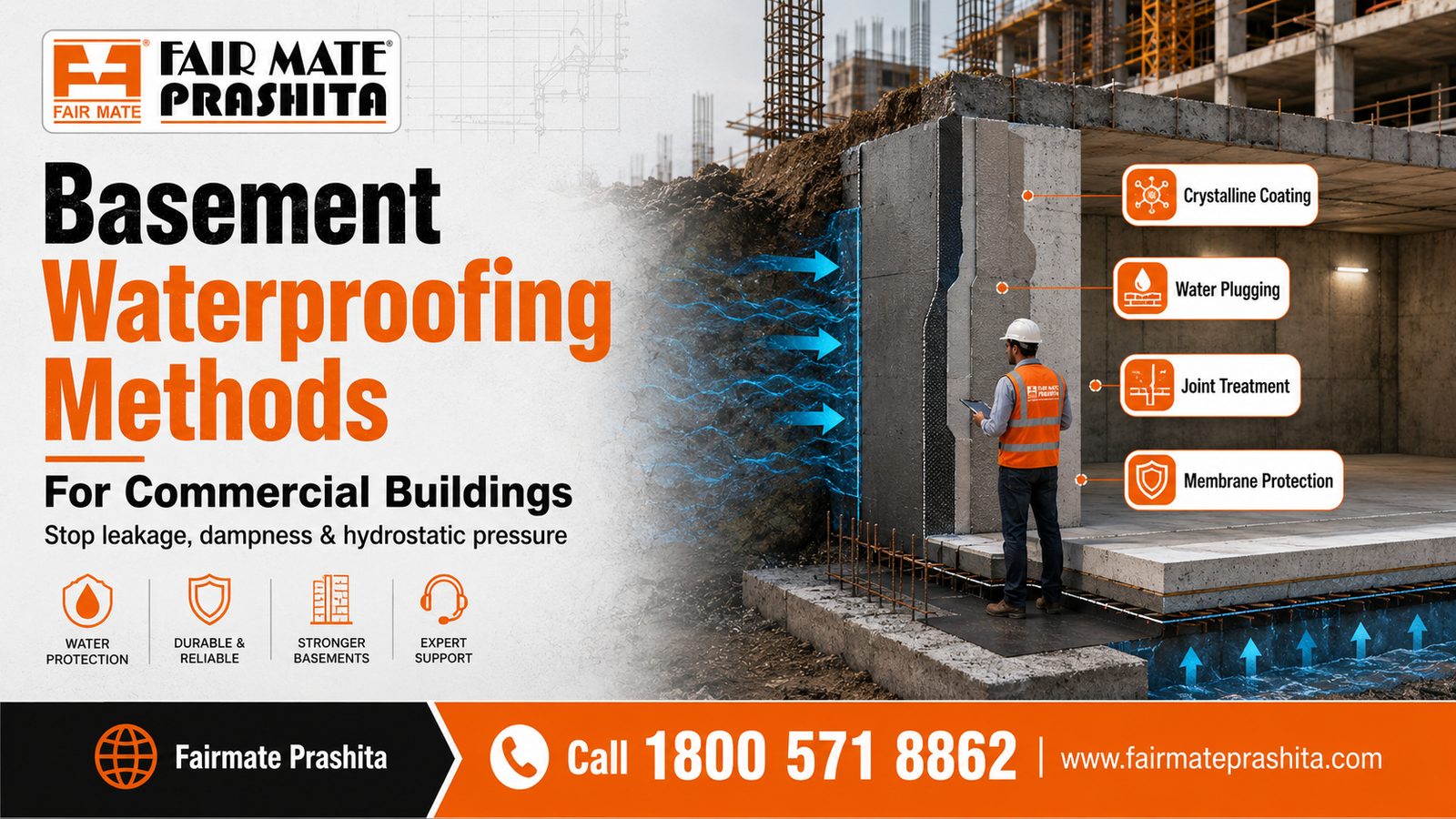
6 Basement Waterproofing Methods for Commercial Buildings

Basement Waterproofing Methods for Commercial Buildings

6 Basement Waterproofing Methods for Commercial Buildings
Basement waterproofing is one of the most important protection systems in commercial construction. In malls, hotels, hospitals, office buildings, factories, parking structures, warehouses and institutional projects, basements are exposed to constant moisture pressure from the surrounding soil. If waterproofing is not planned properly, water seepage, damp patches, concrete deterioration, corrosion of reinforcement, flooring failure, mould growth and long-term structural damage can occur.
For commercial buildings, basement waterproofing should not be treated as a cosmetic repair. It is a technical system that must be selected based on soil condition, water table, hydrostatic pressure, construction joints, concrete quality, retaining wall design and site exposure. A successful basement waterproofing method combines good concrete, proper joint treatment, surface preparation, leakage plugging and the correct waterproofing coating or membrane system.
Fairmate Prashita offers advanced waterproofing systems under the WATERGUARD range for basements, water tanks, retaining walls and other critical areas. These systems are designed to support builders, contractors, engineers, applicators and project consultants with practical product selection and technical guidance.

Why Basement Waterproofing Matters in Commercial Buildings

Commercial basements often serve high-value functions. They may be used for parking, electrical rooms, storage, HVAC systems, service areas, utility rooms or commercial back-end operations. Even small leakage can lead to major maintenance issues. Dampness can damage paint, plaster, flooring, electrical installations and stored materials. In severe cases, water ingress can affect concrete durability and reinforcement protection.
Basements face a different challenge compared to terraces or external walls. Water pressure does not only come from rainfall; it also comes from the surrounding ground. When groundwater pushes against the basement wall or raft slab, it creates hydrostatic pressure. This pressure can force water through cracks, honeycombs, construction joints, pipe penetrations and weak concrete areas. That is why basement waterproofing requires a system-based approach rather than a single coating.

1.Crystalline Waterproofing Method

Crystalline waterproofing is one of the most effective methods for basement concrete because it works within the concrete matrix. The material reacts with moisture and cementitious compounds to form crystals inside pores and capillaries. These crystals help block water movement through the concrete.

For basements exposed to water pressure, crystalline waterproofing is useful because it becomes part of the concrete surface and provides internal protection. It is commonly used on raft slabs, retaining walls, water tanks, lift pits and below-ground structures.

Fairmate Prashita’s WATERGUARD CRYSTALLINE is described as an easily brush-applied cementitious crystalline waterproofing coating. It is designed for well-prepared sound substrates and is applied for water tanks and basements where hydrostatic pressure exists. (Fairmate Prashita)

Best suited for:
Basement retaining walls, raft slabs, lift pits, water tanks, underground structures and concrete surfaces exposed to hydrostatic pressure.

2. Cementitious Waterproofing Coating

Cementitious waterproofing is widely used in commercial basements because it bonds well with concrete and masonry surfaces. It is practical, site-friendly and suitable for internal waterproofing where surfaces are prepared properly. Polymer-modified cementitious systems offer better flexibility, adhesion and durability compared to normal cement-based coatings.

This method is useful for basement walls, internal wet areas, retaining walls, tanks and service zones. It can be applied by brush, roller or trowel, depending on the product type.

Fairmate Prashita’s WATERGUARD A is a two-component acrylic cementitious waterproofing coating. It is described as a brush-applied polymer-modified cementitious waterproof coating that forms a tough, durable, abrasion-resistant and flexible waterproof layer with excellent adhesion. (Fairmate Prashita)

For higher performance needs, WATERGUARD A SUPER is a polymer-modified flexible cementitious waterproof coating. It is suitable for well-prepared substrates and can provide tough, durable waterproof rendering at 2–3 mm thickness for water tanks and basements. (Fairmate Prashita)

Best suited for:
Commercial basement walls, water tanks, retaining walls, internal concrete surfaces, utility rooms and service areas.

3. Fibre-Reinforced Waterproof Render

In basement areas where hydrostatic pressure is high, a simple coating may not always be enough. A thicker, fibre-reinforced waterproof render can provide additional protection. This method is especially helpful where the surface needs a more robust waterproof layer.

Fairmate Prashita’s WATERGUARD T is a trowel-applied, single-pack, fibre-reinforced waterproof cementitious render. It is described for water tanks and basements where hydrostatic pressure exists and is normally used in conjunction with WATERGUARD A as a primer. (Fairmate Prashita)

This type of waterproofing method is useful when the basement structure needs a stronger surface layer against water pressure and site wear. Proper surface cleaning, crack treatment and curing are important for performance.

Best suited for:
Basements with hydrostatic pressure, water-retaining structures, lift pits, retaining walls and heavy-duty below-ground concrete areas.

4. Water Plugging for Active Leakage

Before applying any coating or membrane, active leakage must be stopped. If running water is present through cracks, honeycombs, pipe penetrations or construction joints, coating directly over the leak will not solve the problem. The first step is to plug the leakage source.

Fairmate Prashita’s FAIRMATE WATERPLUG (S) is a fast-setting hydraulic compound that stops running water instantly. It sets in approximately 1 to 3 minutes depending on temperature and site conditions. (Fairmate Prashita)

Water plugging is especially important during basement repair projects where leakage is already visible. After plugging, the surface can be prepared for the correct waterproofing system.

Best suited for:
Active water seepage, running water points, cracks, tie-rod holes, honeycombs, basement wall leaks and emergency leakage repair.

5. PVC Water Stop for Construction Joints

Many basement leakages happen at joints, not through the main concrete body. Construction joints, contraction joints and expansion joints are weak points if not treated correctly. During new construction, PVC water stops are installed inside or outside the concrete joint to prevent water passage.

Fairmate Prashita’s WATERGUARD PVC WATER STOP is designed to stop possible leakage from construction, contraction and expansion joints in concrete elements. It is used for internal and external fixing and is resistant to abrasion and chemicals. (Fairmate Prashita)

For commercial basements, PVC water stops are important in raft-wall junctions, retaining wall joints, podium basement joints, water tanks, underground parking structures and expansion joint areas.

Best suited for:
New basement construction, raft-wall joints, retaining wall joints, expansion joints, water tanks and underground concrete structures.

6. Membrane Waterproofing Systems

For external basement waterproofing, membrane systems are often used on the positive side before backfilling. Membranes create a continuous barrier between the soil and the concrete surface. Depending on project requirements, membrane systems may include APP, SBS, TPO, EPDM, PU, polyurea or liquid-applied membranes.

Fairmate Prashita’s WATERGUARD range includes waterproofing membranes such as APP, SBS, TPO and EPDM options, along with PU, epoxy, acrylic modified coatings and liquid membranes. (Fairmate Prashita) These systems are suitable where the structure needs long-term protection from soil moisture and groundwater exposure.

For commercial projects, membrane selection depends on whether the waterproofing is being applied before backfilling, after concrete casting, on podium levels, or as part of a repair system.

Best suited for:
External basement walls, raft slabs, podiums, retaining walls, foundation areas and large commercial waterproofing projects.

Recommended Basement Waterproofing System Approach

A good basement waterproofing system should follow a proper sequence:

First, inspect the basement area and identify the source of water ingress. Second, repair cracks, honeycombs and weak concrete areas. Third, stop active leakage using a fast-setting plugging compound. Fourth, treat construction joints with the right water stop or joint system. Fifth, apply the selected waterproofing coating, render or membrane based on site exposure. Finally, protect the waterproofing layer before backfilling or finishing work.

The most common failure in basement waterproofing is not product failure but system failure. Poor surface preparation, incorrect product selection, inadequate curing, untreated joints and lack of supervision can reduce performance. That is why commercial projects should always involve technical consultation before finalizing the waterproofing method.

Final Thoughts

Basement waterproofing is a critical investment for commercial buildings. A well-designed waterproofing system protects the building from leakage, dampness, corrosion, maintenance cost and long-term structural deterioration. Whether the project requires crystalline waterproofing, cementitious coating, fibre-reinforced render, water plugging, PVC water stop or membrane waterproofing, the correct method must be selected based on site condition and water pressure.

Fairmate Prashita provides advanced construction chemical solutions for waterproofing, concrete repair, grouting, flooring, protective coatings and other building applications. For basement waterproofing product selection, application guidance or technical support, read the full guide and call 1800 571 8862.

Fairmate Prashita,
Advanced Construction Chemical Solutions
Corporate Office: 2nd Floor, Sarang House, Sheetal Nagar, Akota, Vadodara, Gujarat 390020.
📞 Toll Free: 1800 571 8862
🌐 Website: www.fairmateprashita.com
📧 Email: support@fairmateprashita.com
Waterproofing Chemicals for Roofs: Best Solutions for Long-Lasting Roof Protection

terrace roof waterproofing

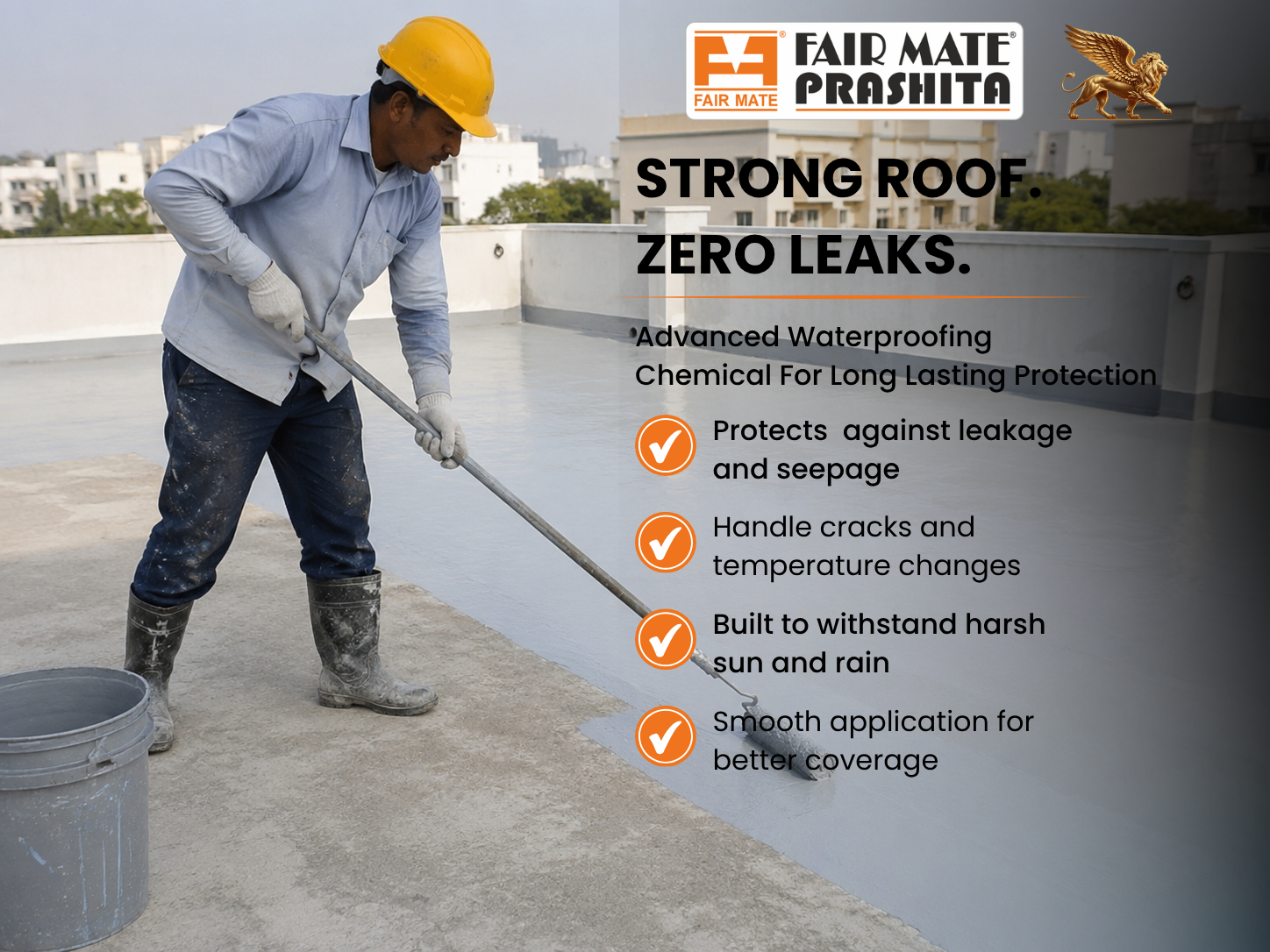
A roof is one of the most exposed parts of any building. It faces direct sunlight, rainfall, temperature changes, wind, pollution and continuous surface movement. Over time, these conditions can create cracks, damp patches, leakage, seepage and deterioration in concrete roof slabs. That is why choosing the right waterproofing chemicals for roofs is essential for every residential, commercial and industrial structure.

Whether it is a new building, an old terrace, a commercial roof slab or an industrial facility, roof waterproofing should never be treated as a temporary repair. It is a protective system that helps stop water ingress, reduce maintenance costs and increase the service life of the structure.

At Fairmate Prashita, we offer advanced construction chemical solutions for waterproofing, concrete repair, flooring, grouting, protective coatings and structural durability. Our WATERGUARD waterproofing systems are developed to support engineers, contractors, builders and applicators with reliable roof and terrace waterproofing performance.


What Are Waterproofing Chemicals for Roofs?

Waterproofing chemicals for roofs are specially formulated materials applied on roof slabs, terraces, concrete surfaces and exposed areas to stop water penetration. These chemicals create a protective barrier over the surface or within the concrete pores, depending on the type of waterproofing system used.

A good roof waterproofing chemical should provide:

  • Strong adhesion to concrete and masonry
  • Water resistance against rain and seepage
  • Flexibility to handle thermal movement
  • Crack-bridging performance
  • UV and weather resistance for exposed terraces
  • Long-term durability under Indian climatic conditions
  • Easy application by brush, roller, spray or trowel

Modern roof waterproofing is not just about applying a coating. It is about selecting the right system based on the roof condition, surface type, crack pattern, drainage slope, exposure level and expected performance.


Why Roof Waterproofing Is Important

Roof leakage usually starts slowly. A small crack, weak joint, poor slope or untreated surface may allow water to enter the roof slab. Once water enters the concrete, it can lead to dampness, paint peeling, corrosion of reinforcement, mould growth and structural deterioration.

Proper roof waterproofing helps prevent:

  • Terrace leakage during monsoon
  • Damp patches on ceilings and walls
  • Concrete deterioration due to moisture
  • Corrosion of steel reinforcement
  • Repeated repair expenses
  • Damage to interiors, electrical systems and furniture
  • Reduced building life

For Indian weather conditions, especially during heavy rainfall and high heat exposure, roof waterproofing chemicals must be selected carefully. A roof surface expands and contracts due to temperature variation, so the waterproofing layer should remain flexible and strongly bonded.


Common Causes of Roof Leakage

Before selecting the best waterproofing chemical for a roof, it is important to understand why leakage happens. Most roof leakage problems are caused by one or more of the following issues:

1. Hairline Cracks in Concrete

Concrete naturally develops micro-cracks due to shrinkage, thermal movement or poor curing. These cracks allow water to slowly penetrate the slab.

2. Poor Surface Slope

If water remains stagnant on the terrace, it increases pressure on the surface and may enter through weak points.

3. Weak Parapet Wall Joints

The junction between the roof slab and parapet wall is one of the most common leakage points.

4. Damaged Old Waterproofing Layer

Old coatings may lose adhesion, crack or peel due to UV exposure and weathering.

5. Improper Application

Even the best roof waterproofing chemical may fail if the surface is not cleaned, cracks are not repaired or coats are not applied properly.

6. Pipe Penetrations and Drainage Outlets

Areas around pipes, rainwater outlets and joints require proper detailing. Without correct sealing, these points become leakage paths.


How to Choose the Best Waterproofing Chemical for Roofs

The best waterproofing chemical for roof protection depends on the surface condition and site requirement. There is no single product that fits every roof. Before selecting a waterproofing system, check the following points:

1. Type of Roof Surface

Concrete roof slabs, tiled terraces, metal roofs and old coated surfaces may need different preparation and product selection.

2. New Roof or Old Roof

New construction may need preventive waterproofing, while old roofs may require crack repair, surface restoration and re-waterproofing.

3. Exposure to Sunlight

For exposed terraces, UV-resistant acrylic or elastomeric coatings are preferred.

4. Water Ponding

If water remains stagnant, slope correction and proper drainage should be done before waterproofing.

5. Crack Condition

Hairline cracks, active cracks and structural cracks need different treatment methods.

6. Foot Traffic

If the roof will be used frequently, the waterproofing layer may require additional protection.

7. Application Method

Some products are brush-applied, some are roller-applied and some may require professional applicators.

For best results, a technical site inspection is recommended before final product selection.


Step-by-Step Roof Waterproofing Application Process

A good waterproofing chemical can perform properly only when applied correctly. Follow this general roof waterproofing process:

Step 1: Surface Inspection

Check the roof for cracks, hollow areas, old coating failure, water ponding, weak plaster and drainage issues.

Step 2: Surface Cleaning

Remove dust, oil, loose particles, old paint, laitance, algae and weak material from the roof surface.

Step 3: Crack Repair

Repair all visible cracks, joints, pipe penetrations and parapet junctions before waterproofing.

Step 4: Slope and Drainage Correction

Water should flow properly toward drain outlets. Waterproofing should not be used as a replacement for poor slope correction.

Step 5: Surface Dampening or Priming

Depending on the waterproofing chemical, the surface may need dampening or primer application.

Step 6: First Coat Application

Apply the first coat uniformly using brush, roller or trowel as per product guidelines.

Step 7: Second Coat Application

Apply the second coat after the first coat dries. In many systems, the second coat is applied perpendicular to the first coat for better coverage.

Step 8: Detailing at Critical Areas

Give special attention to corners, drain outlets, pipe penetrations and parapet joints.

Step 9: Curing and Protection

Allow proper drying and curing time. Avoid foot traffic or water exposure before the system is ready.

Step 10: Final Inspection

Check the full roof surface for missed areas, pinholes, cracks or weak patches.


Why Choose Fairmate Prashita for Roof Waterproofing Chemicals?

Fairmate Prashita provides advanced construction chemical solutions for waterproofing, concrete repair, grouting, flooring, protective coatings and admixtures. For roof and terrace waterproofing, our WATERGUARD range is designed to support practical site requirements with durable, easy-to-apply and performance-focused systems.

For roof and terrace waterproofing, Fairmate Prashita offers a wide range of WATERGUARD Waterproofing Systems, including WATERGUARD ROOFCOAT for acrylic roof coating, WATERGUARD LIQUID MEMBRANE for flexible liquid-applied membrane waterproofing, WATERGUARD PU LIQUID MEMBRANE for polyurethane-based waterproofing, WATERGUARD A for cementitious waterproofing coating, and WATERGUARD CRYSTALLINE for crystalline waterproofing requirements. For concrete and plaster waterproofing during construction, FAIRCRETE RMW can also be considered as an integral waterproofing additive. 

Fairmate Prashita waterproofing advantages:

  • Wide range of WATERGUARD waterproofing systems
  • Solutions for roof slabs, terraces, tanks, basements and wet areas
  • Technical support for product selection
  • Suitable systems for new construction and repair projects
  • Strong focus on durability, adhesion and water resistance
  • Support for contractors, applicators, builders and engineers
  • Trusted construction chemical expertise for Indian site conditions

Whether the issue is roof leakage, terrace seepage, dampness, cracks or preventive waterproofing, Fairmate Prashita can help you choose the right waterproofing chemical for your project.

Conclusion

Waterproofing chemicals for roofs are essential for protecting buildings from leakage, seepage, dampness and long-term structural damage. A roof is constantly exposed to rain, heat, UV rays and surface movement, so selecting the right waterproofing system is a critical decision.

For concrete roof slabs and terraces, solutions such as cementitious waterproofing coatings, acrylic waterproofing coatings, liquid waterproofing membranes and polyurethane waterproofing systems can provide strong and durable protection when applied correctly.

If you are looking for reliable roof waterproofing chemicals, terrace waterproofing chemicals or a professional roof leakage solution, Fairmate Prashita’s WATERGUARD range offers practical and performance-driven options for different site requirements.

Protect your roof before leakage becomes a costly repair.
For product guidance, technical support or waterproofing solution selection, contact Fairmate Prashita today.

Call: 1800 571 8862
Website: www.fairmateprashita.com


FAQs

1. Which is the best waterproofing chemical for roofs?

The best waterproofing chemical for roofs depends on the roof type, crack condition, exposure and leakage severity. Cementitious coatings, acrylic waterproofing coatings, liquid membranes and polyurethane coatings are commonly used for roof waterproofing.

2. Which waterproofing chemical is best for terrace leakage?

For terrace leakage, flexible waterproofing coatings such as acrylic coatings, cementitious waterproofing systems or liquid waterproofing membranes are commonly recommended. The final choice should be made after checking cracks, slope, drainage and surface condition.

3. Can waterproofing chemicals stop roof leakage permanently?

Waterproofing chemicals can provide long-term leakage protection when the correct system is selected and applied properly. Surface preparation, crack repair, slope correction and proper coating thickness are important for durable performance.

4. How many coats are required for roof waterproofing?

Most roof waterproofing systems require two or more uniform coats. Some cementitious and acrylic systems may require 2–3 coats depending on site condition and product guidelines.

5. Can waterproofing be done during monsoon?

Waterproofing should ideally be done before monsoon. Application during active rain or on unsuitable wet surfaces can affect bonding and performance. Emergency leakage treatment may be possible in some cases, but full waterproofing should be planned in dry weather.

6. Is roof waterproofing different from terrace waterproofing?

Roof waterproofing and terrace waterproofing are closely related. A terrace is usually an accessible roof surface, so it may need additional attention to foot traffic, slope, cracks, parapet joints and drainage outlets.

7. Why does roof waterproofing fail?

Roof waterproofing may fail due to poor surface preparation, wrong product selection, inadequate crack repair, low coating thickness, poor drainage, trapped moisture or incorrect application method.

GET IN TOUCH

Schedule a Call

A wide-angle view of a modern construction material plant with stacks of concrete pipes, silos, and machinery. The foreground shows a bright orange industrial vehicle, while the background features a clear sky with light clouds and a distant mountain range. Overlaid text reads: "Sustainable Construction Using High-Performance Building Materials" with the Prashita Associates LLP logo in the top-left corner.

Sustainable Construction Using High-Performance Building Materials

Sustainability is no longer a trend — it’s a necessity. With increasing environmental regulations, rising material costs, and growing awareness of climate impact, the construction industry is undergoing a transformation.

At Fairmate Prashita LLP, we empower engineers, developers, and builders to make this shift with high-performance construction chemicals that reduce waste, enhance longevity, and support green building initiatives.

Why Sustainable Construction Matters

Traditional construction methods often lead to:

  • Excess material usage
  • High water consumption
  • Frequent maintenance and repairs
  • Shorter structure lifespans
  • High carbon emissions

Sustainable construction is about doing more with less — building smarter, stronger, and greener. And that starts with the materials you choose.

Two hands gently hold a futuristic digital representation of eco-friendly construction materials, including green bricks and plants growing from concrete blocks, symbolizing sustainability and innovation. The background is dark gray, with the overlaid text reading: "How Our Products Enable Greener Construction". Branding context: Prashita Associates LLP promotes sustainable construction solutions through advanced material science.

How Our Products Enable Greener Construction

Our building material solutions are designed with sustainability at their core. Here’s how:

1. Concrete Admixtures That Save Water and Cement

Fairmate Prashita’s range of water reducers, plasticizers, and superplasticizers enables:

  • Reduced water-cement ratios by up to 30%
  • Enhanced early and long-term strength
  • Lower cement consumption without compromising performance

By using less water and cement, these admixtures contribute to lower CO₂ emissions per cubic meter of concrete.

These are based on long-established product platforms known for their efficiency in green building certifications.

2. Waterproofing Systems That Extend Life Span

Waterproofing isn’t just about keeping water out — it’s about keeping structures intact for longer.

Our waterproofing range includes:

  • Crystalline coatings
  • Acrylic membranes
  • Bituminous membranes
  • Liquid-applied barriers

These systems:

  • Prevent corrosion of rebars
  • Minimize structural degradation
  • Eliminate the need for frequent repairs or reconstruction

Longer lifespan = lower material usage over time.

3. Flooring and Surface Hardeners That Resist Wear

In industrial and commercial environments, floor replacement is both expensive and environmentally taxing.

Our flooring systems like FAIRTOP and FAIRSCREED EP provide:

  • High abrasion resistance
  • Dustproof and chemical-resistant surfaces
  • Lower maintenance cycles
  • Less frequent renovation needs

Result: less material use, lower life-cycle cost, and longer intervals between replacements.

4. Sealants and Surface Treatments That Protect

Using the right joint sealants, curing compounds, and surface coatings can prevent moisture ingress, UV damage, and cracking — all of which contribute to early failure.

Prashita’s protective coatings and sealants:

  • Are non-toxic and VOC-compliant
  • Enhance thermal and chemical resistance
  • Improve building envelope durability

5. Smart Repair Solutions That Reduce Demolition

We also offer fast-setting repair mortars, injection grouts, and bonding agents that help restore aging structures without full-scale demolition.

This significantly reduces:

  • Debris generation
  • Material waste
  • Downtime on projects

Many of these products follow global benchmarks for eco-compliance and durability.

Certifications and Green Building Compliance

Our products contribute to:

  • IGBC & GRIHA credit points
  • LEED Green Building certifications
  • Sustainable infrastructure benchmarks
  • Reduced embodied energy and water footprint

They are ideal for projects with sustainability goals in residential, commercial, and public infrastructure segments.

Success in Practice: Sustainable Projects Delivered

Prashita has supported developers and civil engineers across India in green building projects, including:

  • Metro rail systems
  • Green-certified residential towers
  • Industrial plants with EHS mandates
  • Institutional buildings and campuses

Each solution is backed by formulations trusted for long-term performance and supported with our technical expertise.

Conclusion

Sustainable construction starts at the material level. With eco-conscious, performance-driven building materials, Prashita Associates LLP helps clients balance quality, cost-efficiency, and environmental responsibility.

By choosing advanced construction chemicals — you’re not just building for today, you’re building for generations.

Partner With Prashita for Greener Projects

📩 Email: support@fairmateprashita.com
🌐 Website:www.fairmateprashita.com
📞 Let’s design your next sustainable site together.


WATERPROOFING SYSTEM

Waterproofing system provides protection to the structure from water ingress. The practice of waterproofing dates back to ages where the different techniques used were bituminous, metallic sheet, poly-urethane based and so on.

The modern techniques used in waterproofing include:

1. Crystalline Waterproofing System

The crystalline waterproofing system works in a system where there are certain insoluble crystals which block the water bearing capillaries. This is a cement based system and is commonly used for the terrace gardens, balconies, basements, bathrooms, water tanks and other water bodies.

2. Flexible Membrane Waterproofing System

There are two main components involved for the successful working of the flexible membrane waterproofing system, Liquid Component and Powder Component. The liquid components acts as an acrylic emulsion and the powder component performs the function of a forming chemicals and fillers with polymer-modified cement. The combination of these two components forms slurry which is applied to the surface area needed to waterproof.

Importance of Waterproofing

Moisture and Humidity knows very well to find its way and seep into the interiors of your place thereby causing significant damage. It is very important to waterproof your home or building from all possible damage.

No waterproofing can lead to the development of cracks, paint peel off and even molds, mildew and air contaminants. It is also a great risk for the structure and foundation of the building. Not only for the building, it can also create health problems for the inhabitants. They also develop a musty smell which gradually increases making it difficult for the inhabitants.

Things to consider

Make sure you choose the best firm for waterproofing. If you select cheap waterproofing contractors you can also expect your work to be of cheap quality.
Before starting the waterproofing work give proper consideration to the area you need to waterproof in order to get an idea on the intensity of work to be done.
The right waterproofing system should be used according to their area of specification. That is, there are certain types of surfaces where crystalline waterproofing system is more suitable than the flexible membrane waterproofing system and vice versa. Though the products are of utmost quality there are fewer chances that you get the desired results.
Use the products before the expiry period. After which the application would not bring any desired results.

It is always recommended to go for those waterproofing companies which are BBB accreditation. In spite of spending a lot on this you deserve to get your waterproofing work last.