
Concrete Admixture Types: Uses, Benefits & Selection Guide for Better Concrete Performance

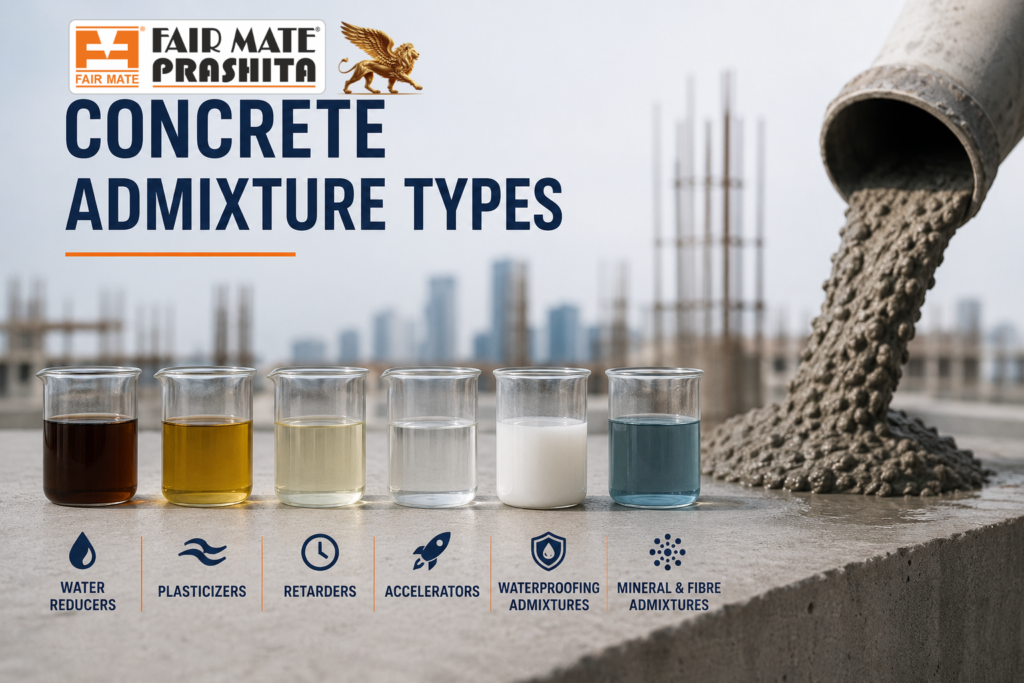
Concrete admixture types infographic showing water reducers, plasticizers, retarders, accelerators, waterproofing admixtures and mineral fibre admixtures for modern concrete construction by Fairmate Prashita.

Concrete is one of the most widely used construction materials in the world. But modern concrete is no longer just a mixture of cement, sand, aggregate, and water. Today, engineers, contractors, builders, RMC plants, and infrastructure companies use advanced concrete admixtures to improve workability, strength, durability, setting time, pumpability, and long-term performance.

Understanding different concrete admixture types is important because every project has different site conditions. Some projects need high workability, some need early strength, some need delayed setting time, and some need reduced permeability. The right admixture helps concrete perform better without unnecessarily increasing cement or water content.

At Fairmate Prashita, we provide advanced construction chemical solutions for concrete admixtures, waterproofing systems, grouts, repair mortars, flooring, protective coatings, and other site-performance requirements. Our concrete admixture solutions are designed to support modern construction with better workability, durability, and technical reliability.


What Are Concrete Admixtures?

Concrete admixtures are special materials added to concrete during mixing to improve its fresh or hardened properties. They are used in small quantities but can create a major improvement in concrete performance.

Concrete admixtures help control:

  • Workability
  • Setting time
  • Water demand
  • Slump retention
  • Pumpability
  • Strength development
  • Durability
  • Permeability
  • Segregation and bleeding
  • Surface finish

In simple words, admixtures help concrete become easier to place, stronger, more durable, and more suitable for specific site conditions.


Why Concrete Admixtures Are Important in Modern Construction

In earlier construction practices, workers often added extra water to concrete when the mix became stiff. This made placement easier, but it reduced strength, increased porosity, and affected long-term durability.

Modern construction cannot depend on such methods. High-rise buildings, bridges, roads, tunnels, industrial floors, precast elements, and RMC projects require controlled concrete performance. This is where concrete admixtures become essential.

The right admixture can help achieve:

  • Better workability without excess water
  • Higher compressive strength
  • Improved concrete density
  • Reduced water-cement ratio
  • Better pumpability for high-rise construction
  • Reduced honeycombing
  • Controlled setting time
  • Better finishing
  • Improved durability in aggressive environments
  • Lower maintenance and repair costs

Concrete admixtures are especially useful for RMC plants, infrastructure projects, industrial construction, precast concrete, mass concrete, and high-performance concrete.


Major Concrete Admixture Types

There are different types of concrete admixtures based on their function. Below are the most commonly used concrete admixture types in construction.


1. Water Reducing Admixtures

Water reducing admixtures are used to reduce the amount of water required in a concrete mix while maintaining the required workability. These admixtures improve the flow of concrete without increasing the water-cement ratio.

Uses

Water reducing admixtures are commonly used in:

  • RCC structures
  • Residential buildings
  • Commercial buildings
  • RMC concrete
  • Pumpable concrete
  • Precast concrete
  • Slabs, beams, columns, and foundations

Benefits

  • Reduces water demand
  • Improves workability
  • Enhances strength
  • Reduces porosity
  • Improves surface finish
  • Helps achieve better compaction
  • Reduces shrinkage and bleeding

Water reducing admixtures are suitable when the project requires improved concrete quality without adding extra water.


2. Plasticizers

Plasticizers are one of the most commonly used concrete admixture types. They improve the workability of concrete and make the mix easier to place and compact.

Plasticizers are useful for normal concrete where moderate improvement in workability is required. They are commonly used for M20, M25, and general RCC concrete applications.

Uses

  • General RCC work
  • Slabs and beams
  • Footings and columns
  • Site-mixed concrete
  • Low to medium grade concrete
  • Better compaction in reinforcement areas

Benefits

  • Improves flow of concrete
  • Reduces water requirement
  • Improves compaction
  • Reduces honeycombing
  • Enhances surface finish
  • Improves concrete quality

Plasticizers are a practical and economical solution for improving everyday concrete performance.


3. Superplasticizers

Superplasticizers are high-range water reducing admixtures used when concrete needs very high workability and strength. They are commonly used in high-performance concrete, RMC, precast concrete, self-compacting concrete, and heavily reinforced structures.

Superplasticizers allow concrete to flow easily without adding excess water. This helps maintain strength and durability while improving placement.

Uses

  • High-rise buildings
  • RMC plants
  • Precast concrete
  • Bridges and flyovers
  • Self-compacting concrete
  • Pumpable concrete
  • High-strength concrete
  • Congested reinforcement areas

Benefits

  • Provides high workability
  • Reduces water-cement ratio
  • Improves early and final strength
  • Enhances pumpability
  • Reduces segregation
  • Improves surface finish
  • Supports high-performance concrete

Superplasticizers are ideal where concrete must remain workable, strong, and durable under demanding site conditions.


4. Retarding Admixtures

Retarding admixtures are used to slow down the setting time of concrete. These admixtures are especially useful in hot weather, long-distance transportation, large pours, and RMC applications.

In hot weather, concrete can set too quickly, making placement and finishing difficult. Retarders help keep concrete workable for a longer time.

Uses

  • Hot weather concreting
  • RMC transportation
  • Mass concrete pours
  • Raft foundations
  • Dams and large structures
  • Long-distance concrete delivery
  • Large industrial slabs

Benefits

  • Delays setting time
  • Extends workability
  • Reduces cold joints
  • Improves placement time
  • Supports mass concreting
  • Helps in hot climatic conditions

Retarding admixtures are useful when concrete requires controlled setting and extended working time.


5. Accelerating Admixtures

Accelerating admixtures are used to speed up the setting and early strength development of concrete. These admixtures are useful when faster construction progress is required.

They are commonly used in repair works, precast production, cold weather concreting, and projects where early formwork removal is needed.

Uses

  • Fast-track construction
  • Precast concrete
  • Road repair
  • Concrete repair work
  • Cold weather concreting
  • Early strength requirement
  • Emergency repair applications

Benefits

  • Speeds up setting time
  • Improves early strength
  • Reduces construction time
  • Helps early demoulding
  • Supports repair and maintenance work
  • Useful in low temperature conditions

Accelerating admixtures are suitable when quick strength gain and faster project execution are required.


6. Slump Retaining Admixtures

Slump retaining admixtures are used to maintain concrete workability for a longer period. These are very important in RMC and long-distance concrete transportation.

Concrete may lose slump during transit due to time, temperature, cement type, and site delays. Slump retaining admixtures help maintain consistency until placement.

Uses

  • Ready-mix concrete
  • Long-distance concrete transportation
  • High-rise pumping
  • Hot weather concreting
  • Delayed placement sites
  • Infrastructure projects

Benefits

  • Maintains workability
  • Reduces need for water addition
  • Improves pumpability
  • Helps avoid site rejection
  • Reduces slump loss
  • Supports consistent concrete quality

Slump retaining admixtures are highly useful for RMC plants and large construction projects.


7. Air Entraining Admixtures

Air entraining admixtures introduce tiny, controlled air bubbles into concrete. These air bubbles improve resistance against freeze-thaw cycles and enhance durability in certain environmental conditions.

Although air entraining admixtures are more common in cold climates, they may also be used in specific applications where durability and workability improvement are required.

Uses

  • Pavements
  • Roads
  • Exposed concrete
  • Cold-region structures
  • Concrete exposed to freeze-thaw conditions
  • Durable infrastructure applications

Benefits

  • Improves freeze-thaw resistance
  • Enhances workability
  • Reduces bleeding
  • Improves durability
  • Helps protect concrete in harsh environments

Air entraining admixtures should be used carefully because excessive air can reduce concrete strength.


8. Waterproofing Admixtures

Waterproofing admixtures reduce water permeability and help improve concrete resistance against moisture ingress. These admixtures are used in concrete and plaster where water resistance is required throughout the depth of the mix.

Uses

  • Water tanks
  • Basements
  • Roof slabs
  • Bathrooms
  • External plaster
  • Retaining walls
  • Foundations
  • Concrete exposed to moisture

Benefits

  • Reduces permeability
  • Improves water resistance
  • Protects reinforcement
  • Enhances durability
  • Improves cohesion and compaction
  • Helps reduce seepage problems

Fairmate Prashita’s FAIRCRETE RMW is an integral waterproofing additive for concrete and plaster. It improves workability, reduces permeability throughout the depth of concrete, protects rebars, maintains strength, increases durability, and improves plasticity, cohesion, placing, compaction, and finishing.


9. Mineral Admixtures

Mineral admixtures are finely divided materials added to concrete to improve strength, durability, workability, or resistance to aggressive conditions. Common examples include fly ash, silica fume, ground granulated blast furnace slag, and other pozzolanic materials.

Uses

  • High-performance concrete
  • Mass concrete
  • Durable structures
  • Marine structures
  • Industrial floors
  • Infrastructure projects

Benefits

  • Improves long-term strength
  • Enhances durability
  • Reduces heat of hydration
  • Improves workability
  • Reduces permeability
  • Supports sustainable construction

Mineral admixtures are often used where long-term durability and lower heat generation are important.


10. Fibre Admixtures

Fibre admixtures are used to improve crack resistance, impact resistance, and toughness of concrete. These fibres may be synthetic, steel, polypropylene, macro, or micro fibres depending on the project requirement.

Uses

  • Industrial floors
  • Pavements
  • Shotcrete
  • Tunnel linings
  • Precast elements
  • Crack control applications

Benefits

  • Reduces plastic shrinkage cracks
  • Improves impact resistance
  • Enhances toughness
  • Helps control micro-cracking
  • Improves durability of concrete surfaces

Fibre admixtures are useful where concrete is exposed to movement, impact, abrasion, or shrinkage stress.


How to Select the Right Concrete Admixture Type

Selecting the correct admixture depends on the project requirement, mix design, cement type, aggregate quality, temperature, transportation time, and placement method.

Before selecting a concrete admixture, check:

  • Required concrete grade
  • Required slump
  • Water-cement ratio
  • Setting time requirement
  • Ambient temperature
  • Transportation distance
  • Pumping height or distance
  • Reinforcement congestion
  • Early strength requirement
  • Durability requirement
  • Exposure condition
  • Compatibility with cement and other materials

A trial mix is always recommended before final site use. The same admixture can perform differently with different cement brands, aggregate sources, water quality, and mix proportions.


Concrete Admixture Selection Guide

Project RequirementRecommended Admixture Type
Better workabilityPlasticizer or water reducing admixture
High strength concreteSuperplasticizer
Long-distance RMC supplySlump retaining admixture
Hot weather concretingRetarding admixture
Fast setting or early strengthAccelerating admixture
Reduced water permeabilityWaterproofing admixture
Crack controlFibre admixture
Durable mass concreteMineral admixture
Pumpable concreteSuperplasticizer or PCE-based admixture
Dense reinforced concreteHigh-range water reducer

Common Mistakes to Avoid While Using Concrete Admixtures

Even the best concrete admixture may fail if it is not used correctly.

Avoid these common mistakes:

  • Adding admixture without trial mix
  • Using wrong dosage
  • Adding extra water at site
  • Mixing admixture directly with dry cement without proper procedure
  • Ignoring cement compatibility
  • Not checking slump retention
  • Using expired or improperly stored admixture
  • Not following manufacturer’s technical data sheet
  • Mixing multiple admixtures without compatibility testing
  • Using the same admixture for every project without evaluation

Concrete admixtures should always be used with proper technical guidance and controlled dosage.


Why Choose Fairmate Prashita for Concrete Admixtures?

Fairmate Prashita offers a wide range of concrete admixture solutions for modern construction requirements. Our admixture range supports improved workability, slump retention, reduced water-cement ratio, setting control, durability, waterproofing, and better concrete performance.

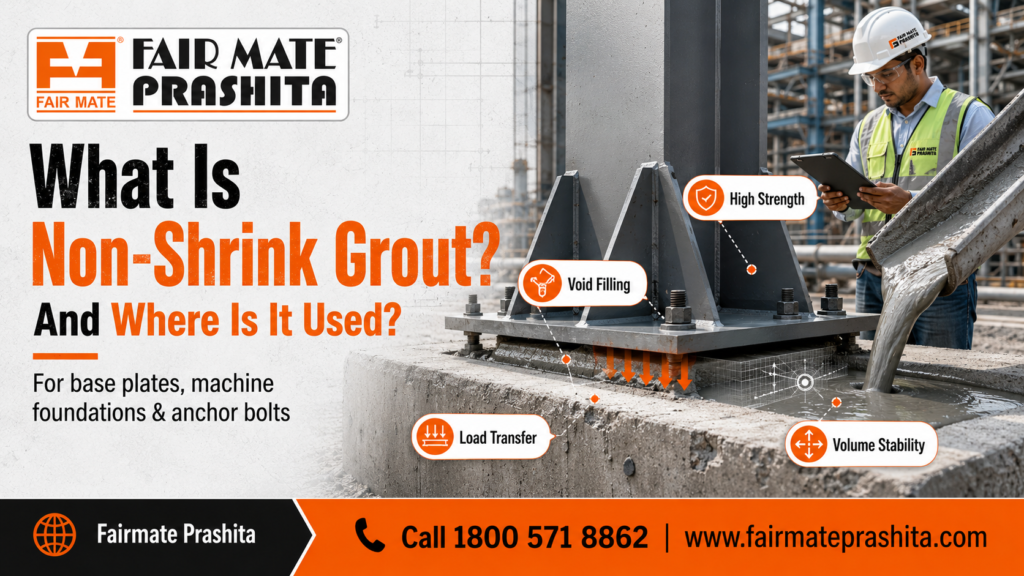
Fairmate Prashita offers a complete Concrete Admixtures range for modern concrete performance. Depending on project requirements, engineers and RMC plants can explore FAIRCRETE HP for water reduction, FAIRFLO for high-range superplasticizing performance, FAIRFLO RMC 100 and BROCRETE TRANSIT for slump retention and transit concrete, FAIRCRETE NC for early strength and acceleration, FAIRCRETE AE for air entrainment, FAIRCRETE RMW for integral waterproofing, FAIRMATE MICRO SILICA for mineral admixture applications, and FAIRFIBRE MACRO for fibre-reinforced concrete applications. 

Fairmate Prashita Admixture Advantages

  • Wide range of concrete admixture products
  • Solutions for RMC, RCC, precast, infrastructure, plaster, and waterproofing applications
  • Support for workability, strength, durability, and setting control
  • Technical guidance for product selection
  • Suitable for builders, contractors, engineers, applicators, and project consultants
  • Practical site-focused support for Indian construction conditions
  • Trusted construction chemical expertise

Fairmate Prashita’s concrete admixture range includes solutions for normal plasticizing, superplasticizing, slump retention, waterproofing, acceleration, retardation, fibre reinforcement, and mineral admixture applications.


Conclusion

Understanding different concrete admixture types helps engineers, contractors, builders, and RMC plants choose the right solution for better concrete performance. Whether the project requires workability, high strength, waterproofing, early strength, slump retention, or long-term durability, the right admixture can make concrete more reliable and economical.

Concrete admixtures are not just optional additives. They are performance-enhancing construction chemicals that help modern concrete meet demanding project requirements.

For technical guidance, product selection, and concrete admixture solutions, contact Fairmate Prashita for reliable construction chemical support.

Website:www.fairmateprashita.com
Toll Free: 18005718862


FAQs

1. What are the main concrete admixture types?

The main concrete admixture types include water reducing admixtures, plasticizers, superplasticizers, retarding admixtures, accelerating admixtures, air entraining admixtures, waterproofing admixtures, mineral admixtures, and fibre admixtures.

2. Which admixture is used to improve concrete workability?

Plasticizers and superplasticizers are commonly used to improve concrete workability without adding excess water.

3. Which admixture is best for high strength concrete?

Superplasticizers or high-range water reducing admixtures are generally used for high strength concrete because they reduce water-cement ratio while maintaining high workability.

4. Which admixture is used in RMC concrete?

RMC concrete commonly uses plasticizers, superplasticizers, water reducing admixtures, retarders, and slump retaining admixtures depending on transportation time and site requirement.

5. What is the use of retarding admixture?

Retarding admixtures slow down the setting time of concrete. They are useful in hot weather concreting, mass concrete, and long-distance concrete transportation.

6. What is the use of accelerating admixture?

Accelerating admixtures speed up the setting time and early strength development of concrete. They are used in repair works, precast concrete, and fast-track construction.

7. Can admixtures increase concrete strength?

Yes, some admixtures help increase concrete strength by reducing water demand, improving compaction, reducing porosity, and improving the water-cement ratio.

GET IN TOUCH

Schedule a Visit

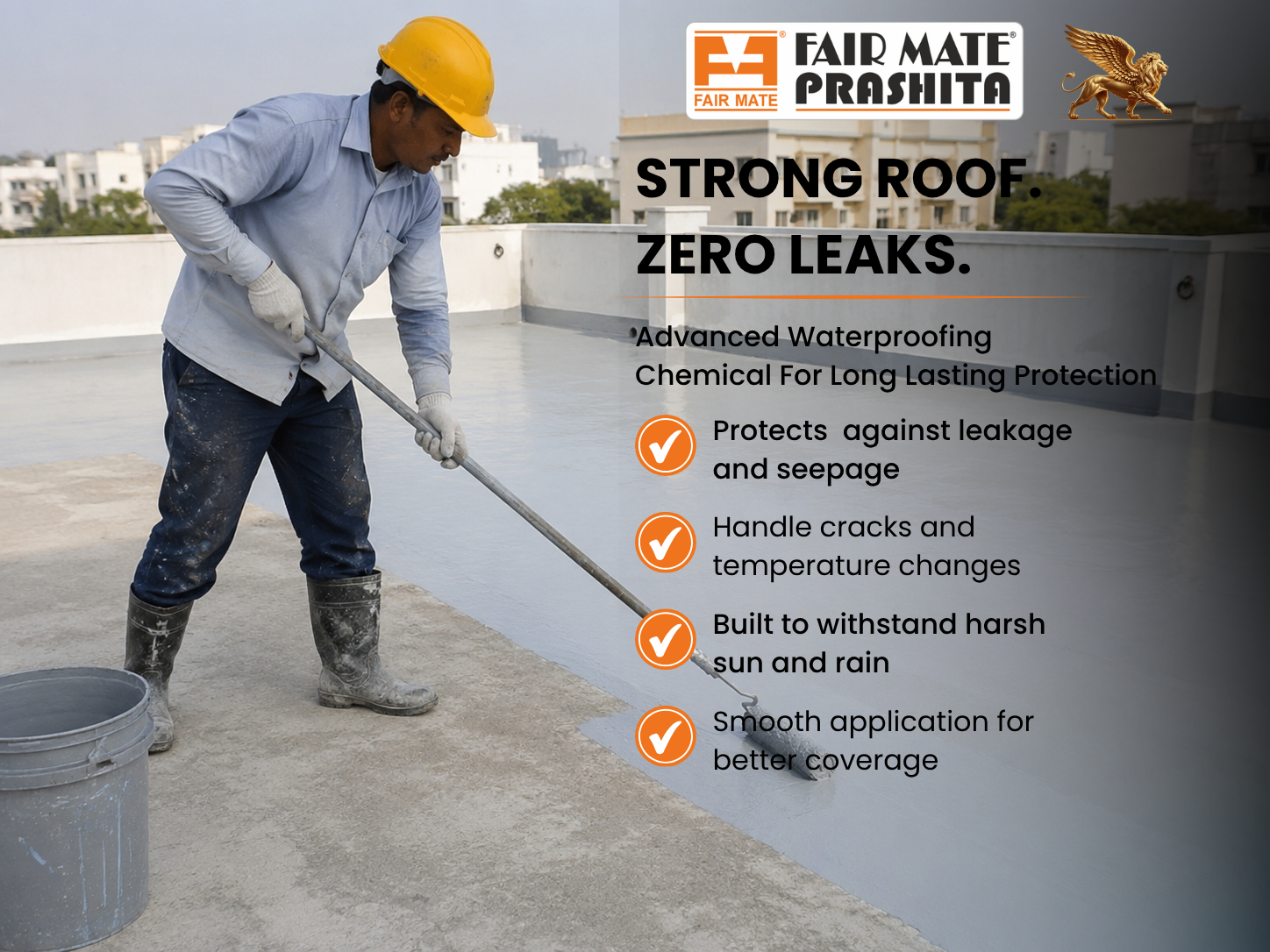
Waterproofing Chemicals for Roofs: Best Solutions for Long-Lasting Roof Protection

terrace roof waterproofing

A roof is one of the most exposed parts of any building. It faces direct sunlight, rainfall, temperature changes, wind, pollution and continuous surface movement. Over time, these conditions can create cracks, damp patches, leakage, seepage and deterioration in concrete roof slabs. That is why choosing the right waterproofing chemicals for roofs is essential for every residential, commercial and industrial structure.

Whether it is a new building, an old terrace, a commercial roof slab or an industrial facility, roof waterproofing should never be treated as a temporary repair. It is a protective system that helps stop water ingress, reduce maintenance costs and increase the service life of the structure.

At Fairmate Prashita, we offer advanced construction chemical solutions for waterproofing, concrete repair, flooring, grouting, protective coatings and structural durability. Our WATERGUARD waterproofing systems are developed to support engineers, contractors, builders and applicators with reliable roof and terrace waterproofing performance.


What Are Waterproofing Chemicals for Roofs?

Waterproofing chemicals for roofs are specially formulated materials applied on roof slabs, terraces, concrete surfaces and exposed areas to stop water penetration. These chemicals create a protective barrier over the surface or within the concrete pores, depending on the type of waterproofing system used.

A good roof waterproofing chemical should provide:

  • Strong adhesion to concrete and masonry
  • Water resistance against rain and seepage
  • Flexibility to handle thermal movement
  • Crack-bridging performance
  • UV and weather resistance for exposed terraces
  • Long-term durability under Indian climatic conditions
  • Easy application by brush, roller, spray or trowel

Modern roof waterproofing is not just about applying a coating. It is about selecting the right system based on the roof condition, surface type, crack pattern, drainage slope, exposure level and expected performance.


Why Roof Waterproofing Is Important

Roof leakage usually starts slowly. A small crack, weak joint, poor slope or untreated surface may allow water to enter the roof slab. Once water enters the concrete, it can lead to dampness, paint peeling, corrosion of reinforcement, mould growth and structural deterioration.

Proper roof waterproofing helps prevent:

  • Terrace leakage during monsoon
  • Damp patches on ceilings and walls
  • Concrete deterioration due to moisture
  • Corrosion of steel reinforcement
  • Repeated repair expenses
  • Damage to interiors, electrical systems and furniture
  • Reduced building life

For Indian weather conditions, especially during heavy rainfall and high heat exposure, roof waterproofing chemicals must be selected carefully. A roof surface expands and contracts due to temperature variation, so the waterproofing layer should remain flexible and strongly bonded.


Common Causes of Roof Leakage

Before selecting the best waterproofing chemical for a roof, it is important to understand why leakage happens. Most roof leakage problems are caused by one or more of the following issues:

1. Hairline Cracks in Concrete

Concrete naturally develops micro-cracks due to shrinkage, thermal movement or poor curing. These cracks allow water to slowly penetrate the slab.

2. Poor Surface Slope

If water remains stagnant on the terrace, it increases pressure on the surface and may enter through weak points.

3. Weak Parapet Wall Joints

The junction between the roof slab and parapet wall is one of the most common leakage points.

4. Damaged Old Waterproofing Layer

Old coatings may lose adhesion, crack or peel due to UV exposure and weathering.

5. Improper Application

Even the best roof waterproofing chemical may fail if the surface is not cleaned, cracks are not repaired or coats are not applied properly.

6. Pipe Penetrations and Drainage Outlets

Areas around pipes, rainwater outlets and joints require proper detailing. Without correct sealing, these points become leakage paths.


How to Choose the Best Waterproofing Chemical for Roofs

The best waterproofing chemical for roof protection depends on the surface condition and site requirement. There is no single product that fits every roof. Before selecting a waterproofing system, check the following points:

1. Type of Roof Surface

Concrete roof slabs, tiled terraces, metal roofs and old coated surfaces may need different preparation and product selection.

2. New Roof or Old Roof

New construction may need preventive waterproofing, while old roofs may require crack repair, surface restoration and re-waterproofing.

3. Exposure to Sunlight

For exposed terraces, UV-resistant acrylic or elastomeric coatings are preferred.

4. Water Ponding

If water remains stagnant, slope correction and proper drainage should be done before waterproofing.

5. Crack Condition

Hairline cracks, active cracks and structural cracks need different treatment methods.

6. Foot Traffic

If the roof will be used frequently, the waterproofing layer may require additional protection.

7. Application Method

Some products are brush-applied, some are roller-applied and some may require professional applicators.

For best results, a technical site inspection is recommended before final product selection.


Step-by-Step Roof Waterproofing Application Process

A good waterproofing chemical can perform properly only when applied correctly. Follow this general roof waterproofing process:

Step 1: Surface Inspection

Check the roof for cracks, hollow areas, old coating failure, water ponding, weak plaster and drainage issues.

Step 2: Surface Cleaning

Remove dust, oil, loose particles, old paint, laitance, algae and weak material from the roof surface.

Step 3: Crack Repair

Repair all visible cracks, joints, pipe penetrations and parapet junctions before waterproofing.

Step 4: Slope and Drainage Correction

Water should flow properly toward drain outlets. Waterproofing should not be used as a replacement for poor slope correction.

Step 5: Surface Dampening or Priming

Depending on the waterproofing chemical, the surface may need dampening or primer application.

Step 6: First Coat Application

Apply the first coat uniformly using brush, roller or trowel as per product guidelines.

Step 7: Second Coat Application

Apply the second coat after the first coat dries. In many systems, the second coat is applied perpendicular to the first coat for better coverage.

Step 8: Detailing at Critical Areas

Give special attention to corners, drain outlets, pipe penetrations and parapet joints.

Step 9: Curing and Protection

Allow proper drying and curing time. Avoid foot traffic or water exposure before the system is ready.

Step 10: Final Inspection

Check the full roof surface for missed areas, pinholes, cracks or weak patches.


Why Choose Fairmate Prashita for Roof Waterproofing Chemicals?

Fairmate Prashita provides advanced construction chemical solutions for waterproofing, concrete repair, grouting, flooring, protective coatings and admixtures. For roof and terrace waterproofing, our WATERGUARD range is designed to support practical site requirements with durable, easy-to-apply and performance-focused systems.

For roof and terrace waterproofing, Fairmate Prashita offers a wide range of WATERGUARD Waterproofing Systems, including WATERGUARD ROOFCOAT for acrylic roof coating, WATERGUARD LIQUID MEMBRANE for flexible liquid-applied membrane waterproofing, WATERGUARD PU LIQUID MEMBRANE for polyurethane-based waterproofing, WATERGUARD A for cementitious waterproofing coating, and WATERGUARD CRYSTALLINE for crystalline waterproofing requirements. For concrete and plaster waterproofing during construction, FAIRCRETE RMW can also be considered as an integral waterproofing additive. 

Fairmate Prashita waterproofing advantages:

  • Wide range of WATERGUARD waterproofing systems
  • Solutions for roof slabs, terraces, tanks, basements and wet areas
  • Technical support for product selection
  • Suitable systems for new construction and repair projects
  • Strong focus on durability, adhesion and water resistance
  • Support for contractors, applicators, builders and engineers
  • Trusted construction chemical expertise for Indian site conditions

Whether the issue is roof leakage, terrace seepage, dampness, cracks or preventive waterproofing, Fairmate Prashita can help you choose the right waterproofing chemical for your project.

Conclusion

Waterproofing chemicals for roofs are essential for protecting buildings from leakage, seepage, dampness and long-term structural damage. A roof is constantly exposed to rain, heat, UV rays and surface movement, so selecting the right waterproofing system is a critical decision.

For concrete roof slabs and terraces, solutions such as cementitious waterproofing coatings, acrylic waterproofing coatings, liquid waterproofing membranes and polyurethane waterproofing systems can provide strong and durable protection when applied correctly.

If you are looking for reliable roof waterproofing chemicals, terrace waterproofing chemicals or a professional roof leakage solution, Fairmate Prashita’s WATERGUARD range offers practical and performance-driven options for different site requirements.

Protect your roof before leakage becomes a costly repair.
For product guidance, technical support or waterproofing solution selection, contact Fairmate Prashita today.

Call: 1800 571 8862
Website: www.fairmateprashita.com


FAQs

1. Which is the best waterproofing chemical for roofs?

The best waterproofing chemical for roofs depends on the roof type, crack condition, exposure and leakage severity. Cementitious coatings, acrylic waterproofing coatings, liquid membranes and polyurethane coatings are commonly used for roof waterproofing.

2. Which waterproofing chemical is best for terrace leakage?

For terrace leakage, flexible waterproofing coatings such as acrylic coatings, cementitious waterproofing systems or liquid waterproofing membranes are commonly recommended. The final choice should be made after checking cracks, slope, drainage and surface condition.

3. Can waterproofing chemicals stop roof leakage permanently?

Waterproofing chemicals can provide long-term leakage protection when the correct system is selected and applied properly. Surface preparation, crack repair, slope correction and proper coating thickness are important for durable performance.

4. How many coats are required for roof waterproofing?

Most roof waterproofing systems require two or more uniform coats. Some cementitious and acrylic systems may require 2–3 coats depending on site condition and product guidelines.

5. Can waterproofing be done during monsoon?

Waterproofing should ideally be done before monsoon. Application during active rain or on unsuitable wet surfaces can affect bonding and performance. Emergency leakage treatment may be possible in some cases, but full waterproofing should be planned in dry weather.

6. Is roof waterproofing different from terrace waterproofing?

Roof waterproofing and terrace waterproofing are closely related. A terrace is usually an accessible roof surface, so it may need additional attention to foot traffic, slope, cracks, parapet joints and drainage outlets.

7. Why does roof waterproofing fail?

Roof waterproofing may fail due to poor surface preparation, wrong product selection, inadequate crack repair, low coating thickness, poor drainage, trapped moisture or incorrect application method.

GET IN TOUCH

Schedule a Call

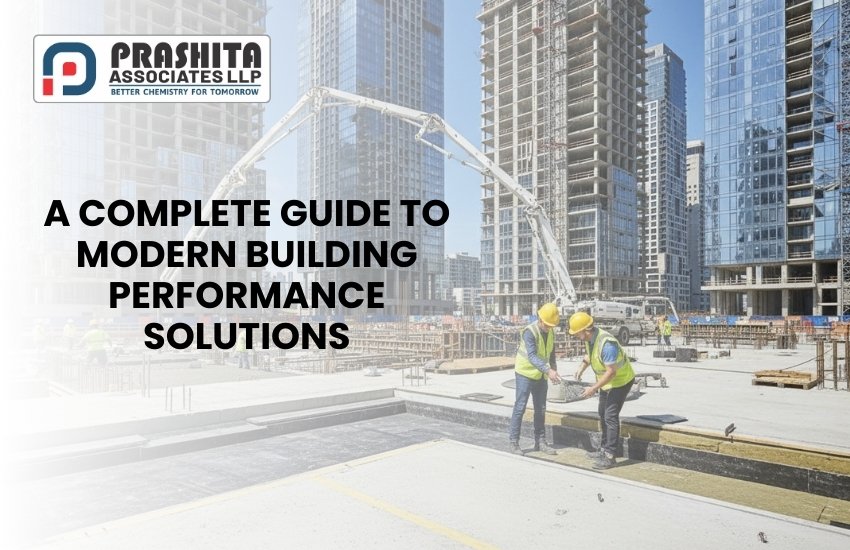
Construction chemicals used in modern building projects including concrete, waterproofing, and flooring systems

Construction Chemicals: A Complete Guide to Modern Building Perfothyrmance Solutions

In today’s fast-evolving construction industry, durability, efficiency, and long-term performance are no longer optional—they are essential. Traditional construction methods alone are not sufficient to meet the demands of modern structures exposed to harsh weather, chemical attack, load variations, and time. This is where construction chemicals play a decisive role.

Construction chemicals enhance the quality, strength, protection, and lifespan of buildings and infrastructure. From foundations to rooftops, from concrete production to final finishes, these specialized products have become an integral part of every successful construction project.

At Fairmate Prashita (formerly Fairmate / Prashita Associates LLP), construction chemicals are not treated as standalone products but as complete performance systems designed to solve real site challenges.

What Are Construction Chemicals?

Construction chemicals are specially formulated materials added or applied during construction to improve the properties of concrete, masonry, steel, and other building components. They are used to enhance workability, strength, waterproofing, bonding, durability, and resistance to environmental stress.

Unlike conventional materials, construction chemicals work at a chemical and micro-structural level, making structures stronger, more resilient, and more sustainable.

Why Construction Chemicals Are Essential Today

Modern construction faces challenges such as:

  • Reduced water availability
  • Faster project timelines
  • Higher load and usage demands
  • Aggressive environmental conditions
  • Increasing expectations for finish and aesthetics

Construction chemicals address these challenges by:

  • Improving concrete performance without increasing cement content
  • Protecting structures against water ingress and corrosion
  • Extending service life and reducing maintenance costs
  • Enhancing construction speed and consistency

Key Categories of Construction Chemicals

1. Waterproofing Chemicals

Water is one of the biggest enemies of concrete structures. Uncontrolled moisture leads to corrosion, cracking, efflorescence, mold growth, and structural deterioration.

Waterproofing chemicals form protective barriers or crystalline structures that prevent water penetration while maintaining breathability where required.

Applications include:

  • Basements and foundations
  • Roof slabs and terraces
  • Bathrooms and wet areas
  • Water tanks and reservoirs
  • External walls

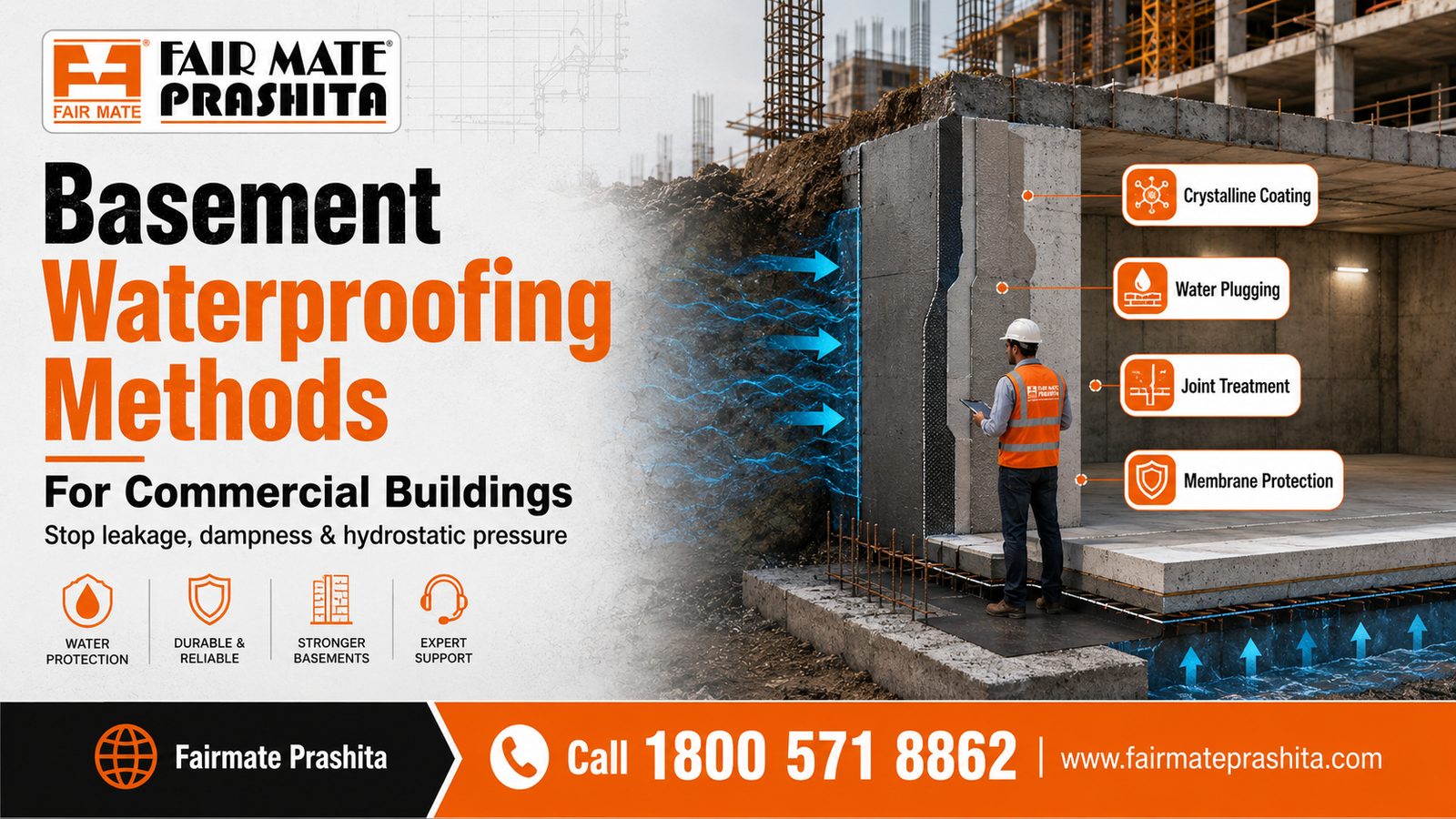
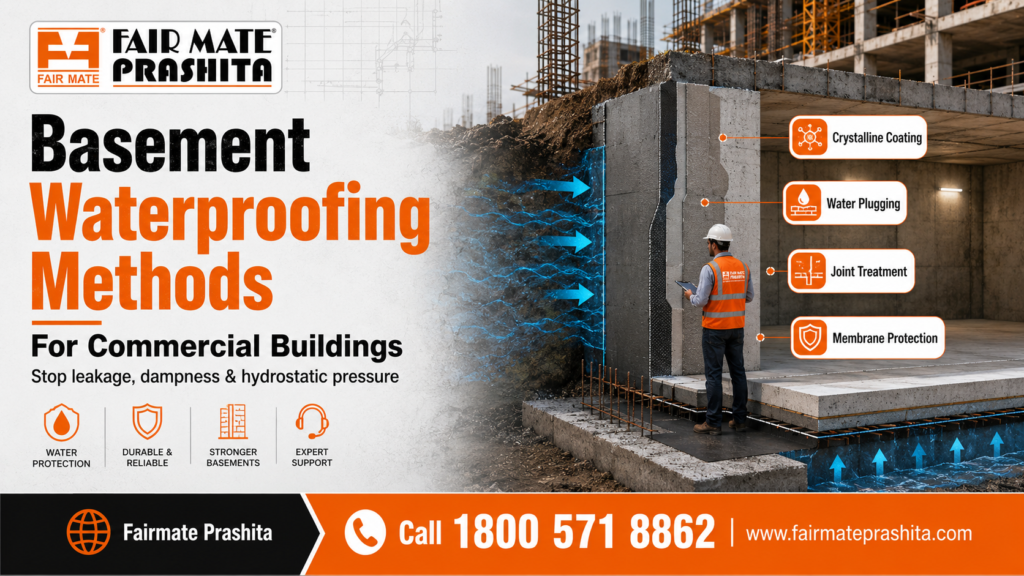
Prashita Associates provides waterproofing systems designed for positive side, negative side, and integral protection, ensuring comprehensive moisture control throughout the structure.

2. Concrete Admixtures

Concrete admixtures modify the behavior of concrete in both fresh and hardened states. They are essential for achieving consistent quality and performance under varying site conditions.

Benefits of admixtures:

  • Improved workability with lower water content
  • Higher early and ultimate strength
  • Reduced permeability
  • Controlled setting time
  • Enhanced durability

Concrete admixtures are used in:

  • Ready-mix concrete plants
  • High-rise buildings
  • Infrastructure projects
  • Precast elements

Prashita Associates offers admixture solutions that balance performance, economy, and site practicality, ensuring reliability across different cement grades and aggregates.

3. Repair Mortars and Structural Rehabilitation

Over time, structures suffer from cracks, spalling, corrosion, and surface damage. Repairing these defects without addressing their root cause often leads to recurring failures.

Repair mortars and rehabilitation systems are engineered to:

  • Restore structural integrity
  • Protect reinforcement steel
  • Improve load-carrying capacity
  • Extend the life of existing structures

Typical applications include:

  • Concrete patch repairs
  • Column and beam restoration
  • Structural strengthening
  • Industrial maintenance

Prashita Associates’ repair systems are designed with compatibility in mind, ensuring proper bonding, low shrinkage, and long-term durability.

4. Grouts and Anchoring Systems

Precision and load transfer are critical in machinery installation, precast connections, and anchoring applications. Grouts ensure full contact, high strength, and vibration resistance.

Types of grouts include:

  • Cementitious non-shrink grouts
  • Precision grouts for machinery bases
  • Flowable grouts for void filling

Anchoring chemicals provide high pull-out strength for:

  • Anchor bolts
  • Rebar dowels
  • Structural fixings

Prashita Associates supplies grout solutions engineered for flowability, strength development, and dimensional stability.

5. Industrial Flooring Solutions

Industrial floors are subjected to heavy loads, abrasion, chemicals, and constant traffic. Standard concrete floors are rarely sufficient without additional protection.

Industrial flooring systems provide:

  • Seamless and hygienic surfaces
  • Chemical and abrasion resistance
  • Improved safety and aesthetics
  • Easy maintenance

Used in:

  • Manufacturing plants
  • Warehouses and logistics centers
  • Pharmaceutical units
  • Commercial and institutional spaces

Prashita Associates delivers flooring solutions tailored to specific operational and environmental demands.

How Construction Chemicals Improve Sustainability

Construction chemicals contribute significantly to sustainable construction practices by:

  • Reducing cement consumption
  • Increasing structural lifespan
  • Lowering maintenance frequency
  • Enhancing energy efficiency through better sealing and insulation

By improving performance at a material level, they help reduce the overall environmental footprint of construction projects.

Choosing the Right Construction Chemical Partner

Selecting the right supplier is as important as choosing the right product. A reliable construction chemical partner offers more than materials—they provide technical guidance, application support, and long-term accountability.

Prashita Associates focuses on:

  • Application-oriented product development
  • Consistent quality and performance
  • On-site technical assistance
  • Solutions tailored to Indian conditions

Backed by industry experience and supported by proven formulations, Fairmate Prashita ensures that each project receives the right chemical system for lasting results. Selected product lines are sourced and manufactured in alignment with established brands such as Fairmate, ensuring reliability and performance consistency.

Conclusion

Construction chemicals are no longer optional additives—they are core components of modern construction. From enhancing concrete performance to protecting structures against water, chemicals, and wear, they play a vital role in building safer, stronger, and longer-lasting structures.

With its comprehensive range of construction chemicals and solution-driven approach, Fairmate Prashita stands as a dependable partner for builders, contractors, engineers, and architects seeking performance without compromise.

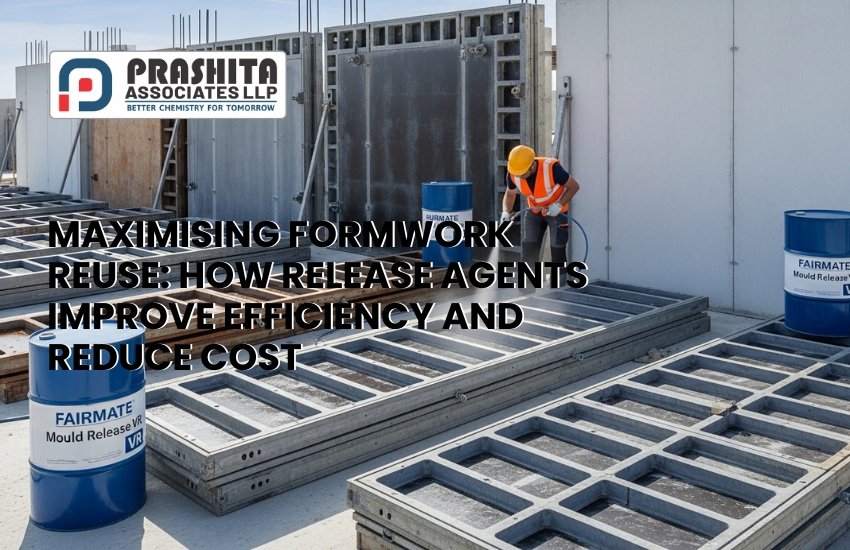
Formwork Reuse Maximization: How Release Agents Improve Efficiency and Reduce Cost

Formwork Resue represents a significant portion of the cost and time in any concrete job. Every cycle of casting, stripping, cleaning and reuse is an opportunity to reduce cost and improve efficiency. One overlooked but impactful lever is the release agent used on the formwork. The right product can transform operations, reduce downtime and deliver better concrete finishes.

Why Formwork Reuse is Critical

  • Cost implications: Formwork materials (timber, steel, plastic) represent capital investment. Maximizing the number of uses per shutter cycle reduces cost per cast.
  • Labour/time savings: Faster stripping and minimal clean-up reduce labour hours, free up resources and accelerate schedules.
  • Maintenance and refurbishment: Poor release agents cause build-up of cement paste, which means frequent cleaning, sand-blasting or recoating of formwork surfaces — adding cost.
  • Quality of finish: Smooth, uniform formwork surfaces lead to high-quality cast-concrete with fewer defects.

What a Premium Release Agent Delivers

A high-performance release agent should provide:

  • Clean demoulding with minimal residue
  • Lower cleaning and refurbishment requirements
  • Consistent texture and finish on the cast concrete
  • Protection of the formwork surface itself, increasing its reuse life
  • Compatibility across formwork materials for simplified logistics

FAIRMATE Mould Release VR / Super – Features & Advantages

With FAIRMATE’s Mould Release VR, you get:

  • Eco-friendly formulation: Vegetable-oil based, ready to use, non-toxic.
  • Multi-substrate support: Works across plywood, timber, steel, aluminium and plastic-faced moulds.
  • Surface finish enhancement: Non-staining, provides uniform texture and aesthetics.
  • Operational efficiency: Easier cleanup and faster turnaround of formwork.

Operational Benefits: Turnaround, Labour, Quality

  • Faster stripping: Because the agent forms a bond-break film, formwork can be stripped quickly without waiting for additional release action.
  • Lower labour costs: Less time spent cleaning cement paste and shutter faces reduces labour hours and improves site productivity.
  • Improved surface quality: Uniform release leads to better fair-faced concrete, fewer defects, less rework and higher client satisfaction.
  • Formwork longevity: By protecting shutter surfaces, the agent enables more reuse cycles and lowers cost over time.

Implementation Tips for Contractors

  • Ensure shutter cleanliness: Before application, remove old oils, cement residue and rust.
  • Apply thin, even coats: Over-application doesn’t improve release but can cause surface issues.
  • Monitor coverage: Track litres per m² and maintain consistency across casts.
  • Train labour: Make sure applicators understand the material and cure/strip timing.
  • Track reuse cycles: Monitor formwork reuse count and inspect shutter faces regularly.

ROI & Long-Term Gains

Consider a mid-rise project using steel formwork:

  • With a conventional oil, formwork needed cleaning every 5 cycles, renewal at cycle 50.
  • With Mould Release VR, cleaning interval extended to 10 cycles, renewal delayed to cycle 70+.
  • Labour saved, shutter refurbishment postponed, and surface quality improved — the cumulative cost benefit over hundreds of casts can be significant.
    In addition, sustainability gains from fewer chemicals, less waste and less downtime create indirect value.

In today’s competitive construction environment, minute improvements in turnaround and formwork reuse translate into real savings and quality gains. A high-performance release agent like FAIRMATE Mould Release VR is a strategic tool not just a chemical.

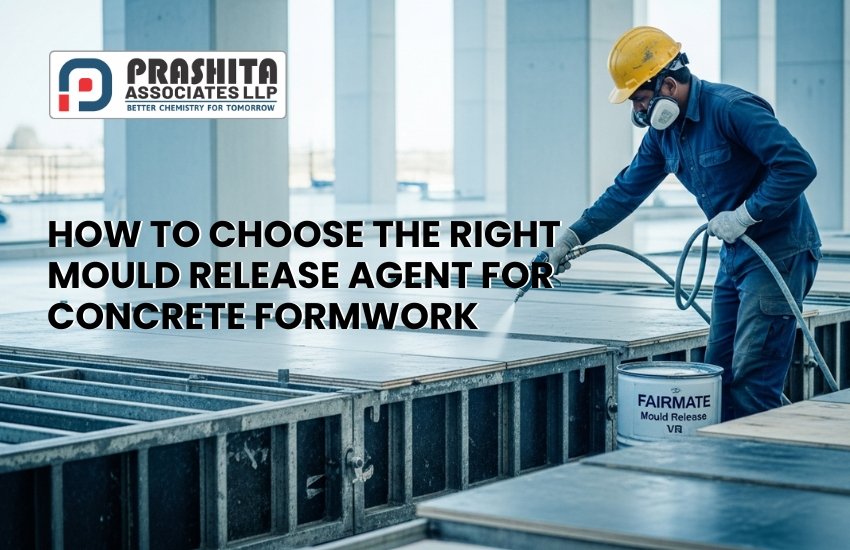
How to Choose the Right Mould Release Agent for Concrete Formwork

How to Choose the Right Mould Release Agent for Concrete Formwork?

Concrete Formwork - Fairmate Prashita

Concrete formwork is the silent hero behind every successful cast-in-place or precast structure. While the structural steel, reinforcement and concrete mix capture attention, the interaction between form-work and concrete often determines surface quality, turnaround time and long-term form reuse. One of the most critical, yet overlooked components of this process is the mould release agent. Choose the wrong one and you risk sticking, delayed stripping, damage to formwork, uneven finishes and wasted labour. Choose right — and you unlock efficient operations, excellent surfaces and reusable formwork.

What makes a good mould release agent?

When you evaluate release agents, the following attributes matter:

  • Form-work compatibility: It should work equally well on plywood, timber, steel, aluminum and plastic-faced moulds.
  • Non-staining, clean finish: The agent must not leave oil stains on the concrete or shuttering, and must facilitate reuse of formwork without lengthy cleaning.
  • Effective release and minimal residue: The concrete should strip cleanly, with minimal paste adhering to the formwork and no compromise on texture.
  • Re-reuse and economy: A good release film allows the same shuttering to be used across cycles without refurbishment.
  • Safety and environment: Non-toxic, low VOC, biodegradable or vegetable-oil based agents reduce environmental footprint and meet modern sustainability demands.

Challenges in conventional mould oils

Traditional mould oils often come with problems:

  • Sticky shutter faces, which delay the demoulding process and cause labour bottlenecks.
  • Accumulated residue that requires time-consuming cleaning or refurbishment of formwork.
  • Inconsistent concrete surface finishing — oil bloom, voids, stains or blemishes may appear.
  • Poor reuse of formwork leading to higher cost per cast cycle.

Introducing FAIRMATE Mould Release VR / Super

FAIRMATE’s Mould Release VR is a ready-to-use water emulsion release agent with a unique vegetable-oil base and broad form-work compatibility.

 Key features include:

  • Made from non-toxic vegetable oils, offering an eco-friendly alternative to conventional mould oils.
  • Works across plywood, timber, steel, aluminium and plastic-faced moulds.
  • Reacts with concrete alkali to form a protective water-repellent film on the form surface, aiding clean stripping and reduced residue.
  • Non-staining and gives uniform surface textures, enabling superior fair-faced concrete.
  • Speeds up formwork turnaround by reducing cleaning time and enabling immediate reuse.

Application & Best Practices

To maximize benefits, consider these steps:

  • Formwork preparation: Ensure shutter faces are clean, free from hardened paste or oil build-up, and that formwork materials (timber/steel/plastic) are intact.
  • Application method: Apply Mould Release VR by spray, brush or roller as per site conditions. A thin uniform coat is preferable — avoid puddling or over-application.
  • Coverage: Follow manufacturer’s recommended coverage rates (check technical datasheet for your mould type).
  • Timing: Apply just before concrete placement. After stripping, clean the shutter lightly and re-apply a fresh coat before the next cycle.
  • Compatibility check: While the product is multi-substrate compatible, perform a pre-trial on a small batch if unusual formwork material is used.

Case Study / Industry Example

Consider a project where steel and plastic-faced formwork were used for a residential high-rise. With conventional mineral oil, the contractor faced repeated cleaning stops and surface blemishes. Switching to Mould Release VR resulted in:

  • Faster stripping (by ~15%)
  • Less formwork retention downtime
  • Uniform wall finishes with minimal touch-up
  • Better reuse of formwork for multiple cycles

Sustainability & Safety Aspects

Modern construction demands sustainable products. The use of vegetable-oil bases in Mould Release VR minimizes environmental load and reduces health risks associated with solvent-based oils. Additionally, cleaner formwork leads to less waste and rework, promoting leaner construction processes.

Selecting the right mould release agent is not just about convenience — it’s about surface quality, formwork efficiency and cost-effectiveness. FAIRMATE Mould Release VR offers a future-ready, high-performance solution that supports your project goals.

Partnership-Driven Success: How Fairmate Prashita LLP Empowers Engineers and Builders

Partnership-Driven Success: How Fairmate Prashita LLP Empowers Engineers and Builders

In the world of construction, a dependable partner like Fairmate Prashita LLP can make the difference between delay and delivery, between a strong foundation and a structural issue.

At Fairmate Prashita LLP, we don’t just supply products — we work shoulder-to-shoulder with engineers, architects, contractors, and developers to solve complex construction challenges with reliable chemical systems and hands-on support.

Our work is rooted in one principle: success is shared.

Why Partnership Matters in Construction

Modern construction demands more than materials. It requires:

  • Adaptable systems for diverse job sites
  • Guidance on mix designs, dosage, and sequencing
  • Fast delivery and product availability
  • Assistance with troubleshooting on-site
  • Product knowledge that translates into practical performance

That’s where Fairmate Prashita steps in — not just as a supplier, but as a solutions partner.

What We Offer Our Partners

🧱 Field-Tested Products

We distribute construction chemical solutions developed using industry-trusted formulations, including many based on Fairmate’s global-quality technologies, giving your projects a dependable chemical foundation.

🧪 Technical Advisory Support

From selecting the right waterproofing system to optimizing a concrete mix with superplasticizers, our team provides site-specific technical consultation — saving both time and cost.

🚧 On-Site Support

We assist your applicators and engineers on-site, helping with:

  • Surface preparation
  • Mixing and curing guidance
  • Grouting techniques
  • Floor coating or membrane application

📦 Timely Material Delivery

We know construction timelines are tight. That’s why we maintain consistent inventory flow and support projects with scheduled delivery, even for bulk or remote site demands.

How Engineers Benefit

  • 🎯 Clarity in Chemical Selection
    We simplify complex product categories, helping civil engineers select the most effective product for their design intent and environmental conditions.
  • 📈 Better Quality Output
    Our admixtures, grouts, and coatings improve strength, finish, and durability — helping you meet performance specs more confidently.
  • 🧰 Lower Site Risk
    With application support, engineers avoid errors that lead to curing failure, poor bonding, or misapplication.

How Builders and Contractors Benefit

  • Reduced Rework & Material Waste
    Our non-shrink grouts, flowable concretes, and high-bond adhesives reduce failures and rebonding needs.
  • Higher Productivity
    Fast-setting materials, easy-to-apply membranes, and better concrete control reduce downtime and speed up completion.
  • Improved Reputation
    Successful projects lead to client trust, referrals, and stronger branding for construction firms.

Our Collaboration Model

PhaseOur Contribution
Pre-constructionProduct mapping, design consultation
Material selectionProduct compatibility and dosage planning
Application phaseOn-site training and tech team support
Post-applicationPerformance feedback and site monitoring

Projects We’ve Empowered

From metro stations to industrial warehouses, residential towers to tunnel waterproofing — Prashita has provided product systems and support in:

  • Public sector infrastructure
  • EPC-led turnkey projects
  • Private high-rise developments
  • Factory and utility construction

We’ve earned the trust of teams who demand more than delivery — they expect answers, assurance, and accountability.

Conclusion

Fairmate prashita LLP exists to be more than a chemical distributor. We are partners in your project’s success — helping engineers build confidently, and contractors deliver consistently.

By combining field-ready products, expert knowledge, and reliable execution, we help you solve today’s construction challenges with tomorrow’s performance in mind.

What Sets Fairmate Prashita LLP Apart in the Construction Chemical Industry

Introduction

The construction chemical industry is crowded — but not all suppliers are created equal.

At Fairmate prashita LLP, we’ve built more than a product portfolio. We’ve built a reputation for being dependable, knowledgeable, and solutions-driven. Our brand is defined by a unique blend of technical integrity, responsive service, and long-term thinking — making us a preferred partner for civil engineers, contractors, and project owners.

So, What Truly Sets Us Apart?

🔹 1. A Solutions-First Mindset

We don’t just sell bags and drums. We ask:

  • What is the exact need at your site?
  • What mix design or membrane system suits your condition?
  • How can we minimize material usage and increase output?

This mindset enables fewer failures, lower costs, and better construction outcomes.

🔹 2. Backed by Proven Formulations

Many of our offerings — including admixtures, grouts, waterproofing systems, and surface coatings — are based on tried-and-tested chemical technologies developed by Fairmate, adapted and distributed under the Prashita name.

This blend of legacy formulations with localized support allows us to provide:

  • Proven chemical performance
  • Field-tested product consistency
  • Compatibility with Indian materials and conditions

🔹 3. Personalized Technical Support

We work directly with:

  • Engineers and consultants to align with project specs
  • Site managers to optimize mix, curing, and application
  • Applicators to ensure correct installation and coverage
  • Procurement teams to plan just-in-time delivery

From site trials to batch customization, our support is as real-time as your work.

🔹 4. A Team That Knows the Field

Our leadership and service team include:

  • Former engineers and site consultants
  • Product specialists trained in chemical systems
  • Field coordinators with hands-on knowledge of concrete, waterproofing, and grout behavior

This ensures your concerns are met with real solutions — not just sales scripts.

🔹 5. Accountability, Not Just Access

We take responsibility for product performance.

We’re transparent with:

  • Expected coverage
  • Curing time
  • Application method
  • Limitations and precautions

And we follow up — even after project completion — because we value relationships more than transactions.

Trusted by Builders Nationwide

Prashita is already the trusted chemical partner for:

  • Infrastructure contractors (metro, highway, tunnel)
  • Developers and high-rise construction firms
  • Government-approved vendors
  • Waterproofing and flooring contractors
  • RMC suppliers and civil consultants

Our growing reputation stems from doing the basics well — and doing them consistently.

A Brand That Stands for More

We’re proud to represent:

  • Reliability: In supply, performance, and advice
  • Clarity: In every spec, document, and price
  • Simplicity: Making chemistry usable, not confusing
  • Support: Available when needed, not just when asked

Conclusion

Fairmate Prashita LLP is more than a brand — it’s a belief system:

That chemistry, when delivered with care, can shape stronger structures, smoother execution, and smarter cities.If you’re looking for a construction chemical partner that combines proven technology with hands-on service, Prashita is ready to stand with you — at the foundation of your next project.

From Product Expertise to Technical Support – The Full-Service Advantage of Working with Fairmate Prashita

In a competitive construction environment, product quality is essential — but service quality is what builds long-term partnerships.

At Fairmate Prashita LLP, we believe supplying a construction chemical is just the beginning. What follows — technical guidance, mix recommendations, surface preparation advice, on-site troubleshooting, and post-application monitoring — is what defines our full-service model.

We’re here not just to deliver products, but to deliver peace of mind.

The Prashita Full-Service Model

Our approach is simple:

Provide high-performance materials, backed by high-quality support — at every step of the project.

Here’s what that means in action:

1. Expert Product Selection

Choosing the right chemical solution requires a deep understanding of:

  • Site conditions
  • Performance requirements
  • Compatibility with existing materials
  • Application sequence and skill level

Our team helps you select the best-fit waterproofing, grout, admixture, sealant, or coating, based on your design and execution needs.

Many of our systems are based on proven chemical technologies originally developed by Fairmate, giving clients the confidence of legacy quality with local expertise.

2. Mix Design & Dosage Optimization

Concrete admixtures and waterproofing additives aren’t one-size-fits-all. That’s why we offer:

  • Custom dosage guidance based on cement type
  • Compatibility checks with aggregates and water sources
  • Target strength and slump control solutions

Our goal? Optimize your concrete mix for strength, setting time, and durability — while reducing material wastage.

3. On-Site Application Support

We provide hands-on assistance through:

  • Applicator training for membranes and coatings
  • Demonstrations for grouting and anchoring
  • Support for curing, finishing, and sealing practices
  • Surface prep recommendations to avoid failures

This ensures that every product performs as it’s supposed to — even under real-world site conditions.

4. Documentation & Compliance Support

Prashita helps clients meet regulatory, quality, and technical compliance with:

  • Detailed product datasheets
  • MSDS for all chemical systems
  • Application method statements
  • Test certifications (where applicable)

All documentation is formatted for client handover, PMC approval, or internal audits.

5. After-Sales Follow-Up

Even after the product is applied, we remain available to:

  • Address site feedback
  • Guide reapplication if needed
  • Provide remedial suggestions in case of errors
  • Assist in performance validation

You’re never left without answers — that’s our full-service promise.

Where Our Advantage Shines

Service StagePrashita’s Contribution
Pre-site PlanningProduct mapping, BOQ assistance
Site SetupSupply planning, primer/coating advice
ExecutionOn-site supervision and training
Post-CompletionQuality check, documentation, support

Clients We Work With

Our support system benefits:

  • Civil engineers and site consultants
  • Real estate developers
  • Infrastructure EPC contractors
  • Applicators and sub-contractors
  • Ready-mix concrete suppliers

Whether it’s a basement waterproofing job or a 1000-ton transformer grout — we deliver more than just materials. We deliver trust.

Conclusion

Fairmate Prashita LLP is redefining what it means to be a construction chemical supplier. With in-depth product expertise and on-ground technical support, we help you get the job done — faster, safer, and smarter.

From the first bag to the final coat, we’re with you.

ANCHORGROUT & FLOWGROUT EP – Specialized Grouting for Dynamic Load Applications

Not all grouting jobs are the same. Some involve static columns, others involve dynamic machines, vibrating rails, or rotating equipment. In such cases, specialized grouts are essential to prevent failure, vibration loosening, and early wear.

At Fairmate Prashita LLP, we offer two specialized products — ANCHORGROUT and FLOWGROUT EP — developed for anchoring and load transfer in high-stress environments. These products are based on advanced chemical systems originally created by Fairmate, tailored by Prashita for Indian site requirements and applications.

Why Specialized Grouting is Critical

Dynamic load applications introduce challenges like:

  • Micro-movements and structural shifts
  • Thermal expansion
  • Continuous vibration
  • Load cycling and fatigue stress

Ordinary cementitious grouts may shrink, crack, or loosen over time — leading to failures and costly downtime.

Specialized grouts like ANCHORGROUT and FLOWGROUT EP resist these stresses with superior adhesion, strength, and flexibility.

Product 1: ANCHORGROUT – Precision Anchoring Grout

ANCHORGROUT is a polyester-resin-based compound designed for anchoring bolts, rebar, and inserts into concrete or masonry.

Ideal For:

  • Machinery bolt anchoring
  • Fixing crash barriers and railings
  • Rebar anchoring into walls and footings
  • Fast installations with minimal downtime

Features:

  • Thixotropic (non-sag) nature for vertical and overhead fixing
  • Quick-setting, high pull-out strength
  • Excellent bond with concrete, stone, and steel
  • Chemical and water resistance

Built on Fairmate’s anchoring resin chemistry, ANCHORGROUT is field-proven for long-term reliability in industrial and highway projects.

Product 2: FLOWGROUT EP – Epoxy Grout for Vibration Zones

FLOWGROUT EP is a three-part, epoxy-based high-performance grout designed for high-vibration, high-load environments.

Ideal For:

  • Rotating machinery foundations
  • Compressor and pump bases
  • Metro and railway track grouting
  • Base plate and crane rail grouting

Features:

  • Ultra-high compressive and tensile strength
  • Chemical and oil resistance
  • Minimal shrinkage and thermal expansion
  • Excellent flowability for large pours

Developed using Fairmate’s advanced epoxy grout technology, FLOWGROUT EP is widely used where precision and endurance are mission-critical.

Key Benefits of Using These Products

FeatureBenefit
High bond strengthSecure anchoring without movement or loosening
Early settingReduced downtime and faster commissioning
High chemical resistanceWorks in harsh industrial environments
Load transfer capabilityUniform stress distribution under dynamic conditions
Long life cycleLess maintenance, reduced operational risk

Typical Applications

  • Heavy equipment bases in factories
  • Rail base and dowel grouting for metro tracks
  • Highway crash barrier and fencing installations
  • Structural retrofitting and anchoring
  • Bridge bearing and bolt grouting

Backed by Trusted Technology

While branded and supplied by Prashita Associates LLP, ANCHORGROUT and FLOWGROUT EP are based on established Fairmate chemical technologies, trusted by engineers, EPCs, and infrastructure developers across India and globally.

We provide:

  • Site-specific product recommendations
  • On-site application guidance
  • Technical datasheets and safety documents
  • Contractor training for epoxy mixing and anchoring

Conclusion

In demanding construction environments, anchoring and vibration resistance require precision-engineered solutions. With ANCHORGROUT and FLOWGROUT EP, Prashita offers high-performance, field-tested products that deliver confidence under load.

Trust our experience and the science behind every formulation to keep your structures locked in place — no matter the stress.


FAIRTOP & Industrial Flooring Solutions for High Traffic Areas

Floors in industrial and commercial spaces endure constant wear — from forklifts, trolley wheels, heavy machinery, and chemical spills. If the floor fails, operations suffer.

That’s why selecting the right industrial flooring system is critical to long-term functionality and safety. At Fairmate Prashita LLP, we provide high-performance flooring solutions through our FAIRTOP product range, tailored to meet the demands of heavy traffic and tough environments.

FAIRTOP is engineered using trusted material science, with formulation roots in Fairmate’s industrial coatings and screeds — refined over decades for strength and endurance.

Why FAIRTOP for Industrial Flooring?

The FAIRTOP flooring systems are:

  • Abrasion-resistant
  • Non-metallic and iron-free
  • Non-slip and anti-skid
  • High compressive strength (up to 800 kg/cm²)
  • Available in eco-safe, solvent-free variants

These floors are ideal for both new builds and refurbishment of manufacturing plants, logistics facilities, loading bays, and garages.

Product Highlights

FAIRTOP STD

A single-pack, non-metallic, smooth-finish, abrasion-resistant flooring compound. Designed for light to medium traffic areas like workshops, stores, and warehouses.

FAIRTOP

A carborundum-based monolithic surface hardener, ideal for medium to heavy-duty areas. It resists oil, water, and impact and is applied as a dry-shake on fresh concrete.

FAIRTOP FAST FLOOR

A self-smoothing, rapid-hardening cementitious screed, allowing foot traffic in just a few hours. Best suited for time-sensitive flooring refurnishments.

FAIRTOP METALLIC

A screedable, iron aggregate topping for ultra-heavy-duty use — often applied in industrial zones with constant impact and abrasion.

Where These Floors Work Best

Application AreaRecommended FAIRTOP Product
Manufacturing floorsFAIRTOP or FAIRTOP METALLIC
Warehouses & depotsFAIRTOP STD / FAST FLOOR
Loading docksFAIRTOP METALLIC
Service garagesFAIRTOP STD
Cold storage areasFAIRTOP FAST FLOOR (fast curing)

Features That Set FAIRTOP Apart

  • Dustproof Finish: Reduces airborne particles in clean or packaging areas
  • Anti-Skid Texture: Enhances workplace safety in wet or oily zones
  • High Hardness: Mho’s scale hardness up to 9 (FAIRTOP)
  • Color Options: Available in grey, red, green, and more for zoning or aesthetics
  • Low Maintenance: Longer service cycles between repairs

These flooring solutions are adapted for Indian site conditions and can be customized as per load requirements and finishing needs.

Built on Proven Chemistry

All FAIRTOP flooring systems offered by Prashita are based on proven formulation standards originally developed by Fairmate, ensuring consistency and compliance with ASTM, IS, and BS norms.

We adapt these technologies for your specific projects, supported by our in-house technical team — from specification to post-application support.

Services We Offer Alongside Products

  • On-site substrate assessment
  • Coverage estimation and mix guidance
  • Color and texture recommendations
  • Application supervision for contractors
  • Technical datasheets and warranty options

We work with applicators, architects, and EPC contractors to optimize industrial floor performance and lifespan.

Conclusion

Industrial floors do more than hold weight — they hold your operations together. With FAIRTOP flooring systems from Prashita Associates LLP, you get dependable surface strength, long-term value, and minimal downtime.Engineered using materials with a legacy of reliability from Fairmate’s industrial solutions, our products are tailored to meet your project’s unique wear and durability needs.