
FAIRFIX MORTAR – CERAMIC AND VITRIFIED TILE MORTAR
Why do we need to use tile adhesive to lay tiles, what are the benefits?
SAND-CEMENT conventional way of tile fixing
• Sand cement composes of Ordinary Portland Cement (OPC) and sand. OPC is used for rendering and masonry while sand is normally river sand, which is hard to control grain size, cleanliness, and quality.
• Inconvenience to work with OPC comes in form of small bags and sand must be bought in huge quantity, which extensively occupy storage areas. OPC and sand must be relocated to another area for mixing and the process is dirty and dusty. Tiles need to be soaked in water for at least one day before being laid with sand-cement, and this is time consuming.
Tiles soaking in water
Time consuming and inefficiency
• To lay tiles with sand-cement traditional way is to apply the mixture of sand-cement in lump on tiles’ back so it has to be done with one tile at a time.
Aesthetic and de-bonding problem
• Without additive to help retaining water, mixture of sand-cement dries fast and then causes the difficulty to adjust the tiles after being laid. This leads to aesthetic problem of the line of tiles and also poor bonding strength, which will be the reason of de-bonded tiles later. Laying tiles traditional way by applying sand-cement mixture in lump at tiles’ back will create voids underneath the tiles and water can seep through. This creates white stain problem. Moreover, tile will be fragile at the area without any adhesive underneath.
Limitation of application
• Poor bonding strength of sand-cement mixture causes by dirt(mitti) in the sand and uncertain proportion of the mixture. Besides, there are limitations to use the mixture for laying following tiles in the following conditions.
• Low absorbent tiles
• Granito with 60 x 60 cm or greater size
• Glass mosaics – On polished substrates
• On existing tiles
• On substrates where subject to movement
• On the areas with high pressure and impact
Material wastage
Thick layer of sand-cement mixture must be used to lay tile traditionally in lump and/or to adjust the floor level, in order to gain its bonding mechanism. There will then be more loads onto structure. Moreover, there will be material wastage since the mixture dries faster than the application.
TILE ADHESIVE – FAIRFIX MORTAR – TECHNICAL WAY OF TILE FIXING
Tile adhesive is ready-mixed and specially formulated from special cement grade, selected fine sand, and additives to improve its essential properties for laying tiles. High performance tile adhesive can be used to lay tiles on existing tiles, on polished cement, on wooden substrates (with the use of primer), or on other special substrates.
Easy to use
It’s very easy to use tile adhesive, it will be already ready to use after just mixing with water. Bagging product makes it convenient for transportation process, providing low dust and clean working space. Tiles are not needed to be soaked, just un-box them and lay.
Fast
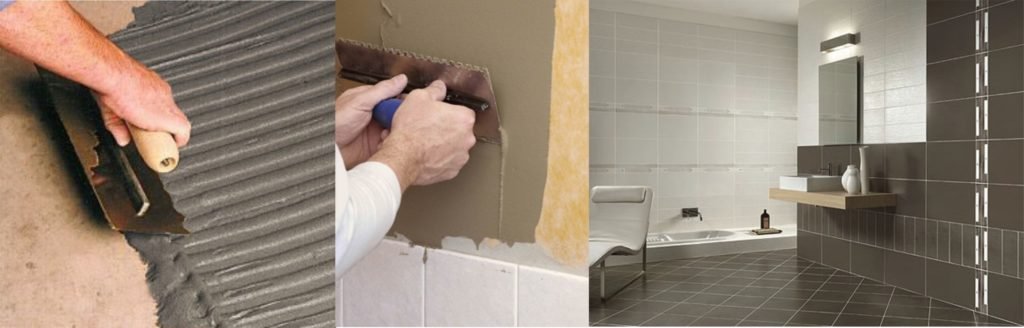
Notched trowel is normally and efficiently used to apply the mixture of tile adhesive on the area of about 1 m2. Tiles are then continuously laid onto notched adhesive and quickly adjusted into the lines.
Working quality
Optimum setting time of tile adhesive allows tiles to be easily adjusted within a certain period of time. It makes tiles being laid in line and gives the aesthetic final look. Applying tile adhesive with notched trowel provides full spread on back of tiles and will reduce many problems like broken tiles esp. on the corner, water seeping, and stain or efflorescent. Full contact of the adhesive on tiles’ back and substrate provides strong bonding strength and long lasting tiling work.
Variety of work
Tile adhesives are formulated according to specific applications such as to lay tiles, glass mosaics, large-size granito (up from 60 x 60 cm), to lay tiles on polished substrates, on dry wall system, on existing tiles without removing them, on external areas, parking areas, industrial areas, in swimming pools, and many more.
Economical reasons
Laying tiles by using tile adhesive with notched trowel requires less amount of material. Adhesive layer is a lot thinner than the mixture of sand-cement, and this leads to lighter load to building structure. A bag of 20 kg tile adhesive can be used to lay tiles on the average area of 4 – 5 m2. A bag of 25 kg tile adhesive can be used to lay tiles on the average of 6 – 7 m2. Area coverage depends on substrate smoothness, working tools, and skill of tilers.
ADVANTAGES AND DISADVANTAGES OF TILE ADHESIVE- FAIRFIX MORTAR VS SAND-CEMENT CONVENTIONAL FIXING
Tile Adhesive- FAIRFIX MORTAR
Advantages
• Fast and efficient
• Easy to use, only mix with water
• Better bonding strength
• Can be grouted within 24 hours without waiting for the moisture to evaporate
• Applicable on existing tiles, many special substrates like polished cement, dry wall system, etc.
• Thinner layer
Disadvantages
• Higher price per bag
• Substrate needed to be proper leveled
Sand-cement Conventional way
Advantages
• Cheaper
• Laying tiles and leveling at the same time
Disadvantages
• Time consuming
• Tiles must be soaked
• Moisture can be accumulated beneath tiles
• Tiles are easily de-bonded
• Not applicable to lay low absorbent tiles like 60 x 60 cm granite or any larger sizes
• Not applicable to lay tiles on existing tiles, and on polished cement
• Not applicable to lay glass mosaics
FAIRFIX MORTAR confirms to IS 15477: 2004. It is approved by Bureau of Indian Standard vide ISI registration no. CM/L 3717363.
FAIRFIX MORTAR is composed of ordinary Portland cement properly selected & graded aggregates, polymer, rheology modifier & additives. It is used for fixing of ceramic tiles, glaze tiles, natural stones, etc. internally & externally over walls & floors with an added application of tile on tile because it gives excellent bond on cementitious surfaces like, concrete, plaster, etc. It forms a waterproof barrier between two surfaces and has excellent ‘grab’ properties of tiles to the substrate. It is specially designed for heavy-duty tile applications like granite, mosaic on internal/external vertical surfaces. Highly flexible adhesive also has an excellent waterproofing ability.
Areas of Application
• Permanent fixing of ceramic tiles.
• Fixing of insulating and acoustic boards.
• Swimming pool tile fixing.
• Large format tiles on internal/external applications.
TYPICAL PROPERTIES
Physical Appearance : Grey Powder
Mix ratio product: water parts : 3: 1 by volume
Open time@30 0C : 25 min
Adjustability time : 20 min
Trafficable time : 24 hrs