
Protective Coating and Sealant Selection Guide for Concrete and Steel Surfaces
Introduction
Concrete and steel surfaces are exposed to multiple site challenges such as moisture, carbonation, weathering, chemical contact, abrasion, temperature variation, joint movement and regular construction stress. If these surfaces are not protected with the right coating or sealant system, the structure may face surface deterioration, leakage paths, corrosion risk, joint failure and repeated maintenance issues.
Protective coatings and sealants play an important role in long-term structure protection. Coatings help protect exposed surfaces, while sealants help manage movement and sealing in joints, gaps and construction interfaces.
Fairmate Prashita LLP offers a wide range of protective coating and sealant solutions for buildings, industrial structures, infrastructure projects, factories, commercial spaces, concrete surfaces, steel substrates and construction joints.
Why Protective Coatings Are Important
Protective coatings are used to create a functional layer over concrete or steel surfaces. This layer helps reduce direct exposure of the substrate to moisture, chemicals, weather, carbonation, abrasion and other damaging site conditions.
In construction and industrial maintenance, coatings are not selected only for appearance. They are selected based on performance requirement, exposure condition and substrate type.
Protective coatings are commonly required for:
Concrete walls and slabs
Steel structures
Industrial floors and service areas
External building surfaces
Tanks and plant areas
Chemical exposure zones
Parking areas
Infrastructure projects
Food, pharma and hygiene-sensitive areas
Maintenance and repair zones
When the right coating system is selected, it supports better surface life, cleaner maintenance and improved durability.
Faircoat Range for Protective and Decorative Coating
Fairmate Prashita’s Faircoat range supports protective, decorative and anti-carbonation coating requirements for exterior and interior surfaces.
Faircoat systems are useful where concrete or plastered surfaces need a clean finish along with surface protection. These products are suitable for buildings, public structures, concrete surfaces, exterior walls and interior areas where protection and appearance both matter.
Key Benefits of Faircoat-Type Coatings
Protective and decorative surface finish
Anti-carbonation support
Weather resistance
Suitable for exterior and interior surfaces
Helps improve surface appearance
Useful for building and infrastructure applications
Faircoat is suitable where the surface needs protection from exposure but also requires a clean, finished look.
Safecore Range for Industrial and High-Performance Protection
The Safecore range includes different protective coating systems for concrete, steel, industrial and chemical exposure applications. These products are useful where the surface requires higher protection than a regular decorative coating.
Safecore PU
Safecore PU is a high-build protective and decorative polyurethane coating for concrete and steel substrates. It is suitable where concrete or steel surfaces require durable protection, improved finish and resistance to site exposure.
It can be considered for industrial buildings, plant areas, steel substrates and concrete surfaces where performance coating is required.
Safecore SF
Safecore SF is a thixotropic protective coating for concrete and steel surfaces. It is suitable for areas where hygiene, chemical resistance and surface protection are important.
It can be considered for clean industrial environments, processing zones, service areas and surfaces exposed to demanding site conditions.
Safecore AR
Safecore AR is positioned as a protective coating with outstanding chemical and acid resistance. It is useful for industrial areas where surfaces may come in contact with chemicals, acids or aggressive exposure conditions.
Safecore MIO
Safecore MIO is a high-build two-component MIO-based epoxy coating for steel structures. It is useful for steel protection where long-term corrosion resistance and barrier protection are important.
Safecore CE
Safecore CE is a high-build tar-extended epoxy coating. It is suitable where high-build protective coating is required for steel and concrete in specific exposure conditions.
Why Sealants Are Equally Important
A construction joint is not only a gap. It is a movement area.
Concrete joints, expansion joints, façade joints, pavement joints and building joints experience movement due to temperature changes, load, vibration, settlement, shrinkage and environmental exposure. If the joint is filled with the wrong material, it may crack, debond, allow water entry or fail during movement.
Sealants help close joints while allowing controlled movement. This makes them important in waterproofing, façade performance, industrial flooring, road joints, building joints and infrastructure work.
Fairseal Range for Joint Sealing Applications
Fairmate Prashita’s Fairseal range includes sealant systems for different construction and expansion joint requirements.
Fairseal
Fairseal is a gun-grade two-part polysulphide sealant. It is used for sealing expansion and construction joints between structures. It is suitable for building construction, civil projects, walls, basements, floors and brickwork joints.
Fairseal P
Fairseal P is a pourable-grade two-part polysulphide sealant. It is suitable for horizontal structural expansion joints such as concrete roads, runways, basements, parking decks and similar horizontal joint areas.
Fairseal C
Fairseal C is a two-part polysulphide-based crack filling compound. It is used for sealing and filling cracks in construction joints, basements, buildings, walls and brickwork joints.
Fairseal PU
Fairseal PU is a cold-applied high-performance pavement joint sealant. It is designed for movement accommodation and is suitable for joints in concrete roads, floors, runways and pavement areas.
Fairseal PU(S)
Fairseal PU(S) is a high-performance one-component gun-grade polyurethane joint sealant. It is useful for common building joints, roof areas, ducts, pipes, prefabricated panels, masonry, metal and industrial joint applications.
Fairseal Acrylic
Fairseal Acrylic is an acrylic-based single-pack sealant. It is suitable for indoor and window frame surroundings, joint filling, sealing gaps and general internal applications.
How to Select the Right Protective Coating
Before selecting a coating, check the following factors:
1. Surface Type
Is the surface concrete, steel, plaster, floor, wall, tank or structural member?
Concrete and steel require different protection systems.
2. Exposure Condition
Is the surface exposed to sun, rain, water, chemicals, oils, humidity or traffic?
Exterior and industrial areas need higher protection than internal decorative areas.
3. Chemical Contact
If the surface is exposed to acids, alkalis, solvents, oils or process chemicals, a chemical-resistant coating system should be considered.
4. Traffic and Abrasion
Floors, parking areas and service zones need coatings that can support traffic and abrasion resistance.
5. Hygiene Requirement
Food, pharma, clean rooms and laboratories need smooth, cleanable and hygienic protective coating systems.
6. Finish Requirement
Some areas require a decorative appearance, while others require functional industrial protection.
How to Select the Right Sealant
Sealant selection depends on movement, joint size and exposure.
1. Joint Type
Expansion joint, construction joint, façade joint, pavement joint and crack filling applications may need different sealant types.
2. Movement Requirement
Joints expand and contract. The sealant must support this movement without cracking or debonding.
3. Application Method
Gun-grade sealants are suitable for vertical and controlled application areas. Pourable-grade sealants are suitable for horizontal joints.
4. Surface Compatibility
The sealant must bond properly with concrete, masonry, metal or other surfaces.
5. Exposure Condition
Wet areas, roads, roofs, basements, industrial floors and exterior joints need different sealant performance.
Common Mistakes to Avoid
Using decorative paint instead of protective coating
Using one sealant for every joint type
Ignoring joint movement
Applying coating without proper surface preparation
Not checking chemical exposure before coating selection
Using rigid fillers in moving joints
Skipping primer or surface cleaning where required
Selecting coating only based on colour
Ignoring TDS and application guidelines
Conclusion
Protective coatings and sealants are essential for long-term surface protection and joint performance. Coatings help protect concrete and steel surfaces from exposure, while sealants help manage joint movement and prevent water or dust entry through gaps.
Fairmate Prashita LLP offers coating and sealant solutions for concrete, steel, industrial surfaces, building joints, expansion joints, pavement joints and construction applications.
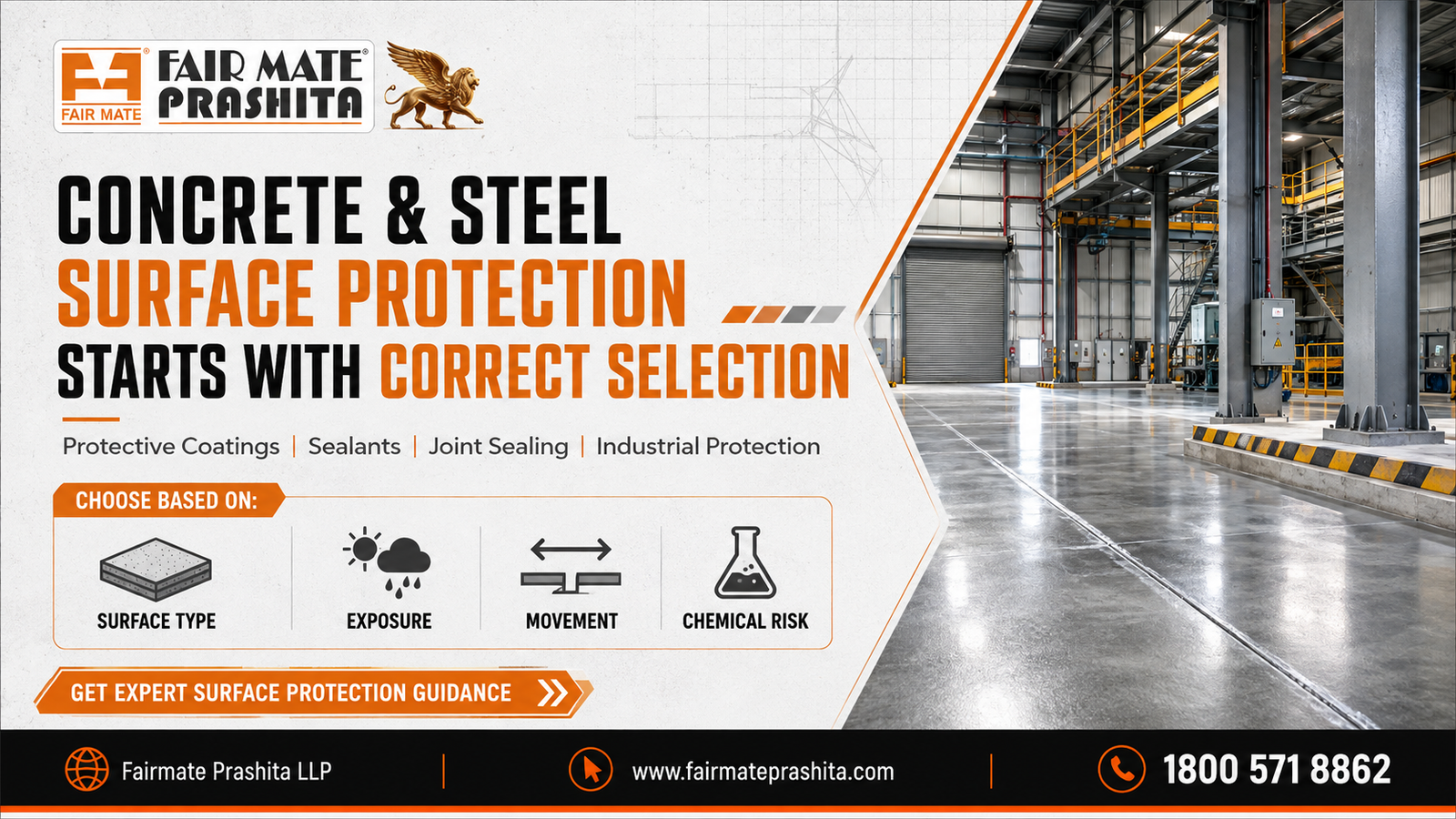
For the right product selection, always evaluate surface type, exposure condition, chemical risk, joint movement, traffic and maintenance requirement.
Call to Action
Need help selecting the right protective coating or sealant for your project?
Contact Fairmate Prashita LLP for product guidance, TDS support and technical recommendation.
Toll Free: 1800 571 8862
Website: www.fairmateprashita.com
Suggested FAQs
Which coating is used to protect concrete and steel surfaces?
Protective coating selection depends on exposure condition, surface type and required performance. Fairmate Prashita offers Faircoat and Safecore range products for concrete and steel surface protection.
Which sealant is used for expansion joints?
Sealant selection depends on whether the joint is vertical, horizontal, moving, exposed to traffic or exposed to water. Fairseal, Fairseal P and Fairseal PU(S) are used for different joint sealing applications.
Why is surface preparation important before coating?
Surface preparation helps improve coating bonding, performance and durability. Dust, oil, weak concrete, moisture and loose particles can affect coating performance.
Can the same sealant be used for all joints?
No. Different joints have different movement, exposure and application requirements. Sealant should be selected based on joint type, surface and movement condition.