
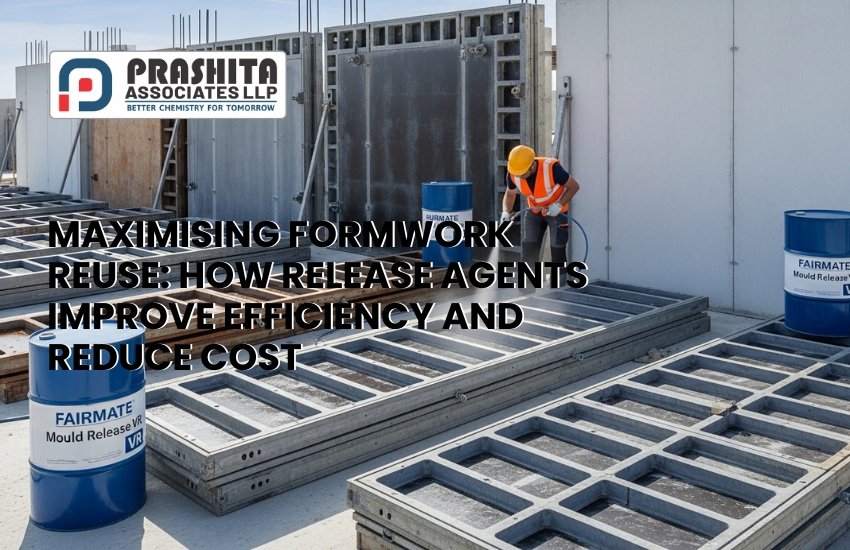
Maximising Formwork Reuse: How Release Agents Improve Efficiency and Reduce Cost

Formwork represents a significant portion of the cost and time in any concrete job. Every cycle of casting, stripping, cleaning and reuse is an opportunity to reduce cost and improve efficiency. One overlooked but impactful lever is the release agent used on the formwork. The right product can transform operations, reduce downtime and deliver better concrete finishes.

Why Formwork Reuse is Critical

  • Cost implications: Formwork materials (timber, steel, plastic) represent capital investment. Maximizing the number of uses per shutter cycle reduces cost per cast.
  • Labour/time savings: Faster stripping and minimal clean-up reduce labour hours, free up resources and accelerate schedules.
  • Maintenance and refurbishment: Poor release agents cause build-up of cement paste, which means frequent cleaning, sand-blasting or recoating of formwork surfaces — adding cost.
  • Quality of finish: Smooth, uniform formwork surfaces lead to high-quality cast-concrete with fewer defects.

What a Premium Release Agent Delivers

A high-performance release agent should provide:

  • Clean demoulding with minimal residue
  • Lower cleaning and refurbishment requirements
  • Consistent texture and finish on the cast concrete
  • Protection of the formwork surface itself, increasing its reuse life
  • Compatibility across formwork materials for simplified logistics

FAIRMATE Mould Release VR / Super – Features & Advantages

With FAIRMATE’s Mould Release VR, you get:

  • Eco-friendly formulation: Vegetable-oil based, ready to use, non-toxic.
  • Multi-substrate support: Works across plywood, timber, steel, aluminium and plastic-faced moulds.
  • Surface finish enhancement: Non-staining, provides uniform texture and aesthetics.
  • Operational efficiency: Easier cleanup and faster turnaround of formwork.

Operational Benefits: Turnaround, Labour, Quality

  • Faster stripping: Because the agent forms a bond-break film, formwork can be stripped quickly without waiting for additional release action.
  • Lower labour costs: Less time spent cleaning cement paste and shutter faces reduces labour hours and improves site productivity.
  • Improved surface quality: Uniform release leads to better fair-faced concrete, fewer defects, less rework and higher client satisfaction.
  • Formwork longevity: By protecting shutter surfaces, the agent enables more reuse cycles and lowers cost over time.

Implementation Tips for Contractors

  • Ensure shutter cleanliness: Before application, remove old oils, cement residue and rust.
  • Apply thin, even coats: Over-application doesn’t improve release but can cause surface issues.
  • Monitor coverage: Track litres per m² and maintain consistency across casts.
  • Train labour: Make sure applicators understand the material and cure/strip timing.
  • Track reuse cycles: Monitor formwork reuse count and inspect shutter faces regularly.

ROI & Long-Term Gains

Consider a mid-rise project using steel formwork:

  • With a conventional oil, formwork needed cleaning every 5 cycles, renewal at cycle 50.
  • With Mould Release VR, cleaning interval extended to 10 cycles, renewal delayed to cycle 70+.
  • Labour saved, shutter refurbishment postponed, and surface quality improved — the cumulative cost benefit over hundreds of casts can be significant.
    In addition, sustainability gains from fewer chemicals, less waste and less downtime create indirect value.

In today’s competitive construction environment, minute improvements in turnaround and formwork reuse translate into real savings and quality gains. A high-performance release agent like FAIRMATE Mould Release VR is a strategic tool not just a chemical.

How to Choose the Right Mould Release Agent for Concrete Formwork

Concrete formwork is the silent hero behind every successful cast-in-place or precast structure. While the structural steel, reinforcement and concrete mix capture attention, the interaction between form-work and concrete often determines surface quality, turnaround time and long-term form reuse. One of the most critical, yet overlooked components of this process is the mould release agent. Choose the wrong one and you risk sticking, delayed stripping, damage to formwork, uneven finishes and wasted labour. Choose right — and you unlock efficient operations, excellent surfaces and reusable formwork.

What makes a good mould release agent?

When you evaluate release agents, the following attributes matter:

  • Form-work compatibility: It should work equally well on plywood, timber, steel, aluminum and plastic-faced moulds.
  • Non-staining, clean finish: The agent must not leave oil stains on the concrete or shuttering, and must facilitate reuse of formwork without lengthy cleaning.
  • Effective release and minimal residue: The concrete should strip cleanly, with minimal paste adhering to the formwork and no compromise on texture.
  • Re-reuse and economy: A good release film allows the same shuttering to be used across cycles without refurbishment.
  • Safety and environment: Non-toxic, low VOC, biodegradable or vegetable-oil based agents reduce environmental footprint and meet modern sustainability demands.

Challenges in conventional mould oils

Traditional mould oils often come with problems:

  • Sticky shutter faces, which delay the demoulding process and cause labour bottlenecks.
  • Accumulated residue that requires time-consuming cleaning or refurbishment of formwork.
  • Inconsistent concrete surface finishing — oil bloom, voids, stains or blemishes may appear.
  • Poor reuse of formwork leading to higher cost per cast cycle.

Introducing FAIRMATE Mould Release VR / Super

FAIRMATE’s Mould Release VR is a ready-to-use water emulsion release agent with a unique vegetable-oil base and broad form-work compatibility.

 Key features include:

  • Made from non-toxic vegetable oils, offering an eco-friendly alternative to conventional mould oils.
  • Works across plywood, timber, steel, aluminium and plastic-faced moulds.
  • Reacts with concrete alkali to form a protective water-repellent film on the form surface, aiding clean stripping and reduced residue.
  • Non-staining and gives uniform surface textures, enabling superior fair-faced concrete.
  • Speeds up formwork turnaround by reducing cleaning time and enabling immediate reuse.

Application & Best Practices

To maximize benefits, consider these steps:

  • Formwork preparation: Ensure shutter faces are clean, free from hardened paste or oil build-up, and that formwork materials (timber/steel/plastic) are intact.
  • Application method: Apply Mould Release VR by spray, brush or roller as per site conditions. A thin uniform coat is preferable — avoid puddling or over-application.
  • Coverage: Follow manufacturer’s recommended coverage rates (check technical datasheet for your mould type).
  • Timing: Apply just before concrete placement. After stripping, clean the shutter lightly and re-apply a fresh coat before the next cycle.
  • Compatibility check: While the product is multi-substrate compatible, perform a pre-trial on a small batch if unusual formwork material is used.

Case Study / Industry Example

Consider a project where steel and plastic-faced formwork were used for a residential high-rise. With conventional mineral oil, the contractor faced repeated cleaning stops and surface blemishes. Switching to Mould Release VR resulted in:

  • Faster stripping (by ~15%)
  • Less formwork retention downtime
  • Uniform wall finishes with minimal touch-up
  • Better reuse of formwork for multiple cycles

Sustainability & Safety Aspects

Modern construction demands sustainable products. The use of vegetable-oil bases in Mould Release VR minimizes environmental load and reduces health risks associated with solvent-based oils. Additionally, cleaner formwork leads to less waste and rework, promoting leaner construction processes.

Selecting the right mould release agent is not just about convenience — it’s about surface quality, formwork efficiency and cost-effectiveness. FAIRMATE Mould Release VR offers a future-ready, high-performance solution that supports your project goals.